The
History Guy
Philippine-American
War
(1899-1902)
See
also Philippine-American
Wars and Conflicts
U.S.
Marines in Combat During the Philippine-American War
(1899-1902)
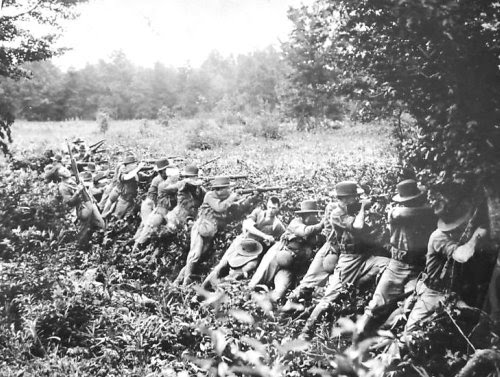
This was
America's first true colonial war as a world power. After defeating
Spain in Cuba and in the Philippines in 1898, the U.S. purchased the
Philippines, Puerto Rico and several other islands from the Spanish.
However, the Filipinos had been fighting a bloody revolution against
Spain since 1896, and had no intention of becoming a colony of
another imperialist power. In February of 1899, fighting broke out
between the occupying American Army and the Filipino forces.
"I am not
afraid, and am always ready to do my duty, but I would like some one
to tell me what we are fighting for."--Arthur
H. Vickers, Sergeant in the First Nebraska Regiment
"Talk about
war being 'hell,' this war beats the hottest estimate ever made of
that locality. Caloocan was supposed to contain seventeen thousand
inhabitants. The Twentieth Kansas swept through it, and now Caloocan
contains not one living native. Of the buildings, the battered walls
of the great church and dismal prison alone remain. The village of
Maypaja, where our first fight occurred on the night of the fourth,
had five thousand people on that day, -- now not one stone remains
upon top of another. You can only faintly imagine this terrible scene
of desolation. War is worse than
hell."--Captain
Elliott, of the Kansas Regiment, February 27th
*Quotes
are from
"Soldier's
Letters...",
part of an anti-imperialism website formerly operated and edited by
the late Jim Zwick.
Links
NAME OF CONFLICT:
The Philippine-American War
ALTERNATE
NAMES: The Philippine Insurrection (US), The Philippine War of
Independence (Phil)
BELLIGERENTS:
The United
States
vs.
The
Philippines
DATES OF
CONFLICT:
BEGAN:
February 4, 1899
ENDED:
July 4, 1902 (This is the "official" end of the war, as
proclaimed by U.S. President Theodore Roosevelt. Fighting
continued on several islands for years to come.)
TYPE(S) OF CONFLICT:
Inter-State
(From the Philippine perspective) and Colonial (From the American
perspective).
RELATED
CONFLICTS:
PREDECESSOR:
The Philippine Revolution of 1896 (1896-1898),
The
Spanish-American War
(1898)
CONCURRENT:
The Boxer Rebellion (1900)
SUCCESSOR:
The Moro Wars (1902-1913?)
CAUSES OF
CONFLICT:
The basic causes
of the Philippine-American War can be found in the U.S.
government's quest for an overseas empire and the desire of the
Filipino people for freedom. In other words, this war was a clash
between the forces of imperialism and nationalism.
After centuries as a
Spanish colony, a revolution led in part by Emilio Aguinaldo broke
out in 1896 in the Philippine Islands. After fighting a savage
guerilla war for two and a half years, the Filipinos suddenly
found themselves in a seemingly advantageous position as allies of
the United States. In 1898, Spain fought a losing war with the
United States in which her colonies of Cuba, Puerto Rico, and Guam
were overrun with relative ease by the U.S. Army and her Atlantic
Fleet devastated outside of Santiago, Cuba. Similarly, Spain's
Pacific Fleet was wiped out in the Battle of Manila Bay, and
American troops landed on the outskirts of the capitol
city.
Following the surrender
of the Spanish colonial government in the Philippines to American
military forces in August,1898, tensions developed between U.S.
and Filipino forces near Manila. The American government decided
to keep the Philippines as a colony, thereby denying independence
to the Filipino people. Aguinaldo and his army of nearly 80,000
veteran troops realized that their "allies" in the Spanish War
would soon become foes.
DESCRIPTION OF
CONFLICT:
As early 1899,
U.S. and Filipino forces faced off as a tense situation became
worse. American forces held the capitol of Manila, while
Aguinaldo's army occupied a trench-line surrounding the city. On
the evening of February 4, 1899, Private William Grayson of the
Nebraska Volunteers fired the first shot in what would turn out to
be a very bloody war. Grayson shot at a group of Filipinos
approaching his position, provoking an armed response. Shooting
soon spread up and down the ten-mile U.S.-Filipino lines, causing
hundreds of casualties. Upon the outbreak of hostilities, U.S.
troops, supported by shelling from Admiral Dewey's fleet, quickly
overwhelmed the Filipino positions while inflicting thousands of
casualties. Within days, American forces spread outward from
Manila, using superior firepower, mobile artillery and command of
the sea to full effect.
By November of 1899,
Aguinaldo and his forces had been pushed further and further into
central Luzon (the main Philippine island) and he realized he
could not fight the Americans with conventional military units. At
this point, he ordered his followers to turn to guerilla tactics
to combat the American army. From this point on, the war became a
savage, no-holds-barred guerilla conflict made up of ambushes,
massacres and retribution. Both sides engaged in wanton violence
and slaughter. Villages were destroyed, civilians murdered,
prisoners tortured and mutilated along with a host of other
atrocities. Many American officers and non-coms had served in the
Indian Wars, and thus applied the old belief that "the only good
Indian was a dead Indian" to their relations with the Filipinos.
This attitude of course was reciprocated by the native
forces.
Emilio Aguinaldo was
captured in March, 1902, and organized opposition from his
followers soon faded. Despite the official end to hostilities
proclaimed on July 4, 1902, individual tribes in Luzon and the
Muslim Moros of the southern islands launched further uprisings
for another decade or so.
Something new and historical: Want to learn how
to drive a tank? Check out these tank
driving experiences.
CONSEQUENCES OF THE
PHILIPPINE-AMERICAN WAR:
1.
Independence for the Philippines was delayed until
1946.
2. The United
States acquired an overseas colony which served as a base for U.S.
business and military interests in the Asia/Pacific
region.
3. Following the
conclusion of major hostilities, the U.S. did it's best to
"Americanize" the Philippines. Through successful civilian
administration, the Islands were modernized and the nation
prepared for eventual independence. The Philippines became an
independent nation on July 4, 1946.
CASUALTY
FIGURES:
U.S.--
4,234 dead and 2,818 wounded.
Philippines--
20,000 military dead and 200,000 civilian dead. (approximate
numbers). Some historians place the numbers of civilian dead at
500,000 or higher.
UNIQUE FACTS OR
TRENDS:
1. This was the
first major land campaign fought by the U.S. outside of the
Western Hemisphere.
2. The
Philippine-American War can be considered America's first
"Imperialistic" conflict.
SOURCES:
1. In
Our Image: America's Empire In The Philippines. 1989, by
Stanley Karnow. pp. 75-195.
2. The Wars of
America. 1981, by Robert Leckie. pp. 563-574.
LINKS
To
other sites on this conflict:
Philippine-American
War--Summary of the
Philippine-American War (1899-1902), from Veltisezar Bautista's book,
The Filipino American.
US
Counterinsurgency in Iraq: Lessons from the Philippine
War--
Philippine
Scouts Heritage Society--The
site is intended to help support the mission of preserving the
history, heritage and legacy of the Philippine Scouts for present and
future generations.
Small
Wars Manual's Strategical and Psychological Principles in Philippine
Counterinsurgency--consideration
of Small Wars psychological principles looking at the Philippine War
experience.
NARA
- Prologue - Prologue: Selected ArticlesResearching Service in the US
Army During the Philippine
Insurrection --Resources from
the U.S. National Archives on the Philippine-American War.
American-Philippine
Relations: A Guide to the Resources in the Bentley Historical
Library
Philippine-American
War - Wikipedia, the free
encyclopedia
Filipino
Lessons For America Strategy In
Iraq----An analysis comparing warfare
in the Philippines to the war in Iraq.
The
Saga of David Fagen: Black Rebel in the Philippine
Insurrection--The story of an
African-American soldier who joined the Filipino forces opposing the
United States.
The
Philippine History Page: The Filipino
Perspective--A Brief History of the
Philippines from a Filipino Perspective.
The
Spanish-American War Centennial
Site-- A very
ambitious site delving into all aspects of the Spanish American War,
including the issues of Cuba, Philippines, Puerto Rico, Guam, and the
U.S. home front. Definitely worth looking at!
Medal
of Honor Recipients for the Philippine
Insurrection--
From the U.S. Army website. A listing of American military personnel
who won the Medal of Honor in the Philippine War.
Named
Campaigns of the Philippine
Insurrection--A
listing of U.S. Army campaigns in the Philippine War. From the U.S.
Army website.
Soldier's
Letters: Materials for the History of a War of Criminal
Aggression--Part
of a very good website dealing with the issue of
Anti-Imperialism.
The
Swish of the Kris--
This site offers the text of a history book written long ago
detailing the Moros of the Southern Philippine islands. The Moros
fought both the Spanish and the Americans as well as the modern
Manila government.
Copyright
© 1998-2020 History Guy Media; Last Modified:
01.19.20
"The
History Guy" is a Registered Trademark
Copyright
© 1998-2016 History Guy Media; Last Modified:
10.21.16
Please cite
this source when appropriate:
Historyguy.com
"The History Guy: Philippine-American
War 1899-1902"
http://www.historyguy.com/PhilipineAmericanwar.html
"The
History Guy" is a Registered Trademark.
Contact the
webmaster