|
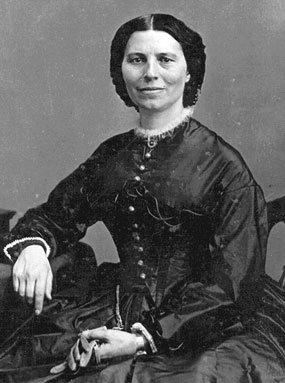
Clara
Barton: "The Angel of the
Battlefield" Clarissa
"Clara" Barton is best known as the
founder of the American Red Cross. She
began her lifetime of helping others at
the beginning of the Civil War, when
she organized medical care for Union
troops wounded in the Baltimore Riots
of 1861. Born
into a middle-class family in Oxford
Massachusetts, she entered into a
typical middle-class career for a woman
at the time as a school teacher. When
the war began, she was living in
Washington D.C. , working as a clerk in
the U.S. Patent Office, (at the time,
she was the first woman to hold the
important clerkship position in the
Federal government), when she saw the
need to help wounded soldiers. Prior to
Barton's work with wounded soldiers,
the military had never allowed female
nurses in army camps or hospitals. She
accompanied the U.S. Army as it marched
and fought in Virginia, nursing the
wounded soldiers at great risk to her
own life. In one battle, a bullet
passed through the sleeve of her dress,
killing the wounded man she was
helping. While with the army, she
contracted typhoid fever, but later
recovered. Her
efforts to bring better medical care
and to help locate missing servicemen
laid the groundwork for her future role
as the founder and leader of the
American Red Cross, which she began in
1881. Her drive to create an American
chapter of the Red Cross, came during a
trip to Europe, which began in 1869.
While there, she learned of the
International Red Cross, an
organization to which the United States
did not belong . Observing Red Cross
volunteers at work with the wounded
during the 1870-1871 Franco-Prussian
War (see Franco-German
Wars),
she saw the need for the United States
to form its own branch of the Red
Cross. One feature of the U.S. Red
Cross that she added to the original
role as a source of wartime aid, was
the idea of Red Cross assistance in
times of natural disasters, such as
hurricanes and floods. Under
Clara Barton's leadership, the American
Red Cross's early peacetime work
included helping victims of of the
Mississippi and Ohio River floods in
1882 and 1884, the Texas famine of
1886, the yellow fever epidemic in 1887
in Florida, an Illinois earthquake in
1888, and the now-famous 1889
Johnstown, Pennsylvania flood. Through
Barton's and the Red Cross's peacetime
work, other countries saw need for such
peacetime aid and the Geneva Convention
adopted the so-called "American
Amendment" to its charter in 1884 to
make peacetime work part of the purpose
of the International Red Cross. The
American Red Cross first experience in
war was in the Spanish-American
War
of 1898. In her career after the Civil
War, she also travelled the country
giving speeches, for which she was paid
quite well. Her friendship with Susan
B. Anthony and Julia Ward Howe led her
to support the women's suffrage
movement. She also supported civil
rights for freed African-Americans
after the war. She
ran the Red Cross until retiring in
1904. She died in Glen Echo, Maryland
on April 12, 1912. Clara
Barton Personal
Information: Role
in the war years: Clara Barton
organized relief efforts for wounded Union
soldiers. She worked as a nurse, and
worked to bring better medical care for
the wounded. She also began efforts to
locate soldiers missing in
action. Soldiers
called her "The Angel of the Battlefield,"
for her nursing work. Date
of Birth: December 25, 1821 Date
of Death: April 12, 1912 Occupation:
Nurse Post-War:
Nurse, Founder of the American Red
Cross
Links
and Resources Internet
Links: Clara
Barton National Historic Site
--From the National Park Services.
Provides information on the Glen Echo
house which served as Barton's home, the
headquarters for the American Red Cross,
and a warehouse for disaster relief
supplies. Includes biography, images, and
lesson plans. Testimony
of Clara Barton to
Congress
-Testifies during the 39th Congress
concerning her experiences and
observations while working in
Andersonville, Georgia. Her testimony is
recorded in the Reports of the Committees
of the House of Representatives on
February 21, 1866. Clara
Barton in Dansville
--Traces Barton's service during the years
of 1866 and 1876-1886. Clara
Barton: American Humanitarian
Life
Stories of Civil War Heroes: Clara Barton
--Biography
of the nurse and founder of the American
Red Cross. Profiles
in Caring: Clara
Barton
--Tribute to the woman who was known
during the U.S. Civil War as the Angel of
the Battlefield. Spectrum
Biography: Clara Barton "The
History Guy" is a Registered Trademark. Contact
the webmaster |