The Korean War
was the first major military conflict of the Cold War
between the Western powers and the Communist nations in
the years following World War Two. The war lasted three
years, cost millions of lives, devasted both North and
South Korea, and actually continues to this day as the
military conflict concluded with a truce, not an actual
peace treaty. The Korean War involved all of the major
powers of the 1950s: The United States, United Kingdom,
France, China, and Russia (the Soviet Union), as well as
the relatively new United Nations. The war in Korea was
just one of several major conflicts pitting the Western
powers against Communist forces, but this was the only
one at the time that carried the potential for escalating
into a Third World War. Such a world war could easily
have become a nuclear conflict as both the U.S. and
Soviet Union possessed atomic weapons.
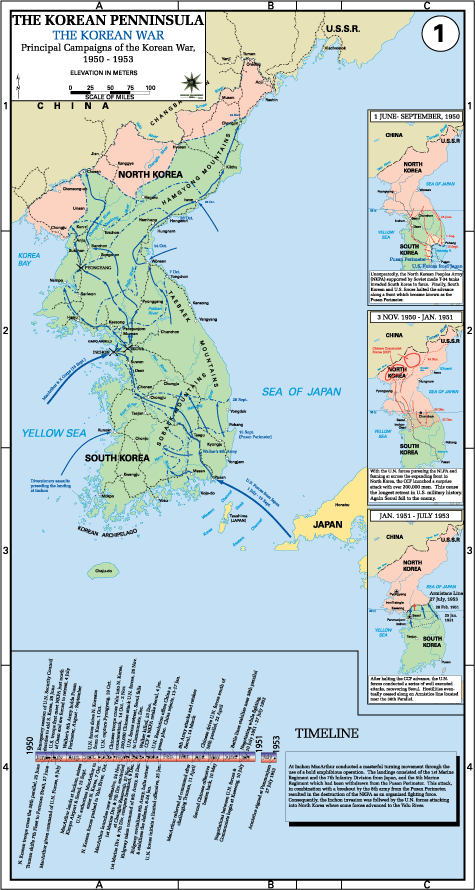
North Korean
People’s Army (NKPA) invades across the 38th
Parallel with 135,000 men. The outnumbered Republic of
Korea Army (ROK), which does not have effective anti-tank
weapons, field artillery, or combat aircraft, suffers
heavy casualties. North Korean forces enter the South
Korean capital of Seoul on June 28.
July 5,
1950
First battle
between the U.S. Army and the NKPA. The 24th Infantry
Division’s Task Force Smith, a battalion combat team
deployed from Japan, attempted to delay the advance of a
NKPA division near Osan. Outnumbered and poorly equipped,
Task Force Smith delays the North Koreans for only a
short period before retreating with heavy
casualties.
Aug. 6 -
Sept. 12, 1950
Defense of the
Pusan Perimeter. After a series of costly delaying
actions during July, the U.S. Eighth Army withdrew on
Aug. 1 into a final defensive line around the key port
city of Pusan. After deploying from Japan the previous
month, the U.S. Eighth Army had assumed command of all
U.S., ROK, and other nations’ ground combat units
fighting to defeat the North Korean invasion. As
reinforcements from the United States and several other
nations arrive at the port, the Eighth Army directed the
successful defense of the perimeter against major NKPA
attacks in August and September.
Sept. 15,
1950
X Corps
amphibious assault at Inchon, Seoul’s port city.
General of the Army Douglas MacArthur, commander-in-chief
of the U.S. Far East Command and commander-in-chief of
United Nations force, plans to liberate Seoul and crush
the NKPA between X Corps and Eighth Army begins its
breakout from the Pusan Perimeter on Sept. 16.
Sept. 28,
1950
X Corps
completes the liberation of Seoul. Eighth Army has linked
up with X Corps, and while many North Korean soldiers
escape, most NKPA units are destroyed.
Oct. 19,
1950
Eighth Army
seizes Pyongyang, capital of the Democratic People’s
Republic of Korea (AKA North Korea), after UN forces
shift from the defense of South Korea to the destruction
of the North Korean regime. The NKPA can mount only very
limited and generally ineffective opposition. Meanwhile,
X Corps has been withdrawn from Seoul to land in
northeastern Korea.
November 26
- 30, 1950
Two army groups
of the Chinese People's Liberation Army (PLA) attack and
defeat outnumbered UN forces in North Korea, inflicting
heavy casualties. The People's Republic of China (PRC),
after warning the UN, intervenes to prevent the
destruction of the North Korean regime and the
establishment of a united, American-allied Korea on its
border. After the attack, the Eighth Army breaks contact
with the Chinese and retreats into South Korea; X Corps
is withdrawn by sea to South Korea where it joins Eighth
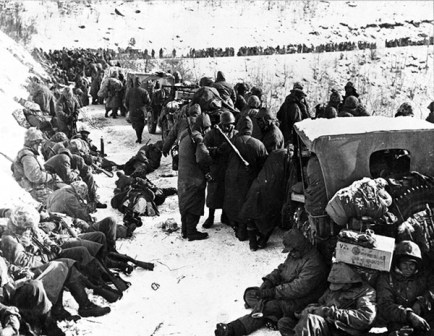
Army. Two significant battles during this period include
the 2nd Infantry Division's harrowing withdrawal through
the Kunu-ri gauntlet and the 1st Marine Division's heroic
efforts in the Chosin Reservoir battle. While the
majority of U.S. and UN forces manage to survive these
first battles with the Chinese, the retreat from North
Korea is a significant defeat for Allied
forces.
Jan. 4,
1951
U.N. forces
evacuate Seoul after the Chinese and NKPA launch another
major offensive. Eighth Army breaks contact with the
enemy and withdraws to a new defensive line south of the
Han River,deep inside South Korean territory.
Jan. 24,
1951
Eighth Army
begins a counter-offensive with an emphasis on using its
superior firepower to inflict heavy casualties on the
enemy. After defeating another major enemy attack in
February, the counter-offensive continues.
March 14,
1951
Eighth Army
retakes Seoul against light enemy resistance.
March 27,
1951
Eighth Army
reaches 38th Parallel. Enemy resistance continues to be
light, but intelligence indicates that the Chinese are
massing their forces for another major
offensive.
April 11,
1951
President
Truman relieves
Gen. MacArthur from his commmand after MacArthur had
publicly and repeatedly questioned President
Truman’s strategy for the war. At the time, this was
a very controversial move, and Truman's public opinion
ratings plummet at home. Many Americans hail MacArthur as
a here.
April 22 -
29, 1951 & May 16-20, 1951
Chinese Spring
Offensives. After forcing the outnumbered Eighth Army to
make tactical withdrawals, Chinese and North Korean units
in April and May are decimated by superior UN firepower.
This is the last attempt by either side to win the war by
inflicting a crushing battlefield defeat on the
enemy’s army.
July 10,
1951
Armistice
negotiations begin as both the US and the PRC decide that
the costs are too high to unify the peninsula under their
Korean ally, and they instead settle for a continuation
of a Korea divided between two regimes. To pressure the
communists and to seize better terrain for defensive
lines, Eighth Army mounts a series of limited-objective
attacks during the summer and autumn that are successful,
but very costly because of fierce enemy
resistance.
Nov. 12,
1951
Eighth Army
assumes the “active defense” as the UN’s
objectives in the armistice negotiations, and the growing
unpopularity of the war in the United States, rule out
major offensives with high casualties. In the active
defense, UN forces hold a main line of resistance,
protected by fortified outposts, from which units patrol
and conduct raids against enemy positions.
May 7 - June
10, 1952
On May 7, NKPA
prisoners-of-war at the UN POW camp on Koje Island
capture the camp commander. He is released unharmed after
an American officer signs a statement admitting to the
mistreatment of POWs. A great propaganda victory for the
communists, this incident is the most notable example of
the communist strategy to turn POW camps into another
battlefield of the war. During June, the UN POW camp
system is reorganized to improve security, although
communist POWs will continue to provoke violent incidents
until the end of the war.
July 17 -
Aug. 4, 1952
Battle for
Outpost Old Baldy. The 2nd Infantry Division loses the
outpost to a Chinese attack that demonstrates the
enemy’s greatly expanded artillery force, mounts
several unsuccessful counterattacks, and then finally
retakes the outpost. While patrolling is now the most
common form of combat, the Chinese for the next year will
attempt to pressure the UN at the armistice negotiations
by inflicting heavy casualties on UN units with attacks
on outposts.
Oct. 6 - 15,
1952
Battle for
White Horse Mountain. The successful defense of this
position by the ROK 9th Division, with the assistance of
U.S. artillery and air strikes, against heavy Chinese
attacks signals the great improvements the ROK has made,
with the aid of American advisers, in its tactical and
technical competence since the first year of the
war.
Oct. 8,
1952
Armistice
negotiations recessed because of a deadlock on the issue
of repatriation of POWs. While the Geneva Convention of
1949 mandates immediate repatriation of POWs after
hostilities end, the United States decides to press for
allowing POWs to choose whether they will be repatriated.
The U.S. takes this position because screening of enemy
POWs has revealed that tens of thousands of them are
either South Koreans conscripted into the NKPA or
Nationalist veterans of the Chinese Civil War drafted
into the PLA after the communist victory in that war.
These POWs do not want to go to North Korea or to
Communist China after hostilities end.
April 26,
1953
Armistice
negotiations resume. While both South and North Koreans
still desire to defeat each other and unify the
peninsula, the UN and the PRC wish to end what has become
a bloody and expensive war whose objective, the status
quo ante bellum, is for them not worth the cost of
continuing.
May 28-29,
1953
25th Infantry
Division battle for Nevada outpost complex. The Chinese
repeatedly attack to take these outposts, suffering very
heavy casualties, until Eighth Army decides to abandon
the outposts. With an armistice agreement in sight,
senior UN commanders conclude that holding an outpost,
after the Chinese have demonstrated a willingness to
sacrifice whatever number of soldiers required to take
it, is not worth the cost in UN soldiers’ lives. The
Chinese take several other outposts with this tactic,
which is designed to distract from their concessions at
the armistice negotiations and to keep pressuring the UN
during the final stage of the negotiations.
June 8,
1953
Agreement
reached at armistice negotiations on repatriation of
POWs. All POWs will choose whether they will be
repatriated, and both sides will be allowed an attempt to
persuade its POWs to choose to be repatriated.
July 13-19,
1953
Chinese
offensive against ROK units in Kumsong Salient. A major
attack breaks through ROK lines and inflicts heavy
losses, but the Chinese do not attempt to exploit the
breach even though they also have suffered heavy
casualties. The purpose of the attack is to punish the
South Koreans for unilaterally releasing 27,000 POWs who
had refused repatriation and to distract world attention
from the concessions made at the armistice
negotiations.
July 27,
1953
Armistice
signed at Panmunjom. Both sides then withdraw slightly to
create a demilitarized zone between the two Korean
regimes.
Aug. 1953 -
Feb. 1954
Exchange of
POWs. A total of 82,493 Koreans and Chinese POWs are
repatriated, as are 13,444 UN POWs (3,746 of which are
Americans). 21,839 communist POWs refuse repatriation, as
do 347 UN POWs, including 21 Americans.