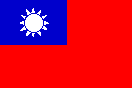
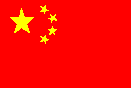
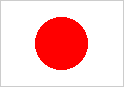
Flag of Nationalist China | Flag of
Communist China | Flag of Japan
The
series of wars and conflicts between China and Japan are
known as the Sino-Japanese Wars. These wars weakened
China, while helping Japan gain more power; that is,
until the final war, in which China finally gained
allies, most notably the United States and Great Britain.
The Second Sino-Japanese War is also considered a part of
World War Two.
While
no armed conflicts have broken out since the end of World
War Two between these two Asian nations, a lot of
distrust and animosity remain, partly as leftovers from
the Japanese Occupation of China, but also as a result of
nationalist politics in both countries, as seen in the
recent dispute over the Diaoyu-Senkaku
Islands.
First
Sino-Japanese War
(1894-1895)--The first conflict between China and
Japan took place over who would control Korea, a small
nation located between them. Japan defeated the
technologically inferior Chinese forces, and gained
control of Korea. Japan would rule Korea until the end of
World War Two in 1945. Japan gained control of the
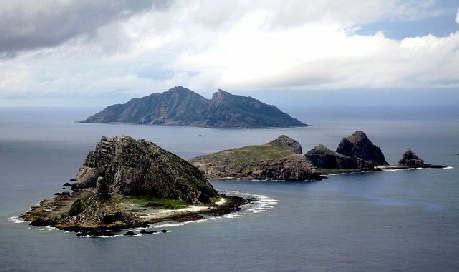
Chinese Diaouy Islands. The Japanese name for this
uninhabited island chain is the Senkaku
Islands.
The
Boxer Rebellion
(1899-1901)--A Chinese secret society called the
Righteous Harmony Society, and called "The Boxers" by
Western observers, began an uprising to drive Western
influence from China. While the rebels also at first
opposed the ruling government, called the Manchu Dynasty,
the government soon managed to direct most of the
violence against European, American, and Japanese
cultural, political, military, and diplomatic interests
in China. After the rebels and the government's military
began a siege of the Foreign Legations (foreign
embassies) in the capital of Beijing (known as Peking at
the time), an unlikely alliance of eight nations gathered
military forces to invade China and save their embassies,
as well as to preserve the power and influence they had
long held in China. These allies included: Great Britain,
France, Germany, Italy, Austria-Hungary, Russia, the
United States, and Japan. This China Relief Expedition
totaled nearly 45,000 men, and quickly invaded China,
seizing Beijing. China was forced to pay war reparations,
(in other words, they had to repay their enemies for the
financial cost of the war), accept more foreign troops on
Chinese soil.
Jinan
Incident (May 3rd
Incident)
(1928-1929)--During the period of Chinese civil wars
between the Nationalist government and various warlords,
one of the warlords allied himself with Japan, who
already occupied the Shantung Peninsula during World War
One. In 1927, the advancing Nationalist army clashed with
Japanese and warlord forces. A cease-fire was agreed upon
in March, 1928.
Japanese
Occupation of Manchuria (1931-1932)--The
Japanese Army invaded the Chinese province of Manchuria
in 1931, setting up a puppet government. Japan wanted
Manchuria due to the great natural resources in this
northern portion of China. Japan's excuse for invading
was the so-called Mukden Incident (known as the "9.18
Incident" in China). Some historians date the beginning
of World War Two to the beginning of the Mukden Incident
and the Japanese takeover of Manchuria.
First
Battle of Shanghai (January
28 to March 4, 1932)--In an attempt to break the
Chinese boycott of Japanese goods and businesses begun
after the Mukden Incident, the Japanese Army lands at the
Chinese port city of Shanghai in January of 1932. The
Chinese 19th Route Army held 70,000 Japanese troops to
the area around the waterfront for nearly a month until
being driven from the city by the invaders. As a result
of the Japanese seizure of the city, China abandoned the
boycott. Japan's effective use of aircraft carrier-based
planes was the first use of this tactic in the
Pacific/East Asia region. This is also known as the
Shanghai War of 1932.
Japanese
Invasion of Jehol Province
(January
to March 1933)--The Japanese advanced from their
positions in occupied Manchuria (which they renamed
Manchukou), to occupy Jehol, near the Mongolian border.
Chinese resistance ended as the Japanese advanced closer
to Peking. An armistice was signed on March
31.
Second
Sino-Japanese War
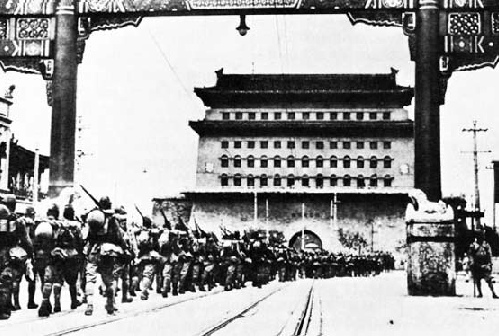
(1937-1945)--Japan launched an all-out invasion of
China after the Marco Polo Bridge Incident on July 7,
1937. Japan used this battle as an excuse to invade
China, beginning a war which would kill millions, draw in
the United States, Great Britain and other nations, and
end with the defeat of Japan in 1945. Some historians
date the beginning of World War Two to the beginning of
this war.
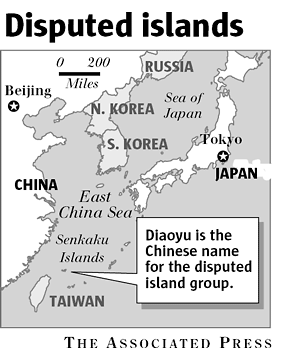
Diaoyu-Senkaku
Islands Dispute
(2010-2013)--While Japan and China have not fought
a war against each other since 1945, they still really do
not like each other. This is partially evidenced by the
ongoing dispute over a group of uninhabited islands
between Japan and China (which Taiwan also claims, by the
way). China calls them the Diaoyu Islands, while Japan
calls them the Senkaku Islands (see map above). Both
nations claim the islands as their territory, and this
dispute escalated in September, 2010, when Japanese
authorities seized a Chinese fishing trawler that
collided with Japanese patrol boats and arrested the
boat's captain.
Nationalist-minded
Chinese activists previously have landed on the rocky
islands in order to raise the Chinese flag, but the boat
incident is the most serious diplomatic dispute over
these islands in decades.
Again, in
August, 2012, the dispute over these islands erupted, as
a group of 14 nationalists from Hong Kong and mainland
Chinese traveled by boat to the disputed islands and
planted Chinese flags. Japanese authorities arrested
them, but then several Japanese nationalists journeyed to
the islands to plant Japanese flags. Chinese public
opinion erupted in anti-Japanese protests and attacks on
Japanese business interests in China.
In
mid-September, 2012, the Japanese national government
purchased the three islands that were under private
ownership, presumably to prevent the governor of Tokyo,
who is an extreme nationalist, from acquiring them with
Tokyo funds. This purchase set off a new round of
protests in China. An escalation of the tension between
China and Japan reached new heights when six chinese
military surveillance ships entered Japanese waters near
the islands. Japanese Coast Guard vessels warned the
Chinese ships via radio to leave. All six Chinese ships
eventually left Japanese-claimed waters.
Throughout 2012 and 2013, the tension
between China and Japan continued to increase, as China
increasingly attempted to lay claim to the islands.
Chinese naval ships, fishing boats, and warplanes
continually entered the waters and airspace near the
islands. Japanese forces constantly patrolled the area,
and fears of an accidental clash between Chinese and
Japanese forces became a constant concern. In November of
2013, China declared a large swath of sea and air off the
Chinese coast, including the area around the islands, as
a new Air Defense Identification Zone (ADIZ), requiring
foreign planes and ships to log travel plans with the
Chinese, among other restrictions. The United States, an
ally of Japan, immediately responded with an overflight
of the ADIZ by two unarmed B-52 bombers. This was
followed by overflights by both South Korean and Japanese
military planes. (The ADIZ also incorporated areas
claimed by South Korea). The next day, Chinese military
planes also overflew the area. This escalation in
tensions came as the U.S. and Japan prepared to start a
massive air and naval exercise in the western Pacific.
The ongoing tensions are serious, and a wrong move or an
accidental clash could develop into a new war between
China and Japan.
Recent
Issues Between Japan and China Resources:
Japanese
activists land, raise flags on disputed island, provoking
Chinese
protests--Businessweek, August
18, 2012
The
Sino-Japanese Naval War of 2012: OK, it's probably not
going to happen. But if it did, who would
win? -Foreign Policy, by By
James R. Holmes, August 20, 2012
Arrest
of boat captain escalates Japan-China
rivalry--Seattle
Times, Sept. 11, 2001
 .
5th ed. Binghamton, NY: CQ Press, 2004.
.
5th ed. Binghamton, NY: CQ Press, 2004. .
New York: Harper & Row, 1970.
.
New York: Harper & Row, 1970.