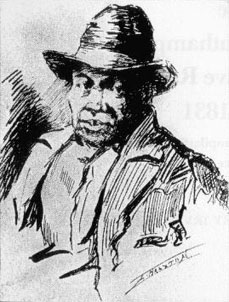
An image of Nat Turner
One of the most distressing and violent aspects of American history was the institution of slavery. For over two hundred years, Africans were brought against their will to Britain's American colonies and to the new United States of America. One historian (Herbert Aptheker), calculated that over two hundred separate slave revolts and conspiracies took place from the 1600's to the end of the U.S. Civil War in 1865.
In addition to the major rebellions listed below, many slaves took part in acts of individual opposition to their slave status. These actions included purposely damaging tools, working slowly, burning down buildings and the occasional act of violence against whites. Of course, an effective way to gain personal freedom, while also hurting their owner economically, was
to attempt escape. Prior to Florida's annexation by the United States, many slaves escaped to that area and set up free communities.
The idea of a slave revolt, or of an individual slave taking violent action against the slave-owners, came into the public eye in 2012 and 2013 with the release of the Quinten Tarantino movie "Django Unchained," which stars Jaime Foxx as the ex-slave named Django, who exacts a bloody retribution upon cruel slave-owners.
Gloucester County, Virginia--Sept. 1663--This was the first major conspiracy for a possible slave rebellion. The plot by black slaves and white indentured servants was betrayed to the authorities. Several plotters were beheaded.
New York City Slave Rebellion--1712--25 slaves armed with guns and clubs burned down houses on the northern edge of New York City and killed nine whites. The rebels were killed after soldiers arrived. The repercussions of this rebellion resulted in the tortuous execution of 18 participants in the rebellion.
Cato's Conspiracy/Stono Rebellion--1739--Approximately 80 slaves armed themselves and attempted to march toward Spanish Florida from their home area of Stono, South Carolina. When confronted by a group of white militia, a battle ensued. Forty-four blacks and twenty-one whites perished.
New York Conspiracy--March and April, 1741-- Thirty-one slaves and four whites were executed as a result of rumors of a major slave rebellion in New York City. It is unknown whether these rumors were based on fact or were part of a larger paranoia which existed regarding slave uprisings.
Gabriel Prosser's Rebellion--1800--Gabriel Prosser, a blacksmith, and his brother Martin, a slave preacher, planned a major rebellion in Virginia. They recruited at least a thousand slaves to their cause and built up a secret cache of weapons in anticipation of marching on the state capital of Richmond. When the day of the revolt arrived though, a violent storm washed out the roads and bridges leading to Richmond. The rebels broke up and Prosser was betrayed by one of his followers. The state militia captured Prosser and he and many of his followers were hanged.
Slave rebellion in St. John the Baptist Parish --Jan 8-10, 1811-- Slave rebellion in Louisiana in which 500 slaves took part and 100 were killed. Louisiana had only recently joined the United States after the Louisiana Purchase of 1803.
Fort Blount--1816--Three hundred fugitive slaves and Florida Indians battled U.S. Army troops at Apalachicola Bay in Florida.
Denmark Vesey's Uprising--1822--Vesey, a free black man living in South Carolina, detested slavery and took great inspiration from stories of Israelite freedom from bondage in the Bible. He began organizing for a major rebellion which would take place in 1822 in the city of Charleston. He and his followers organized into small cells, independent of each other. This way, of a single cell were detected by the authorities, the other rebel cells could survive.
His plan was rather simple. Armed slaves would position themselves outside the houses of whites at night. Then, other slaves would start a major fire in the city. When the white men exited their homes to fight the fire, the slaves would kill them.
Unfortunately for Vesey and his followers, someone betrayed them before they could launch the attack. One of Vesey's companions, who knew the whole plan, turned him in to the authorities. Vesey and the other leaders were hung, but the immensity and ingenuity of the plot terrified southern slave owners.
Nat Turner's Revolt--August, 1831--Nat Turner's rebellion was the most successful of all slave revolts. Turner, a slave preacher, inspired fellow slaves with his apocalyptic visions of white and black angels fighting in heaven. He gathered up his seven original followers and, without the organization or planning of Prosser and Vesey, launched his rebellion by entering his owner's home and killing the entire family, save for a small infant. They moved from one farm to the next, killing all slave-owning whites they found. As they progressed through Southampton county, other slaves joined in the rebellion. The next day, Turner and his eighty followers were intercepted by the state militia. In the confrontation that followed, Turner escaped and remained free for nearly two months. In those two months though, the militia and white vigilantes instituted a reign of terror over slaves in the region. Hundreds of blacks were killed. White Virginians panicked over fears of a larger slave revolt and soon instituted more restrictive laws regulating slave life. Turner was eventually captured and hung.
Other, smaller rebellions occurred throughout the history of British America and the United States. In the future, more of these events will be added to this page.
Brittanica.com article on Slave Rebellions
African Diaspora: Slave Rebellions
Foner, Eric, and John A. Garraty, ed. The Reader's Companion to American History. Boston: Houghton Mifflin Co., 1991.