Supreme Court Decisions
2008-2009 Term:
SAFFORD UNIFIED SCHOOL DISTRICT #1 ET AL. v.
REDDING
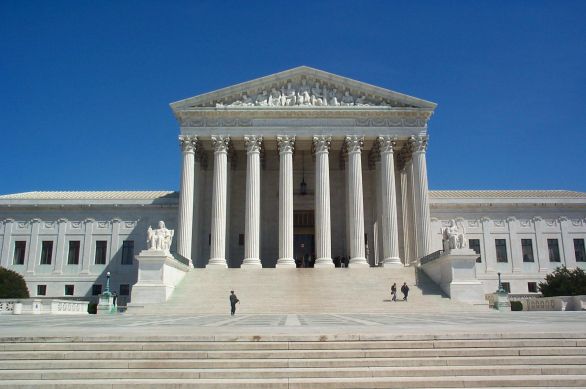
Supreme Court Building
Safford Unified School District v. Redding (2009) was a case decided by the Supreme Court of the United States on June 25, 2009. The Supreme Court decision held that a strip search of a female middle school student violated the Fourth Amendment where the school lacked reasons to suspect either that the drugs involved presented a danger or that they were concealed in her underwear. The court also held, however, that because this was not clearly-established law prior to the court’s decision, the officials involved were shielded from liability by qualified immunity.Text of the Supreme Court Decision is Below:<
Majority: Souter, joined by Kennedy, Breyer, Roberts, Scalia, Alito; Stevens, Ginsburg (in part)
Concur/dissent: Stevens, joined by Ginsburg
Concur/dissent: Ginsburg
Concur/dissent: Thomas
SUPREME COURT OF THE UNITED STATES
Syllabus
SAFFORD UNIFIED SCHOOL DISTRICT #1 ET AL. v.
REDDING
CERTIORARI TO THE UNITED STATES COURT OF APPEALS FOR THE NINTH CIRCUIT
No. 08–479. Argued April 21, 2009—Decided June 25, 2009
After escorting 13-year-old Savana Redding from her middle school classroom to his office, Assistant Principal Wilson showed her a day planner containing knives and other contraband. She admitted own-ing the planner, but said that she had lent it to her friend Marissaand that the contraband was not hers. He then produced four pre-scription-strength, and one over-the-counter, pain relief pills, all of which are banned under school rules without advance permission.She denied knowledge of them, but Wilson said that he had a reportthat she was giving pills to fellow students. She denied it and agreed to let him search her belongings. He and Helen Romero, an adminis-trative assistant, searched Savana’s backpack, finding nothing. Wil-son then had Romero take Savana to the school nurse’s office to search her clothes for pills. After Romero and the nurse, Peggy Schwallier, had Savana remove her outer clothing, they told her topull her bra out and shake it, and to pull out the elastic on her un-derpants, thus exposing her breasts and pelvic area to some degree. No pills were found. Savana’s mother filed suit against petitioner school district (Safford), Wilson, Romero, and Schwallier, allegingthat the strip search violated Savana’s Fourth Amendment rights.Claiming qualified immunity, the individuals (hereinafter petition-ers) moved for summary judgment. The District Court granted the motion, finding that there was no Fourth Amendment violation, and the en banc Ninth Circuit reversed. Following the protocol for evalu-ating qualified immunity claims, see Saucier v. Katz, 533 U. S. 194, 200, the court held that the strip search was unjustified under the Fourth Amendment test for searches of children by school officials set out in New Jersey v. T. L. O., 469 U. S. 325. It then applied the test
Held:
1. The search of Savana’s underwear violated the Fourth Amend-ment. Pp. 3–11.
(a)
For school searches, “the public interest is best served by a Fourth Amendment standard of reasonableness that stops short of probable cause.” T. L. O., 469 U. S., at 341. Under the resulting reasonable suspicion standard, a school search “will be permissible . . . when the measures adopted are reasonably related to the objectives of the search and not excessively intrusive in light of the age and sex of the student and the nature of the infraction.” Id., at 342. The required knowledge component of reasonable suspicion for a school administrator’s evidence search is that it raise a moderate chance of finding evidence of wrongdoing. Pp. 3–5.
(b)
Wilson had sufficient suspicion to justify searching Savana’s backpack and outer clothing. A week earlier, a student, Jordan, had told the principal and Wilson that students were bringing drugs and weapons to school and that he had gotten sick from some pills. On the day of the search, Jordan gave Wilson a pill that he said came from Marissa. Learning that the pill was prescription strength, Wilson called Marissa out of class and was handed the day planner. Once in his office, Wilson, with Romero present, had Marissa turn out her pockets and open her wallet, producing, inter alia, an over-the-counter pill that Marissa claimed was Savana’s. She also denied knowing about the day planner’s contents. Wilson did not ask her when she received the pills from Savana or where Savana might be hiding them. After a search of Marissa’s underwear by Romero and Schwallier revealed no additional pills, Wilson called Savana into his office. He showed her the day planner and confirmed her relation-ship with Marissa. He knew that the girls had been identified as part of an unusually rowdy group at a school dance, during which alcohol and cigarettes were found in the girls’ bathroom. He had other reasons to connect them with this contraband, for Jordan had told the principal that before the dance, he had attended a party at Sa-vana’s house where alcohol was served. Thus, Marissa’s statement that the pills came from Savana was sufficiently plausible to warrant suspicion that Savana was involved in pill distribution. A student who is reasonably suspected of giving out contraband pills is reasonably suspected of carrying them on her person and in her back-pack. Looking into Savana’s bag, in her presence and in the relative privacy of Wilson’s office, was not excessively intrusive, any more
(c) Because the suspected facts pointing to Savana did not indicate that the drugs presented a danger to students or were concealed in her underwear, Wilson did not have sufficient suspicion to warrant extending the search to the point of making Savana pull out her underwear. Romero and Schwallier said that they did not see anything when Savana pulled out her underwear, but a strip search and its Fourth Amendment consequences are not defined by who was looking and how much was seen. Savana’s actions in their presence necessarily exposed her breasts and pelvic area to some degree, and both subjective and reasonable societal expectations of personal privacy support the treatment of such a search as categorically distinct, requiring distinct elements of justification on the part of school authorities for going beyond a search of outer clothing and belongings. Savana’s subjective expectation of privacy is inherent in her account of it as embarrassing, frightening, and humiliating. The reasonable-ness of her expectation is indicated by the common reaction of other young people similarly searched, whose adolescent vulnerability intensifies the exposure’s patent intrusiveness. Its indignity does not outlaw the search, but it does implicate the rule that “the search [be]‘reasonably related in scope to the circumstances which justified the interference in the first place.’ ” T. L. O., supra, at 341. Here, the content of the suspicion failed to match the degree of intrusion. Be-cause Wilson knew that the pills were common pain relievers, he must have known of their nature and limited threat and had no rea-son to suspect that large amounts were being passed around or that individual students had great quantities. Nor could he have suspected that Savana was hiding common painkillers in her underwear.When suspected facts must support the categorically extreme intrusiveness of a search down to an adolescent’s body, petitioners’ general belief that students hide contraband in their clothing falls short; areasonable search that extensive calls for suspicion that it will succeed. Non dangerous school contraband does not conjure up the spec-ter of stashes in intimate places, and there is no evidence of such behavior at the school; neither Jordan nor Marissa suggested that Savana was doing that, and the search of Marissa yielded nothing. Wilson also never determined when Marissa had received the pills from Savana; had it been a few days before, that would weigh heavily against any reasonable conclusion that Savana presently had the pills on her person, much less in her underwear. Pp. 8–11.
2. Although the strip search violated Savana’s Fourth Amendment rights, petitioners Wilson, Romero, and Schwallier are protected from liability by qualified immunity because “clearly established law [did]not show that the search violated the Fourth Amendment,” Pearson
3. The issue of petitioner Safford’s liability under Monell v. New York City Dept. of Social Servs., 436 U. S. 658, 694, should be ad-dressed on remand. P. 13.
531 F. 3d 1071, affirmed in part, reversed in part, and remanded.
SOUTER, J., delivered the opinion of the Court, in which ROBERTS,
C. J., and SCALIA, KENNEDY, BREYER, and ALITO, JJ., joined, and in which STEVENS and GINSBURG, JJ., joined as to Parts I–III. STEVENS, J., filed an opinion concurring in part and dissenting in part, in which GINSBURG, J., joined. GINSBURG, J., filed an opinion concurring in part and dissenting in part. THOMAS, J., filed an opinion concurring in the judgment in part and dissenting in part.
Opinion of the Court
NOTICE: This opinion is subject to formal revision before publication in the preliminary print of the United States Reports. Readers are requested to notify the Reporter of Decisions, Supreme Court of the United States, Washington, D. C. 20543, of any typographical or other formal errors, in order that corrections may be made before the preliminary print goes to press.
PETITIONERS v. APRIL REDDING
ON WRIT OF CERTIORARI TO THE UNITED STATES COURT OF
APPEALS FOR THE NINTH CIRCUIT
[June 25, 2009]
JUSTICE SOUTER delivered the opinion of the Court.
The issue here is whether a 13-year-old student’s Fourth Amendment right was violated when she was subjected to a search of her bra and underpants by school officials acting on reasonable suspicion that she had brought for-bidden prescription and over-the-counter drugs to school. Because there were no reasons to suspect the drugs presented a danger or were concealed in her underwear, we hold that the search did violate the Constitution, but because there is reason to question the clarity with which the right was established, the official who ordered the unconstitutional search is entitled to qualified immunity from liability.
I The events immediately prior to the search in question began in 13-year-old Savana Redding’s math class at Safford Middle School one October day in 2003. The assistant principal of the school, Kerry Wilson, came into the room and asked Savana to go to his office. There, he showed her a day planner, unzipped and open flat on his desk, in which there were several knives, lighters, a
Wilson then showed Savana four white prescription-strength ibuprofen 400-mg pills, and one over-the-counter blue naproxen 200-mg pill, all used for pain and inflammation but banned under school rules without advance permission. He asked Savana if she knew anything about the pills. Savana answered that she did not. Wilson then told Savana that he had received a report that she was giving these pills to fellow students; Savana denied it and agreed to let Wilson search her belongings. Helen Romero, an administrative assistant, came into the office, and together with Wilson they searched Savana’s back-pack, finding nothing.
At that point, Wilson instructed Romero to take Savanato the school nurse’s office to search her clothes for pills.Romero and the nurse, Peggy Schwallier, asked Savana to remove her jacket, socks, and shoes, leaving her in stretchpants and a T-shirt (both without pockets), which she wasthen asked to remove. Finally, Savana was told to pull her bra out and to the side and shake it, and to pull out the elastic on her underpants, thus exposing her breasts and pelvic area to some degree. No pills were found.
Savana’s mother filed suit against Safford Unified School District #1, Wilson, Romero, and Schwallier for conducting a strip search in violation of Savana’s Fourth Amendment rights. The individuals (hereinafter petitioners) moved for summary judgment, raising a defense of qualified immunity. The District Court for the District of Arizona granted the motion on the ground that there was no Fourth Amendment violation, and a panel of the Ninth Circuit affirmed. 504 F. 3d 828 (2007).
A closely divided Circuit sitting en banc, however, re-
U. S. 194, 200 (2001), the Ninth Circuit held that the stripsearch was unjustified under the Fourth Amendment test
for searches of children by school officials set out in New Jersey v. T. L. O., 469 U. S. 325 (1985). 531 F. 3d 1071, 1081–1087 (2008). The Circuit then applied the test for qualified immunity, and found that Savana’s right was clearly established at the time of the search: “‘[t]hese notions of personal privacy are “clearly established” in that they inhere in all of us, particularly middle school teenagers, and are inherent in the privacy component of the Fourth Amendment’s proscription against unreason-able searches.’” Id., at 1088–1089 (quoting Brannum v. Overton Cty. School Bd., 516 F. 3d 489, 499 (CA6 2008)). The upshot was reversal of summary judgment as to Wilson, while affirming the judgments in favor of Schwal-lier, the school nurse, and Romero, the administrative assistant, since they had not acted as independent deci-sionmakers. 531 F. 3d, at 1089.
We granted certiorari, 555 U. S. ___ (2009), and now affirm in part, reverse in part, and remand.
II The Fourth Amendment “right of the people to be secure in their persons . . . against unreasonable searches and seizures” generally requires a law enforcement officer tohave probable cause for conducting a search. “Probable cause exists where ‘the facts and circumstances within [an officer’s] knowledge and of which [he] had reasonably trustworthy information [are] sufficient in themselves to warrant a man of reasonable caution in the belief that’ an offense has been or is being committed,” Brinegar v. United States, 338 U. S. 160, 175–176 (1949) (quoting Carroll v. United States, 267 U. S. 132, 162 (1925)), and that evidence bearing on that offense will be found in the
In T. L. O., we recognized that the school setting “re-quires some modification of the level of suspicion of illicit activity needed to justify a search,” 469 U. S., at 340, and held that for searches by school officials “a careful balanc-ing of governmental and private interests suggests that the public interest is best served by a Fourth Amendment standard of reasonableness that stops short of probable cause,” id., at 341. We have thus applied a standard of reasonable suspicion to determine the legality of a school administrator’s search of a student, id., at 342, 345, and have held that a school search “will be permissible in its scope when the measures adopted are reasonably related to the objectives of the search and not excessively intrusive in light of the age and sex of the student and the nature of the infraction,” id., at 342.
A number of our cases on probable cause have an implicit bearing on the reliable knowledge element of reasonable suspicion, as we have attempted to flesh out the knowledge component by looking to the degree to which known facts imply prohibited conduct, see, e.g., Adams v. Williams, 407 U. S. 143, 148 (1972); id., at 160, n. 9 (Mar-shall, J., dissenting), the specificity of the information received, see, e.g., Spinelli v. United States, 393 U. S. 410, 416–417 (1969), and the reliability of its source, see, e.g., Aguilar v. Texas, 378 U. S. 108, 114 (1964). At the end of the day, however, we have realized that these factors cannot rigidly control, Illinois v. Gates, 462 U. S. 213, 230 (1983), and we have come back to saying that the standards are “fluid concepts that take their substantive con-tent from the particular contexts” in which they are being assessed. Ornelas v. United States, 517 U. S. 690, 696 (1996).
Perhaps the best that can be said generally about the required knowledge component of probable cause for a law enforcement officer’s evidence search is that it raise a “fair
III
A
In this case, the school’s policies strictly prohibit the nonmedical use, possession, or sale of any drug on school grounds, including “‘[a]ny prescription or over-the-counter drug, except those for which permission to use in school has been granted pursuant to Board policy.’” App. to Pet.for Cert. 128a.1 A week before Savana was searched, another student, Jordan Romero (no relation of the school’s administrative assistant), told the principal and Assistant Principal Wilson that “certain students were bringing drugs and weapons on campus,” and that he had been sick after taking some pills that “he got from a classmate.” App. 8a. On the morning of October 8, the same boy handed Wilson a white pill that he said Marissa Glines had given him. He told Wilson that students were
—————— 1When the object of a school search is the enforcement of a school rule, a valid search assumes, of course, the rule’s legitimacy. But the legitimacy of the rule usually goes without saying as it does here. The Court said plainly in New Jersey v. T. L. O., 469 U. S. 325, 342, n. 9 (1985), that standards of conduct for schools are for school administrators to determine without second-guessing by courts lacking the experience to appreciate what may be needed. Except in patently arbitrary instances, Fourth Amendment analysis takes the rule as a given, as it obviously should do in this case. There is no need here either to explainthe imperative of keeping drugs out of schools, or to explain the reasons for the school’s rule banning all drugs, no matter how benign, without advance permission. Teachers are not pharmacologists trained to identify pills and powders, and an effective drug ban has to be enforce-able fast. The plenary ban makes sense, and there is no basis to claimthat the search was unreasonable owing to some defect or shortcoming of the rule it was aimed at enforcing.
Wilson learned from Peggy Schwallier, the school nurse,that the pill was Ibuprofen 400 mg, available only by prescription. Wilson then called Marissa out of class. Outside the classroom, Marissa’s teacher handed Wilson the day planner, found within Marissa’s reach, containing various contraband items. Wilson escorted Marissa back to his office.
In the presence of Helen Romero, Wilson requested Marissa to turn out her pockets and open her wallet.Marissa produced a blue pill, several white ones, and arazor blade. Wilson asked where the blue pill came from, and Marissa answered, “‘I guess it slipped in when she gave me the IBU 400s.’” Id., at 13a. When Wilson asked whom she meant, Marissa replied, “‘Savana Redding.’” Ibid. Wilson then enquired about the day planner and its contents; Marissa denied knowing anything about them. Wilson did not ask Marissa any followup questions to determine whether there was any likelihood that Savana presently had pills: neither asking when Marissa received the pills from Savana nor where Savana might be hiding them.
Schwallier did not immediately recognize the blue pill, but information provided through a poison control hotline 2 indicated that the pill was a 200-mg dose of an anti-inflammatory drug, generically called naproxen, available over the counter. At Wilson’s direction, Marissa was then subjected to a search of her bra and underpants by Romero and Schwallier, as Savana was later on. The search revealed no additional pills.
—————— 2Poison control centers across the country maintain 24-hour help hotlines to provide “immediate access to poison exposure management instructions and information on potential poisons.” American Association of Poison Control Centers, online at http://www.aapcc.org/dnn/About/tabid/74/Default.aspx (all Internet materials as visited June 19, 2009, and available in Clerk of Court’s case file).
This suspicion of Wilson’s was enough to justify a search of Savana’s backpack and outer clothing.3 If a student is reasonably suspected of giving out contraband pills, she is reasonably suspected of carrying them on her person and in the carryall that has become an item of student uniform in most places today. If Wilson’s reasonable suspicion of pill distribution were not understood to support searches of outer clothes and backpack, it would not justify any search worth making. And the look into Savana’s bag, in her presence and in the relative privacy of Wilson’s office,was not excessively intrusive, any more than Romero’s subsequent search of her outer clothing.
—————— 3There is no question here that justification for the school officials’search was required in accordance with the T. L. O. standard of reason-able suspicion, for it is common ground that Savana had a reasonable expectation of privacy covering the personal things she chose to carry in her backpack, cf. 469 U. S., at 339, and that Wilson’s decision to look through it was a “search” within the meaning of the Fourth Amendment.
B
Here it is that the parties part company, with Savana’s claim that extending the search at Wilson’s behest to the point of making her pull out her underwear was constitutionally unreasonable. The exact label for this final step in the intrusion is not important, though strip search is a fair way to speak of it. Romero and Schwallier directed Savana to remove her clothes down to her underwear, and then “pull out” her bra and the elastic band on her under-pants. Id., at 23a. Although Romero and Schwallier stated that they did not see anything when Savana fol-lowed their instructions, App. to Pet. for Cert. 135a, we would not define strip search and its Fourth Amendment consequences in a way that would guarantee litigation about who was looking and how much was seen. The very fact of Savana’s pulling her underwear away from her body in the presence of the two officials who were able to see her necessarily exposed her breasts and pelvic area to some degree, and both subjective and reasonable societal expectations of personal privacy support the treatment of such a search as categorically distinct, requiring distinct elements of justification on the part of school authorities for going beyond a search of outer clothing and belongings.
Savana’s subjective expectation of privacy against such a search is inherent in her account of it as embarrassing,frightening, and humiliating. The reasonableness of her expectation (required by the Fourth Amendment standard) is indicated by the consistent experiences of other young people similarly searched, whose adolescent vulnerability intensifies the patent intrusiveness of the exposure. See Brief for National Association of Social Workers et al. as Amici Curiae 6–14; Hyman & Perone, The Other Side of School Violence: Educator Policies and Practices that may Contribute to Student Misbehavior, 36 J. School Psychology 7, 13 (1998) (strip search can “result in serious emo-tional damage”). The common reaction of these
The indignity of the search does not, of course, outlaw it, but it does implicate the rule of reasonableness as statedin T. L. O., that “the search as actually conducted [be] reasonably related in scope to the circumstances which justified the interference in the first place.” 469 U. S., at 341 (internal quotation marks omitted). The scope will bepermissible, that is, when it is “not excessively intrusive inlight of the age and sex of the student and the nature ofthe infraction.” Id., at 342.
Here, the content of the suspicion failed to match the degree of intrusion. Wilson knew beforehand that the pills were prescription-strength ibuprofen and over-the-counter naproxen, common pain relievers equivalent to two Advil,or one Aleve.4 He must have been aware of the nature and limited threat of the specific drugs he was searching for, and while just about anything can be taken in quantities that will do real harm, Wilson had no reason to suspect
—————— 4An Advil tablet, caplet, or gel caplet, contains 200 mg of ibuprofen.See Physicians’ Desk Reference for Nonprescription Drugs, Dietary Supplements, and Herbs 674 (28th ed. 2006). An Aleve caplet contains 200 mg naproxen and 20 mg sodium. See id., at 675.
Nor could Wilson have suspected that Savana washiding common painkillers in her underwear. Petitioners suggest, as a truth universally acknowledged, that “stu-dents . . . hid[e] contraband in or under their clothing,” Reply Brief for Petitioners 8, and cite a smattering ofcases of students with contraband in their underwear, id., at 8–9. But when the categorically extreme intrusivenessof a search down to the body of an adolescent requiressome justification in suspected facts, general background possibilities fall short; a reasonable search that extensivecalls for suspicion that it will pay off. But nondangerousschool contraband does not raise the specter of stashes inintimate places, and there is no evidence in the record of any general practice among Safford Middle School stu-dents of hiding that sort of thing in underwear; neither Jordan nor Marissa suggested to Wilson that Savana was doing that, and the preceding search of Marissa that Wilson ordered yielded nothing. Wilson never even de-termined when Marissa had received the pills from Sa-vana; if it had been a few days before, that would weigh heavily against any reasonable conclusion that Savana presently had the pills on her person, much less in her underwear.
In sum, what was missing from the suspected facts that pointed to Savana was any indication of danger to thestudents from the power of the drugs or their quantity, and any reason to suppose that Savana was carrying pills in her underwear. We think that the combination of these deficiencies was fatal to finding the search reasonable.
In so holding, we mean to cast no ill reflection on the assistant principal, for the record raises no doubt that hismotive throughout was to eliminate drugs from his school and protect students from what Jordan Romero had gone
We do mean, though, to make it clear that the T. L. O. concern to limit a school search to reasonable scope re-quires the support of reasonable suspicion of danger or of resort to underwear for hiding evidence of wrongdoing before a search can reasonably make the quantum leap from outer clothes and backpacks to exposure of intimate parts. The meaning of such a search, and the degradationits subject may reasonably feel, place a search that intru-sive in a category of its own demanding its own specificsuspicions.
IV A school official searching a student is “entitled to quali-fied immunity where clearly established law does not showthat the search violated the Fourth Amendment.” Pearson
v.
Callahan, 555 U. S. __, __ (2009) (slip op., at 18). To be established clearly, however, there is no need that “thevery action in question [have] previously been held unlaw-ful.” Wilson v. Layne, 526 U. S. 603, 615 (1999). The unconstitutionality of outrageous conduct obviously will beunconstitutional, this being the reason, as Judge Posner has said, that “[t]he easiest cases don’t even arise.” K. H.
v.
Morgan, 914 F. 2d 846, 851 (CA7 1990). But even as to action less than an outrage, “officials can still be on noticethat their conduct violates established law . . . in novel factual circumstances.” Hope v. Pelzer, 536 U. S. 730, 741 (2002).
T.
L. O. directed school officials to limit the intrusive-ness of a search, “in light of the age and sex of the student and the nature of the infraction,” 469 U. S., at 342, and as
T. L. O. standard applies to such searches.
A number of judges have read T. L. O. as the en banc minority of the Ninth Circuit did here. The Sixth Circuit upheld a strip search of a high school student for a drug, without any suspicion that drugs were hidden next to her body. Williams v. Ellington, 936 F. 2d 881, 882–883, 887 (1991). And other courts considering qualified immunity for strip searches have read T. L. O. as “a series of ab-stractions, on the one hand, and a declaration of seeming deference to the judgments of school officials, on the other,” Jenkins v. Talladega City Bd. of Ed., 115 F. 3d 821, 828 (CA11 1997) (en banc), which made it impossible “toestablish clearly the contours of a Fourth Amendmentright . . . [in] the wide variety of possible school settings different from those involved in T. L. O.” itself. Ibid. See also Thomas v. Roberts, 323 F. 3d 950 (CA11 2003) (grant-ing qualified immunity to a teacher and police officer whoconducted a group strip search of a fifth grade class when looking for a missing $26).
We think these differences of opinion from our own aresubstantial enough to require immunity for the school officials in this case. We would not suggest that entitle-ment to qualified immunity is the guaranteed product of disuniform views of the law in the other federal, or state, courts, and the fact that a single judge, or even a group ofjudges, disagrees about the contours of a right does notautomatically render the law unclear if we have beenclear. That said, however, the cases viewing school stripsearches differently from the way we see them are numer-ous enough, with well-reasoned majority and dissenting opinions, to counsel doubt that we were sufficiently clearin the prior statement of law. We conclude that qualified
V The strip search of Savana Redding was unreasonableand a violation of the Fourth Amendment, but petitionersWilson, Romero, and Schwallier are nevertheless pro-tected from liability through qualified immunity. Our conclusions here do not resolve, however, the question of the liability of petitioner Safford Unified School District #1under Monell v. New York City Dept. of Social Servs., 436
U. S. 658, 694 (1978), a claim the Ninth Circuit did not address. The judgment of the Ninth Circuit is thereforeaffirmed in part and reversed in part, and this case isremanded for consideration of the Monell claim.
It is so ordered.
Opinion of STEVENS, J.
SUPREME COURT OF THE UNITED STATES
No. 08–479
SAFFORD UNIFIED SCHOOL DISTRICT #1, ET AL.,
PETITIONERS v. APRIL REDDING
ON WRIT OF CERTIORARI TO THE UNITED STATES COURT OF
APPEALS FOR THE NINTH CIRCUIT
[June 25, 2009]
JUSTICE STEVENS, with whom JUSTICE GINSBURG joins,concurring in part and dissenting in part.
In New Jersey v. T. L. O., 469 U. S. 325 (1985), theCourt established a two-step inquiry for determining the reasonableness of a school official’s decision to search a student. First, the Court explained, the search must be“‘justified at its inception’” by the presence of “reasonable grounds for suspecting that the search will turn up evi-dence that the student has violated or is violating either the law or the rules of the school.” Id., at 342. Second, the search must be “permissible in its scope,” which is achieved “when the measures adopted are reasonably related to the objectives of the search and not excessively intrusive in light of the age and sex of the student and the nature of the infraction.” Ibid. (emphasis added).
Nothing the Court decides today alters this basic framework. It simply applies T. L. O. to declare unconsti-tutional a strip search of a 13-year-old honors student that was based on a groundless suspicion that she might behiding medicine in her underwear. This is, in essence, a case in which clearly established law meets clearly outra-geous conduct. I have long believed that “‘[i]t does notrequire a constitutional scholar to conclude that a nude search of a 13-year-old child is an invasion of constitu-tional rights of some magnitude.’” Id., at 382, n. 25
The Court reaches a contrary conclusion about qualified immunity based on the fact that various Courts of Appealshave adopted seemingly divergent views about T. L. O.’s application to strip searches. Ante, at 12. But the clarityof a well-established right should not depend on whether jurists have misread our precedents. And while our cases have previously noted the “divergence of views” among courts in deciding whether to extend qualified immunity, e.g., Pearson v. Callahan, (2009) 555 U. S., ___, ___ (slip op., at 20) (noting the unsettled constitutionality of the so-called “consent-once-removed” doctrine); Wilson v. Layne, 526 U. S. 603, 618 (1999) (considering conflicting views onthe constitutionality of law enforcement’s practice of al-lowing the media to enter a private home to observe and film attempted arrests), we have relied on that considera-tion only to spare officials from having “‘to predict the future course of constitutional law,’” Id., at 617 (quoting Procunier v. Navarette, 434 U. S. 555, 562 (1978); empha-sis added). In this case, by contrast, we chart no new constitutional path. We merely decide whether the deci-sion to strip search Savana Redding, on these facts, wasprohibited under T. L. O. Our conclusion leaves the boundaries of the law undisturbed.* ——————
*In fact, in T. L. O. we cited with approval a Ninth Circuit case, Bil-brey v. Brown, 738 F. 2d 1462 (1984), which held that a strip searchperformed under similar circumstances violated the Constitution. New Jersey v. T. L. O., 469 U. S. 325, 332, n. 2 (1985); id., at 341, and n. 6 (adopting Bilbrey’s reasonable suspicion standard).
Opinion of GINSBURG, J.
SUPREME COURT OF THE UNITED STATES
No. 08–479
SAFFORD UNIFIED SCHOOL DISTRICT #1, ET AL.,
PETITIONERS v. APRIL REDDING
ON WRIT OF CERTIORARI TO THE UNITED STATES COURT OF
APPEALS FOR THE NINTH CIRCUIT
[June 25, 2009]
JUSTICE GINSBURG, concurring in part and dissenting in part.
I agree with the Court that Assistant Principal Wilson’s subjection of 13-year-old Savana Redding to a humiliating stripdown search violated the Fourth Amendment. But I also agree with JUSTICE STEVENS, ante, at 1–2, that our opinion in New Jersey v. T. L. O., 469 U. S. 325 (1985),“clearly established” the law governing this case.
Fellow student Marissa Glines, caught with pills in her pocket, accused Redding of supplying them. App. 13a.Asked where the blue pill among several white pills in Glines’s pocket came from, Glines answered: “I guess it slipped in when she gave me the IBU 400s.” Ibid. Asked next “who is she?”, Glines responded: “Savana Redding.” Ibid. As the Court observes, ante, at 6, 10, no followup questions were asked. Wilson did not test Glines’s accusa-tion for veracity by asking Glines when did Redding giveher the pills, where, for what purpose. Any reasonablesearch for the pills would have ended when inspection of Redding’s backpack and jacket pockets yielded nothing. Wilson had no cause to suspect, based on prior experience at the school or clues in this case, that Redding had hid-den pills—containing the equivalent of two Advils or one Aleve—in her underwear or body. To make matters worse, Wilson did not release Redding, to return to class
In contrast to T. L. O., where a teacher discovered a student smoking in the lavatory, and where the searchwas confined to the student’s purse, the search of Reddinginvolved her body and rested on the bare accusation ofanother student whose reliability the Assistant Principalhad no reason to trust. The Court’s opinion in T. L. O. plainly stated the controlling Fourth Amendment law: A search ordered by a school official, even if “justified at its inception,” crosses the constitutional boundary if it be-comes “excessively intrusive in light of the age and sex of the student and the nature of the infraction.” 469 U. S., at 342 (internal quotation marks omitted).
Here, “the nature of the [supposed] infraction,” the slimbasis for suspecting Savana Redding, and her “age and sex,” ibid., establish beyond doubt that Assistant PrincipalWilson’s order cannot be reconciled with this Court’s opinion in T. L. O. Wilson’s treatment of Redding wasabusive and it was not reasonable for him to believe that the law permitted it. I join JUSTICE STEVENS in dissenting from the Court’s acceptance of Wilson’s qualified immu-nity plea, and would affirm the Court of Appeals’ judg-ment in all respects.
_________________
_________________
No. 08–479
SAFFORD UNIFIED SCHOOL DISTRICT #1, ET AL.,
PETITIONERS v. APRIL REDDING
ON WRIT OF CERTIORARI TO THE UNITED STATES COURT OF
APPEALS FOR THE NINTH CIRCUIT
[June 25, 2009]
JUSTICE THOMAS, concurring in the judgment in partand dissenting in part.
I agree with the Court that the judgment against theschool officials with respect to qualified immunity shouldbe reversed. See ante, at 11–13. Unlike the majority,however, I would hold that the search of Savana Redding did not violate the Fourth Amendment. The majorityimposes a vague and amorphous standard on school ad-ministrators. It also grants judges sweeping authority tosecond-guess the measures that these officials take tomaintain discipline in their schools and ensure the health and safety of the students in their charge. This deepintrusion into the administration of public schools exem-plifies why the Court should return to the common-law doctrine of in loco parentis under which “the judiciary wasreluctant to interfere in the routine business of school administration, allowing schools and teachers to set andenforce rules and to maintain order.” Morse v. Frederick, 551 U. S. 393, 414 (2007) (THOMAS, J., concurring). But even under the prevailing Fourth Amendment test estab-lished by New Jersey v. T. L. O., 469 U. S. 325 (1985), all petitioners, including the school district, are entitled tojudgment as a matter of law in their favor.
A A “search of a student by a teacher or other school offi-cial will be ‘justified at its inception’ when there are rea-sonable grounds for suspecting that the search will turn up evidence that the student has violated or is violating either the law or the rules of the school.” T. L. O., supra, at 341–342 (footnote omitted). As the majority rightly concedes, this search was justified at its inception because there were reasonable grounds to suspect that Reddingpossessed medication that violated school rules. See ante, at 7. A finding of reasonable suspicion “does not deal withhard certainties, but with probabilities.” United States v. Cortez, 449 U. S. 411, 418 (1981); see also T. L. O., supra, at 346 (“[T]he requirement of reasonable suspicion is not a requirement of absolute certainty”). To satisfy this stan-dard, more than a mere “hunch” of wrongdoing is required,but “considerably” less suspicion is needed than would berequired to “satisf[y] a preponderance of the evidence standard.” United States v. Arvizu, 534 U. S. 266, 274 (2002) (internal quotation marks omitted). Furthermore, in evaluating whether there is a reason-able “particularized and objective” basis for conducting asearch based on suspected wrongdoing, government offi-cials must consider the “totality of the circumstances.” Id., at 273 (internal quotation marks omitted). School officials have a specialized understanding of the school environ-ment, the habits of the students, and the concerns of the community, which enables them to “‘formulat[e] certain common-sense conclusions about human behavior.’” United States v. Sokolow, 490 U. S. 1, 8 (1989) (quoting Cortez, supra, at 418). And like police officers, school
276.
Here, petitioners had reasonable grounds to suspect that Redding was in possession of prescription and non-prescription drugs in violation of the school’s prohibition of the “non-medical use, possession, or sale of a drug” onschool property or at school events. 531 F. 3d 1071, 1076 (CA9 2008) (en banc); see also id., at 1107 (Hawkins, J.,dissenting) (explaining that the school policy defined “drugs” to include “‘[a]ny prescription or over-the-counter drug, except those for which permission to use in school has been granted’”). As an initial matter, school officials were aware that a few years earlier, a student had become“seriously ill” and “spent several days in intensive care” after ingesting prescription medication obtained from aclassmate. App. 10a. Fourth Amendment searches do not occur in a vacuum; rather, context must inform the judi-cial inquiry. See Cortez, supra, at 417–418. In this in-stance, the suspicion of drug possession arose at a middleschool that had “a history of problems with students usingand distributing prohibited and illegal substances on campus.” App. 7a, 10a.
The school’s substance-abuse problems had not abatedby the 2003–2004 school year, which is when the chal-lenged search of Redding took place. School officials had found alcohol and cigarettes in the girls’ bathroom duringthe first school dance of the year and noticed that a group of students including Redding and Marissa Glines smelledof alcohol. Ibid. Several weeks later, another student, Jordan Romero, reported that Redding had hosted a party before the dance where she served whiskey, vodka, and tequila. Id., at 8a, 11a. Romero had provided this reportto school officials as a result of a meeting his mother scheduled with the officials after Romero “bec[a]me vio-
School officials justifiably took quick action in light ofthe lunchtime deadline. The assistant principal took the pill to the school nurse who identified it as prescription-strength 400-mg Ibuprofen. Id., at 12a. A subsequentsearch of Glines and her belongings produced a razor blade, a Naproxen 200-mg pill, and several Ibuprofen 400-mg pills. Id., at 13a. When asked, Glines claimed that she had received the pills from Redding. Ibid. A search of Redding’s planner, which Glines had borrowed, then un-covered “several knives, several lighters, a cigarette, and a permanent marker.” Id., at 12a, 14a, 22a. Thus, as the majority acknowledges, ante, at 7, the totality of relevantcircumstances justified a search of Redding for pills.1
B The remaining question is whether the search wasreasonable in scope. Under T. L. O., “a search will be permissible in its scope when the measures adopted are reasonably related to the objectives of the search and not excessively intrusive in light of the age and sex of the
—————— 1To be sure, Redding denied knowledge of the pills and the materialsin her planner. App. 14a. But her denial alone does not negate the reasonable suspicion held by school officials. See New Jersey v.
T. L. O., 469 U. S. 325, 345 (1985) (finding search reasonable eventhough “T. L. O. had been accused of smoking, and had denied theaccusation in the strongest possible terms when she stated that she didnot smoke at all”).
342. The majority concludes that the school officials’ search of Redding’s underwear was not “‘reasonably re-lated in scope to the circumstances which justified theinterference in the first place,’” see ante, at 8–11, notwith-standing the officials’ reasonable suspicion that Redding“was involved in pill distribution,” ante, at 7. According tothe majority, to be reasonable, this school search required a showing of “danger to the students from the power of thedrugs or their quantity” or a “reason to suppose that [Red-ding] was carrying pills in her underwear.” Ante, at 10. Each of these additional requirements is an unjustifiable departure from bedrock Fourth Amendment law in theschool setting, where this Court has heretofore read theFourth Amendment to grant considerable leeway to school officials. Because the school officials searched in a loca-tion where the pills could have been hidden, the search was reasonable in scope under T. L. O.
1 The majority finds that “subjective and reasonablesocietal expectations of personal privacy support . . . treat[ing]” this type of search, which it labels a “stripsearch,” as “categorically distinct, requiring distinct ele-ments of justification on the part of school authorities for going beyond a search of clothing and belongings.” Ante, at 8.2 Thus, in the majority’s view, although the school officials had reasonable suspicion to believe that Redding —————— 2Like the dissent below, “I would reserve the term ‘strip search’ for asearch that required its subject to fully disrobe in view of officials.” 531
F. 3d 1071, 1091, n. 1 (CA9 2008) (opinion of Hawkins, J.). The distinc-tion between a strip search and the search at issue in this case may beslight, but it is a distinction that the law has drawn. See, e.g., Sandin
v. Conner, 515 U. S. 472, 475 (1995) (“The officer subjected Conner to astrip search, complete with inspection of the rectal area”); Bell v. Wolfish, 441 U. S. 520, 558, and n. 39 (1979) (describing visual inspec-tion of body cavities as “part of a strip search”).
The Court has generally held that the reasonableness of a search’s scope depends only on whether it is limited tothe area that is capable of concealing the object of thesearch. See, e.g., Wyoming v. Houghton, 526 U. S. 295, 307 (1999) (Police officers “may inspect passengers’ be-longings found in the car that are capable of concealingthe object of the search”); Florida v. Jimeno, 500 U. S. 248, 251 (1991) (“The scope of a search is generally defined byits expressed object”); United States v. Johns, 469 U. S. 478, 487 (1985) (search reasonable because “there is noplausible argument that the object of the search could not have been concealed in the packages”); United States v. Ross, 456 U. S. 798, 820 (1982) (“A lawful search . . . gen-erally extends to the entire area in which the object of thesearch may be found”).3
In keeping with this longstanding rule, the “nature ofthe infraction” referenced in T. L. O. delineates the properscope of a search of students in a way that is identical to that permitted for searches outside the school—i.e., the search must be limited to the areas where the object of that infraction could be concealed. See Horton v. Califor-nia, 496 U. S. 128, 141 (1990) (“Police with a warrant for arifle may search only places where rifles might be” (inter-nal quotation marks omitted)); Ross, supra, at 824 (“[P]robable cause to believe that undocumented aliens are being transported in a van will not justify a warrantless
—————— 3The Court has adopted a different standard for searches involving an “intrusio[n] into the human body.” Schmerber v. California, 384
U. S. 757, 770 (1966). The search here does not implicate the Court’scases governing bodily intrusions, however, because it did not involve a “physical intrusion, penetrating beneath the skin,” Skinner v. Railway Labor Executives’ Assn., 489 U. S. 602, 616 (1989).
The analysis of whether the scope of the search here waspermissible under that standard is straightforward.Indeed, the majority does not dispute that “general back-ground possibilities” establish that students conceal “con-traband in their underwear.” Ante, at 10. It acknowledgesthat school officials had reasonable suspicion to look inRedding’s backpack and outer clothing because if “Wilson’sreasonable suspicion of pill distribution were not under-stood to support searches of outer clothes and backpack, it would not justify any search worth making.” Ante, at 7. The majority nevertheless concludes that proceeding any further with the search was unreasonable. See ante, at 8– 10; see also ante, at 1 (GINSBURG, J., concurring in part and dissenting in part) (“Any reasonable search for thepills would have ended when inspection of Redding’sbackpack and jacket pockets yielded nothing”). But there is no support for this conclusion. The reasonable suspicionthat Redding possessed the pills for distribution purposesdid not dissipate simply because the search of her back-pack turned up nothing. It was eminently reasonable to conclude that the backpack was empty because Redding was secreting the pills in a place she thought no one would look. See Ross, supra, at 820 (“Contraband goods rarely are strewn” about in plain view; “by their very nature suchgoods must be withheld from public view”).
Redding would not have been the first person to concealpills in her undergarments. See Hicks, Man Gets 17-Year
p. 1 (Drug courier “told officials she had the [Oxycontin] pills concealed in her crotch”); Conley, Whitehaven: Traffic Stop Yields Hydrocodone Pills, [Memphis] Commercial Appeal, Aug. 3, 2007, p. B3 (“An additional 40 hydro-codone pills were found in her pants”); Caywood, PoliceVehicle Chase Leads to Drug Arrests, [Worcester] Tele-gram & Gazette, June 7, 2008, p. A7 (25-year-old “alleg-edly had a cigar tube stuffed with pills tucked into thewaistband of his pants”); Hubartt, 23-Year-Old Charged With Dealing Ecstasy, The [Fort Wayne] Journal Gazette, Aug. 8, 2007, p. C2 (“[W]hile he was being put into a squad car, his pants fell down and a plastic bag containing pink and orange pills fell on the ground”); Sebastian Residents Arrested in Drug Sting, Vero Beach Press Journal, Sept.16, 2006, p. B2 (Arrestee “told them he had more pills ‘down my pants’”). Nor will she be the last after today’sdecision, which announces the safest place to secrete contraband in school.
2 The majority compounds its error by reading the “natureof the infraction” aspect of the T. L. O. test as a license to limit searches based on a judge’s assessment of a particu-lar school policy. According to the majority, the scope ofthe search was impermissible because the school official “must have been aware of the nature and limited threat of the specific drugs he was searching for” and because he “had no reason to suspect that large amounts of the drugswere being passed around, or that individual students were receiving great numbers of pills.” Ante, at 9–10. Thus, in order to locate a rationale for finding a Fourth Amendment violation in this case, the majority retreatsfrom its observation that the school’s firm no-drug policy “makes sense, and there is no basis to claim that the search was unreasonable owing to some defect or short-
n. 1.
Even accepting the majority’s assurances that it is notattacking the rule’s reasonableness, it certainly is attack-ing the rule’s importance. This approach directly conflicts with T. L. O. in which the Court was “unwilling to adopt a standard under which the legality of a search is dependent upon a judge’s evaluation of the relative importance ofschool rules.” 469 U. S., at 342, n. 9. Indeed, the Court in
T. L. O. expressly rejected the proposition that the major-ity seemingly endorses—that “some rules regarding stu-dent conduct are by nature too ‘trivial’ to justify a searchbased upon reasonable suspicion.” Ibid.; see also id., at 343, n. 9 (“The promulgation of a rule forbidding specified conduct presumably reflects a judgment on the part of school officials that such conduct is destructive of school order or of a proper educational environment. Absent any suggestion that the rule violates some substantive consti-tutional guarantee, the courts should as a general matter, defer to that judgment”).
The majority’s decision in this regard also departs fromanother basic principle of the Fourth Amendment: thatlaw enforcement officials can enforce with the same vigor all rules and regulations irrespective of the perceivedimportance of any of those rules. “In a long line of cases, we have said that when an officer has probable cause tobelieve a person committed even a minor crime in hispresence, the balancing of private and public interests isnot in doubt. The arrest is constitutionally reasonable.” Virginia v. Moore, 553 U. S. ___, ___ (2008) (slip op., at 6). The Fourth Amendment rule for searches is the same: Police officers are entitled to search regardless of theperceived triviality of the underlying law. As we have explained, requiring police to make “sensitive, case-by-case determinations of government need,” Atwater v. Lago Vista, 532 U. S. 318, 347 (2001), for a particular prohibi-
The majority has placed school officials in this “impossi-ble spot” by questioning whether possession of Ibuprofen and Naproxen causes a severe enough threat to warrantinvestigation. Had the suspected infraction involved astreet drug, the majority implies that it would have ap-proved the scope of the search. See ante, at 9 (relying onthe “limited threat of the specific drugs he was searching for”); ante, at 10 (relying on the limited “power of the drugs” involved). In effect, then, the majority has replaceda school rule that draws no distinction among drugs with anew one that does. As a result, a full search of a student’s person for prohibited drugs will be permitted only if theCourt agrees that the drug in question was sufficiently dangerous. Such a test is unworkable and unsound. School officials cannot be expected to halt searches based on the possibility that a court might later find that theparticular infraction at issue is not severe enough to war-rant an intrusive investigation.4
—————— 4 JUSTICE GINSBURG suggests that requiring Redding to “sit on a chairoutside [the assistant principal’s] office for over two hours” and failing to call her parents before conducting the search constitutes an “[a]buseof authority” that “should not be shielded by official immunity.” See ante, at 1–2. But the school was under no constitutional obligation tocall Redding’s parents before conducting the search: “[R]easonablenessunder the Fourth Amendment does not require employing the least intrusive means, because the logic of such elaborate less-restrictive-alternative arguments could raise insuperable barriers to the exercise of virtually all search-and-seizure powers.” Board of Ed. of Independ-ent School Dist. No. 92 of Pottawatomie Cty. v. Earls, 536 U. S. 822, 837 (2002) (internal quotation marks and brackets omitted). For the same reason, the Constitution did not require school officials to ask “followup questions” after they had already developed reasonable suspicion thatRedding possessed drugs. See ante, at 6, 10 (majority opinion); ante, at 1 (opinion of GINSBURG, J.). In any event, the suggestion that requiringRedding to sit in a chair for two hours amounted to a deprivation of her constitutional rights, or that school officials are required to engage in
352. In such an environment, something as simple as a“water pistol or peashooter can wreak [havoc] until it istaken away.” Ibid. The danger posed by unchecked dis-tribution and consumption of prescription pills by students certainly needs no elaboration.
Judges are not qualified to second-guess the best man-ner for maintaining quiet and order in the school envi-ronment. Such institutional judgments, like those con-cerning the selection of the best methods for “restrain[ing students] from assaulting one another, abusing drugs and alcohol, and committing other crimes,” id., at 342, n. 9, “involve a host of policy choices that must be made by locally elected representatives, rather than by federaljudges interpreting the basic charter of Government for the entire country.” Collins v. Harker Heights, 503 U. S. 115, 129 (1992); cf. Regents of Univ. of Mich. v. Ewing, 474
U. S. 214, 226 (1985) (observing that federal courts are not “suited to evaluat[ing] the substance of the multitude of academic decisions” or disciplinary decisions “that are —————— detailed interrogations before conducting searches for drugs, only
reinforces the conclusion that the Judiciary is ill-equipped to second-guess the daily decisions made by public administrators. Cf. Beard v. Banks, 548 U. S. 521, 536–537 (2006) (THOMAS, J., concurring in judgment).
3 Even if this Court were authorized to second-guess theimportance of school rules, the Court’s assessment of the importance of this district’s policy is flawed. It is a crime to possess or use prescription-strength Ibuprofen without a prescription. See Ariz. Rev. Stat. Ann. §13–3406(A)(1) (West Supp. 2008) (“A person shall not knowingly . . .[p]ossess or use a prescription-only drug unless the personobtains the prescription-only drug pursuant to a validprescription of a prescriber who is licensed pursuant to [state law]”).5 By prohibiting unauthorized prescriptiondrugs on school grounds—and conducting a search toensure students abide by that prohibition—the school rule here was consistent with a routine provision of the statecriminal code. It hardly seems unreasonable for school
officials to enforce a rule that, in effect, proscribes conduct
that amounts to a crime.
——————
5Arizona’s law is not idiosyncratic; many States have separatelycriminalized the unauthorized possession of prescription drugs. See, e.g., Mo. Rev. Stat. §577.628(1) (Supp. 2008) (“No person less thantwenty-one years of age shall possess upon the real property comprising a public or private elementary or secondary school or school bus pre-scription medication without a valid prescription for such medication”);Okla. Stat., Tit. 59, §353.24(2) (Supp. 2008) (“It shall be unlawful forany person, firm or corporation to . . . [s]ell, offer for sale, barter or give away any unused quantity of drugs obtained by prescription, except . . .as provided by the State Board of Pharmacy”); Utah Code Ann. §58–17b–501(12) (Lexis 2007) (“ ‘Unlawful conduct’ includes: using a pre-scription drug . . . for himself that was not lawfully prescribed for himby a practitioner”); see also Ala. Code §34–23–7 (2002); Del. Code Ann., Tit. 16, §4754A(a)(4) (Supp. 2008); Fla. Stat. §499.005(14) (2007); N. H. Rev. Stat. Ann. §318:42(I) (Supp. 2008).
School administrators can reasonably conclude that this high rate of drug abuse is being fueled, at least in part, bythe increasing presence of prescription drugs on school campuses. See, e.g., Gibson, Grand Forks Schools See Rise In Prescription Drug Abuse, Grand Forks Herald, Nov. 16,2008, p. 1 (explaining that “prescription drug abuse is growing into a larger problem” as students “bring them to school and sell them or just give them to their friends”).In a 2008 survey, “44 percent of teens sa[id] drugs areused, kept or sold on the grounds of their schools.” CASA, National Survey of American Attitudes on SubstanceAbuse XIII: Teens and Parents 19 (Aug. 2008) (hereinafter National Survey). The risks posed by the abuse of thesedrugs are every bit as serious as the dangers of using a
Teenagers are nevertheless apt to “believe the myth thatthese drugs provide a medically safe high.” ONDCP, Teens and Prescription Drugs: An Analysis of RecentTrends on the Emerging Drug Threat 3 (Feb. 2007) (here-inafter Teens and Prescription Drugs). But since 1999, there has “been a dramatic increase in the number of poisonings and even deaths associated with the abuse of prescription drugs.” Prescription for Danger 4; see also Dept. of Health and Human Services, The NSDUH Report: Trends in Nonmedical Use of Prescription Pain Relievers:2002 to 2007, p. 1 (Feb. 5, 2009) (“[A]pproximately 324,000emergency department visits in 2006 involved the non-medical use of pain relievers”); CASA, Under the Counter:The Diversion and Abuse of Controlled Prescription Drugs in the U. S., p. 25 (July 2005) (“In 2002, abuse of con-trolled prescription drugs was implicated in at least 23 percent of drug-related emergency department admissions and 20.4 percent of all single drug-related emergency department deaths”). At least some of these injuries anddeaths are likely due to the fact that “[m]ost controlledprescription drug abusers are poly-substance abusers,” id., at 3, a habit that is especially likely to result in deadly drug combinations. Furthermore, even if a child is not immediately harmed by the abuse of prescription drugs, research suggests that prescription drugs have become “gateway drugs to other substances of abuse.” Id., at 4; Healy, Skipping the Street, Los Angeles Times, Sept. 15,2008, p. F1 (“Boomers made marijuana their ‘gateway’ . . . but a younger generation finds prescription drugs an easier score”); see also National Survey 17 (noting that teens report “that prescription drugs are easier to buythan beer”).
Admittedly, the Ibuprofen and Naproxen at issue in thiscase are not the prescription painkillers at the forefront of the prescription-drug-abuse problem. See Prescription for
If a student with a previously unknown intolerance toIbuprofen or Naproxen were to take either drug and be-come ill, the public outrage would likely be directed to-ward the school for failing to take steps to prevent theunmonitored use of the drug. In light of the risks in-volved, a school’s decision to establish and enforce a school prohibition on the possession of any unauthorized drug is thus a reasonable judgment.6
—————— 6Schools have a significant interest in protecting all students from prescription drug abuse; young female students are no exception. See Teens and Prescription Drugs 2 (“Prescription drugs are the most commonly abused drug among 12–13-year-olds”). In fact, among 12- to17-year-olds, females are “more likely than boys to have abused pre-scription drugs” and have “higher rates of dependence or abuse involv-ing prescription drugs.” Id., at 5. Thus, rather than undermining the
II By declaring the search unreasonable in this case, the majority has “‘surrender[ed] control of the Americanpublic school system to public school students’” by invali-dating school policies that treat all drugs equally and bysecond-guessing swift disciplinary decisions made byschool officials. See Morse, 551 U. S., at 421 (THOMAS, J., concurring) (quoting Tinker v. Des Moines Independent Community School Dist., 393 U. S. 503, 526 (1969) (Black, J., dissenting)). The Court’s interference in these matters of great concern to teachers, parents, and students illus-trates why the most constitutionally sound approach tothe question of applying the Fourth Amendment in localpublic schools would in fact be the complete restoration of the common-law doctrine of in loco parentis. “[I]n the early years of public schooling,” courts appliedthe doctrine of in loco parentis to transfer to teachers the authority of a parent to “‘command obedience, to control stubbornness, to quicken diligence, and to reform bad habits.’” Morse, supra, at 413–414 (THOMAS, J., concur-
——————
relevant governmental interest here, Redding’s age and sex, if any
-thing, increased the need for a search to prevent the reasonably sus
-pected use of prescription drugs.
If the common-law view that parents delegate to teach-ers their authority to discipline and maintain order were to be applied in this case, the search of Redding would stand. There can be no doubt that a parent would havehad the authority to conduct the search at issue in this case. Parents have “immunity from the strictures of the Fourth Amendment” when it comes to searches of a child
—————— 7The one aspect of school discipline with respect to which the judici-ary at times became involved was the “imposition of excessive physicalpunishment.” Morse, 551 U. S., at 416 (THOMAS, J., concurring). Some early courts found corporal punishment proper “as long as the teacher did not act with legal malice or cause permanent injury;” while other courts intervened only if the punishment was “clearly excessive.” Ibid. (emphasis deleted and internal quotation marks omitted) (collecting decisions).
As acknowledged by this Court, this principle is based on the “societal understanding of superior and inferior”with respect to the “parent and child” relationship. Geor-gia v. Randolph, 547 U. S. 103, 114 (2006). In light of this relationship, the Court has indicated that a parent can authorize a third-party search of a child by consenting to such a search, even if the child denies his consent. See ibid.; see also 4 W. LaFave, Search and Seizure §8.3(d), p. 160 (4th ed. 2004) (“[A] father, as the head of the house-hold with the responsibility and the authority for the discipline, training and control of his children, has a supe-rior interest in the family residence to that of his minor son, so that the father’s consent to search would be effec-tive notwithstanding the son’s contemporaneous on-the-scene objection” (internal quotation marks omitted)).Certainly, a search by the parent himself is no different,regardless of whether or not a child would prefer to be left alone. See id., §8.4(b), at 202 (“[E]ven [if] a minor child . . . may think of a room as ‘his,’ the overall dominance will be in his parents” (internal quotation marks omitted)).
Restoring the common-law doctrine of in loco parentiswould not, however, leave public schools entirely free toimpose any rule they choose. “If parents do not like therules imposed by those schools, they can seek redress in school boards or legislatures; they can send their childrento private schools or home school them; or they can simply move.” See Morse, 551 U. S., at 419 (THOMAS, J., concur-ring). Indeed, parents and local government officials haveproved themselves quite capable of challenging overlyharsh school rules or the enforcement of sensible rules in
For example, one community questioned a school policy that resulted in “an 11-year-old [being] arrested, hand-cuffed, and taken to jail for bringing a plastic butter knifeto school.” Downey, Zero Tolerance Doesn’t Always Add Up, The Atlanta Journal-Constitution, Apr. 6, 2009,
p. A11. In another, “[a]t least one school board member was outraged” when 14 elementary-school students were suspended for “imitating drug activity” after they com-bined Kool-Aid and sugar in plastic bags. Grant, PupilsTrading Sweet Mix Get Sour Shot of Discipline, Pittsburgh Post-Gazette, May 18, 2006, p. B1. Individuals within yetanother school district protested a “‘zero-tolerance’ policy toward weapons” that had become “so rigid that it force[d]schools to expel any student who belongs to a military organization, a drum-and-bugle corps or any other legiti-mate extracurricular group and is simply transportingwhat amounts to harmless props.” Richardson, School Gun Case Sparks Cries For “Common Sense,” Washington Times, Feb. 13, 2009, p. A1.8
These local efforts to change controversial school policies through democratic processes have proven successful in ——————
8See also, e.g., Smydo, Allderdice Parents Decry Suspensions, Pitts-burgh Post-Gazette, Apr. 16, 2009, p. B1 (Parents “believe a one-daysuspension for a first-time hallway infraction is an overreaction”); O’Brien & Buckham, Girl’s Smooch on School Bus Leads to Suspension,Buffalo News, Jan. 6, 2008, p. B1 (Parents of 6-year-old say the “schoolofficials overreacted” when they punished their daughter for “kissing a second-grade boy”); Stewart, Camera Phone Controversy: Dad Says School Overreacted, Houston Chronicle, Dec. 12, 2007, p. B5 (“Thefather of a 13-year-old . . . said the school district overstepped its bounds when it suspended his daughter for taking a cell phone photo of another cheerleader getting out of the shower during a sleepover in his home”); Dumenigo & Mueller, “Cops and Robbers” Suspension Criti-cized at Sayreville School, The [New Jersey] Star-Ledger, Apr. 6, 2000,
p. 15 (“ ‘I think it’s ridiculous,’ said the mother of one of the [kindergar-ten] boys. ‘They’re little boys playing with each other. . . . when did a finger become a weapon?”).
p. B3 (“State lawmakers want schools to dial back strict zero-tolerance policies so students do not end up in juve-nile detention for some ‘goofy thing’ ”); Richardson, Toler-ance Waning for Zero-tolerance Rules, Washington Times,Apr. 21, 2009, p. A3 (“[A] few states have moved to relax their laws. Utah now allows students to bring asthmainhalers to school without violating the zero-tolerance policy on drugs”); see also Nussbaum, Becoming Fed Up With Zero Tolerance, New York Times, Sept. 3, 2000, Section 14, p. 1 (discussing a report that found that “wide-spread use of zero-tolerance discipline policies was creat-ing as many problems as it was solving and that therewere many cases around the country in which students were harshly disciplined for infractions where there was no harm intended or done”).
In the end, the task of implementing and amending public school policies is beyond this Court’s function. Parents, teachers, school administrators, local politicians, and state officials are all better suited than judges to determine the appropriate limits on searches conducted byschool officials. Preservation of order, discipline, andsafety in public schools is simply not the domain of the Constitution. And, common sense is not a judicial monop-oly or a Constitutional imperative.
III “[T]he nationwide drug epidemic makes the war against drugs a pressing concern in every school.” Board of Ed. of Independent School Dist. No. 92 of Pottawatomie Cty. v. Earls, 536 U. S. 822, 834 (2002). And yet the Court has limited the authority of school officials to conduct searches for the drugs that the officials believe pose a serious safetyrisk to their students. By doing so, the majority has con-firmed that a return to the doctrine of in loco parent is is








Comments are closed, but trackbacks and pingbacks are open.