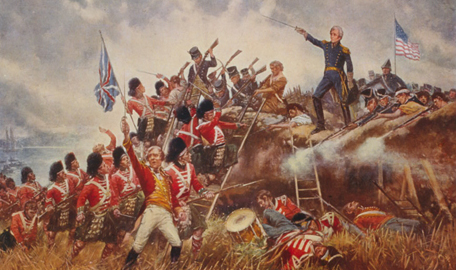
Andrew Jackson at the Battle of New Orleans
The War of 1812 was a conflict between the fairly new nation called the United States of America, and on the other side the United Kingdom of Great Britain and Ireland and its North American colonies in Canada.
The war began in 1812 and ended in 1815. Over 1,600 British and 2,260 American soldiers, marines, and sailors perished in this war on both land and on the ocean. While at war with the United States, Britain was also fighting against France and her allies in Europe.
Due to their war with France, the British sought to restrict American trade with France, and imposed a set of restrictions which the U.S. considered illegal under international law. The U.S. declared war on Britain on July 18, 1812 after years of enduring British restrictions and attacks on American shipping, the forcible impressment of thousands of American sailors into service with the British navy, increasing anger at British restraints on American trade with France and other European nations, and frustration at continuing British military support for Native Americans fighting against the expanding United States.
Also fueling the desire for war with Britain was a feeling that Britain never truly gave up thinking of America as a "lost" colony that should be punished. Many pro-war American saw a new war with Britain as a reaffirmation of American independence; in fact, the war became known as the Second War of Independence.
When war was declared by the United States in the summer of 1812, the American military was woefully unprepared for conflict with the world's most powerful empire. Even though the British were engaged in a life and death struggle with Napoleon's France, troops were sent to reinforce British Canada and to battle the Americans.
The war that developed was a repeat of the American desire to invade and absorb Canada. Just as in the American Revolutionary War, British and Canadian forces beat back an American invasion. Modern Canadians trace the first true inkling of their nationhood to this war and the Canadian contribution to their own defense.
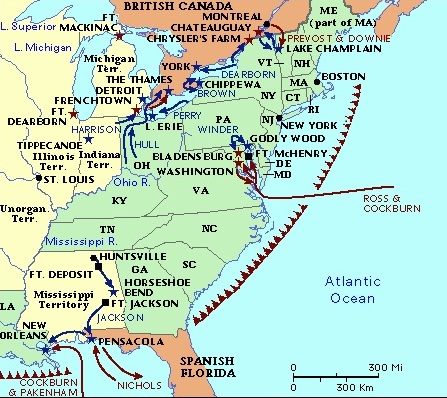 War
of 1812 Map
War
of 1812 MapAs with many aspects of politics and public policy, this new war with Britain was popular in some regions of the United States, and vastly unpopular in others. However, the British Burning of Washington on August 24, 1814, in which the White House and the Capital Building were burned by invading British troops, enraged all sections of the country in enmity towards the British.
Ironically, while many of the battles of the War of 1812 resulted in American defeat and humiliation, the greatest American victory on land came at the Battle of New Orleans, in 1815, which actually took place after the signing of the Treaty of Ghent, which would end the war. The American victory at New Orleans produced a national hero in General Andrew Jackson, which would help propel him into the (rebuilt) White House in later years.
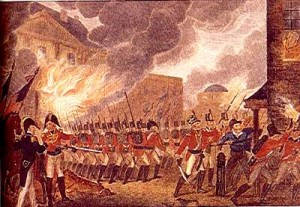
The Burning of the White House and the Capital in Washington, D.C.
Who won the War of 1812?
Basically, the War of 1812 ended in a draw. Per the Treaty of Ghent, which ended the war, neither the U.S., nor Britain lost or gained any territory. The only real change was that American fishermen gained the right to fish in the Gulf of Saint Lawrence.
However, perception is often taken for reality. In the U.S., the war was seen as a victory due to the belief that the mighty British Empire had been held off. While the issue of the impressment of American sailors by the British was not dealt with in the treaty, the British no longer employed that recruitment tactic after the war.
In Canada, the war was also seen as a victory, as the American invasion had been held off, and this conflict is seen in Canada as a major milestone in Canadian national development. The British view was basically that this pesky sidenote to the world war against Napoleon was finally over, and it had not adversely affected the outcome of their much more important war with France.
The real losers of this war were the Native Americans, whose lands were now more firmly in U.S. hands, and who could no longer rely on British aid against the Americans.