The Wars of Iraq
Thus, Iraq became a nation with three large demographic groups; the Sunni Kurds in the north, the Sunni (Sunna) Arabs in the middle of the country, and the Shiite (Shia) Arabs in the south. The Kurds wanted a nation of their own, as did the Kurds living in neighboring Turkey and Iran. Though the British eventually granted full independence to Iraq, it was not without much bloodshed and hard feelings in Iraq about the long occupation.
Below is a list, with some details, on the wars and conflicts of Iraq, from the First World War the current conflict with the Islamic State (ISIS/ISIL) and conflicts involving U.S. troops in Iraq.
World War One—1914-1918 -Also known as the Great War, this conflict brought about the end of the Turkish Ottoman Empire, which aligned itself with the German-led Central Powers. The Turks fought largely against the British Empire forces mostly in Ottoman Palestine, and Ottoman Mesopotamia, and the Russian Empire in the Caucasus region and neighboring Iran. In November, 1914, British forces landed at Basra, in what is now southern Iraq. Despite a serious British defeat at al-Kut in 1916, Baghdad fell to the British army in March, 1917. By November, 1918, the British had gained control over most of the Ottoman vilayets (provinces) that formed Iraq.
The Great Iraqi Revolution (known in Iraq as Ath Thawra al Iraqiyya al Kubra and by the British as the Arab Revolt of 1920)—May 1920-Feb. 1921-Rebellion by Iraqi Arabs against the rule of the British Mandate. The rebellion was suppressed by the British military. This can be considered the First Anglo-Iraqi War.
The immediate causes of this conflict arose out of the results of the British conquest of the Mesopotamian region from the Ottoman Turks during World War I. Following that war, the British established, with League of Nations approval, a colonial-style Mandate over the region now named “Iraq.” Many Iraqi nationalists, who believed independence would result from the ejection of the Turks, were severely disappointed with the establishment of the British Mandate. Other, related events and issues also inflamed Iraqi Arab opinion against the British. The Mandate government almost completely excluded Iraqis, as the British imported experienced civil servants from India (also ruled by Britain) to help administer the country. In northern Iraq, the British allowed thousands of Christian refugees escaping persecution in Turkey to settle in mostly Muslim Iraq.
Kurdish Revolt—1922-1924 -Rebellion by Iraqi Kurds against the British Mandate. Kurdish tribesmen, led by Sheik Mahmud, a powerful Kurdish leader, attempted to establish an independent Kurdish nation. British forces, primarily using airpower, suppressed the rebellion. This turned out to be the first of many Kurdish rebellions against the British Mandate and later, against the Iraqi government. As with many of the later Kurdish uprisings, the rebels were put down with some aid from rival Kurds.
It should be noted that many similar and often related Kurdish uprisings took place in neighboring Turkey and Iran. Government forces always succeeded in defeating the rebels in Iraq, Turkey and Iran. Though Kurds in Iraq and Iran did enjoy some successes, they almost always came with the aid of foreign nations. When the foreign aid eventually is withdrawn, the Kurds’ success, historically, also fades away.
Assyrian “Revolt” and Massacre— August, 1933— The Iraqi military, using a supposed revolt as an excuse, massacre at least 600 Iraqi Assyrian Christians.
Shia Tribal Revolt–1935–Shiite uprising against the Iraqi government.
Anglo-Iraqi War of 1941 (Rashid Ali Coup)–During World War Two, Iraqi politician Rashid Ali seized power in Iraq and aligned himself with the German-led Axis Powers. British forces invaded Iraq and quickly defeated the Iraqi military.
Kurdish Revolt—1943 (July to October)–Rebellion suppressed by the Iraqi Army and the British RAF. Led by Mullah Mustafa Barzani.
Kurdish Revolt-–1945 (August 10 to October)–Rebellion suppressed by the Iraqi Army and the British RAF. Led by Mullah Mustafa Barzani, who escaped into Iran after breaking through an Iraqi Army force. Once in Iran, Mustafa Barzani and his forces joined the army of the new “Mahabad Republic,” the first independent, though in this case, (short-lived) Kurdish state. After Mahabad’s crushing by the Iranian Army, Barzani led his forces back into Iraq on April 28, 1947.
Kurdish Campaign —1947 (May 27 to June 15)– After returning to Iraq from the failed Mahabad Republic, Iraqi government actions (arrests, executions, etc.) caused Mustafa Barzani and 496 followers to begin a fighting retreat from the Barzan region in northern Iraq through Turkey and into Iran in an attempt to reach the Soviet Union. They reached the U.S.S.R. on June 15, 1947, followed by the Iranian Army. (O’Ballance, 1973).
al-Wathbah Uprising– (Jan. to May, 1948) — Anti government uprising led by Iraqi leftists. This revolt was sparked by the Treaty of Portsmouth, in which Iraq agreed to let Britain keep military bases in Iraq and maintain continued influence in Iraqi foreign affairs. The imposition of martial law in May, 1948 allowed the government to crush the rebellion, just in time for the Iraqi army to travel to Palestine for the First Arab-Israeli War.
First Arab-Israeli War –1948-1949-Israel declared independence from the British Mandate Authority on May 1, 1948, and is subsequently invaded by the armies of Egypt, Syria, Lebanon, Transjordan, Iraq, and Saudi Arabia. This is actually a continuation of the violence between Jewish (Israeli) militias and Palestinian Arab militias in the leadup to the British withdrawal. The war concludes on July 20, 1949 with the last Israeli armistice with the Arab nations. A legal state of war continued to exist, despite the temporary end of conventional combat. A legal state of war between Iraq and Israel continues to this day.
Army Revolt/Coup– July 14, 1958–Brigadier General Abdul Karim el Qassim overthrows the royal government of King Faisal II. Both the king and Prime Minister Nouri al Said are killed. Qassim soon withdrew Iraq from the pro-Western Baghdad Pact and established friendly relations with the Soviet Union.
Mosul Revolt—March, 1959–Pro-Qassim Communist militia , called the People’s Resistance Force, violently suppressed an anti-Qassim Sunni Army faction made up mostly of junior officers.
Kirkuk Violence–1959—Pro-Qassim (pro-Communist) Kurds and People’s Resistance Force killed ethnic Turkomen in Kirkuk.
Kurdish Revolt—1961-1970 –After a period of relative calm, Iraqi government promises of Kurdish autonomy, or self-rule, went unfulfilled, sparking discontent and eventual rebellion among the Kurds in 1961. Mullah Mustafa Barzani is again a leader of the Kurdish forces. Beginning in 1963, Syrian Army and Air Force units aid the Iraqi military in fighting against the Kurds. A cease-fire in 1964, lasting until April of 1965, can be seen as a dividing point between two separate conflicts, though this web site interprets this rebellion as one continuous conflict. This prolonged period of Kurdish-Iraqi fighting ends in 1970 with a cease-fire and a government guarantee of Kurdish autonomy.
Six-Day War (3rd Arab-Israeli War) 1967–Israel launched a pre-emptive attack on Egypt, Jordan, and Syria, fearing they were preparing to launch their own attack. The Israeli air force also attacked Iraqi airfields. Iraq sent ground forces to support the Jordanians and the Syrians.
Ramadan (Yom Kipper) War –1973-1974 -Egypt and Syria launched a surprise attack on Israel during the Jewish Yom Kippur holiday. The attack also fell on the Muslim holiday of Ramadan. Iraq sent army and air forces to support Syria.
Kurdish Revolt –March, 1974 -–In March, 1974, Kurdish rebels led by Mullah Mustafa Barzani (having survived an assassination attempt) rebelled against the government. The Kurds felt that the government was not living up to the agreement which ended the previous revolt. The Iraqi Kurds were supported by the Shah (King) of neighboring Iran, who sought to put pressure on the Iraqi government over a border dispute. The Kurds were also assisted by the American Central Intelligence Agency (CIA), who opposed the Iraqi government due to its friendly relations with the Soviet Union. After an agreement between the Shah of Iran and Iraqi leader Saddam Hussein in 1975, (which temporarily settled the border dispute until the Iran-Iraq War began in 1980), the Kurds collapsed under intense Iraqi military pressure. The CIA, allied to the Shah, also suspended aid. Kurds cite this betrayal by two key allies as evidence supporting their future distrust of American attempts to incite them to fight Saddam Hussein’s forces in the 1990s and in the early years of the 21st Century.
Intra-Kurdish warfare 1978-1979 –In 1975, Jalal Talabani formed the Patriotic Union of Kurdistan (PUK)-urban-based and leftist) in opposition the Barzani-led Kurdish Democratic Party (KDP).
Shia unrest in Karbala –February, 1979–Suppressed by the Saddam regime. Under Saddam Hussein, the Shiites (Shia) were a persecuted religious group, both despite the fact, and because of, their numerical majority in the country.
The First Persian Gulf War (also known as the Iran-Iraq War)—1980-1988 – In 1975, Iraq and Iran came to an agreement on the disputed Shatt al-Arab waterway which provides Iraq’s only outlet to the sea. In exchange for Iran stopping support for Kurdish rebels, Iraq agreed to share the Shatt al-Arab with Iran. This and other disputes over their common border, plus the belief that the 1979 revolution had weakened Iran, led Iraqi leader Saddam Hussein to launch an invasion of Iran on September 22, 1980. After initial successes, the Iraqi army ground to a halt and soon retreated under repeated assaults by the numerically larger Iranian Army and Revolutionary Guards. After the Iranians pushed the war into Iraq, Saddam’s forces began using chemical weapons. By 1988, both nations faced exhaustion and, after nearly a million casualties between them, agreed to end the conflict.
Osiraq Reactor Raid—June 7, 1981 –Fearing the consequences of a successful Iraqi nuclear weapons program, Israel launched a pre-emptive air strike on the Osiraq nuclear reactor (under construction) in June, 1981. One of the pilots (the youngest) in that raid was Ilan Ramon, who later became Israel’s first astronaut, and who died in the Space Shuttle Columbia tragedy on February 1, 2003.
Kurdish Revolt—1983-1988 –During the Iran-Iraq War (1980-1988), Iraqi Kurds, aided by Iran, fought against Iraqi government forces. In 1987 and 1988, the Iraqi military used chemical weapons to kill thousands of Kurds (including many civilians) in a successful effort to break the back of the resistance.
Iraq-Kuwait Relations
1961– Iraq threatens Kuwait, claiming that it belonged to Iraq because of old Ottoman territorial claims. The British supported Kuwait by sending military forces to Kuwait. Saddam Hussein used similar excuses for his 1991 invasion of Kuwait.
1973 (March)– Iraq occupies as Samitah, a border post on Kuwait-Iraq border. Dispute began when Iraq demanded the right to occupy the Kuwaiti islands of Bubiyan and Warbah. Saudi and the Arab League convinced Iraq to withdraw.
The Second Persian Gulf War (known in the U.S. as “Operation Desert Storm”—Aug. 2, 1990-Feb. 1991 – On August 2, 1990, Iraqi forces invaded and quickly conquered the small, oil-rich emirate of Kuwait. Almost immediately, an international coalition of nations gathered a powerful military force under the authority of the United Nations and the leadership of the United States, first to defend the United States, first to defend the oil-rich kingdom of Saudi Arabia, and secondly, to force Iraq to withdraw from occupied Kuwait. From the beginning of the crisis, the United Kingdom, led by Prime Minister Margaret Thatcher, worked very closely with the U.S. in assuming a determined posture against Saddam Hussein’s territorial ambition.
Kurdish Revolt—1991 –Encouraged by the stunning defeat of Saddam’s forces in Kuwait and spurred by appeals by President George H. W. Bush of the U.S., Kurds rose up against the Iraqi government With the bulk of his elite forces having escaped from the fighting in Kuwait and southern Iraq, Saddam was able to quell the revolt, causing hundreds of thousands of Kurdish refugees to flee into neighboring Turkey and Iran to escape.
Shiite Revolt—1991 – Encouraged by the stunning defeat of Saddam’s forces in Kuwait and spurred by appeals by President George H. W. Bush of the U.S., the Shiites of southern Iraq rose up against the Iraqi government, only to be crushed by Saddam’s forces. Sporadic guerrilla resistance continued, with the bulk of the Shiite fighting forces seeking refuge in neighboring Shiite Iran.
The “No-Fly Zone War” –1991-2003–Following the cease-fire ending the Gulf War, the Allies, (U.S., U.K., and France) had the right to conduct air patrols over parts of Iraq to ensure Iraqi compliance with the cease-fire terms. France soon left the Coalition, but U.S. and British planes continued to patrol Iraqi skies, often drawing anti-aircraft fire from the ground. Several major bombing campaigns were launched to punish the Baghdad regime. This conflict officially ended when the Third Gulf War began in March, 2003.
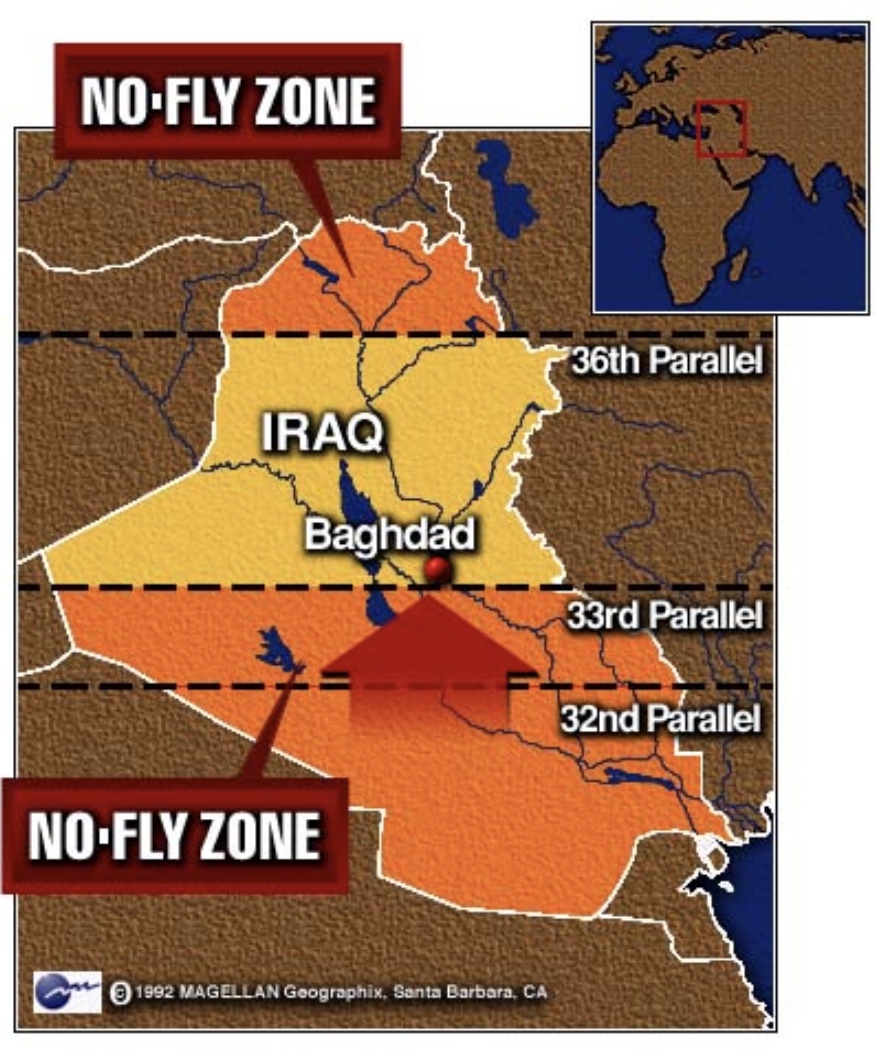
No-Fly Zone War Map
Intra-Kurdish warfare –1996 – Combat between various Kurdish militias.
The Third Persian Gulf War (known in the U.S. as “Operation Iraqi Freedom”)—March 19, 2003- 2011 The current war can be seen in at least two distinct phases: The Invasion and the Occupation. Though Saddam’s regime fell fairly quickly, the insurgency was able to gain strength in large part because the U.S. and Coalition leadership was slow to recognize that they had a nascent guerrilla movement underfoot. Though the Iraqi people have voted, and now have an elected government (featuring a Kurdish president!), the situation is now changing from a war against the occupier, to becoming more of a civil war among Iraqis.
Iraq Civil War (2006-2008)
A confused and complex conflict that pitted the new, sovereign Iraqi government of Prime Minister Nouri al-Maliki. While the first years of this conflict is also a part of the Iraqi Insurgency against the American and Coalition occupation, it was also a rejection of the Shia-dominated al-Maliki government. While the Iraqi government and allied groups have remained in power, a variety of different rebel groups, militias, and foreign-influenced factions have battled the government’s armed forces, and at times, each other.
In the summer of 2014, one of the Sunni Jihadist groups, known by the acronym, ISIL or ISIS, (the literal English translation of the group’s Arabic name is Islamic State of Iraq and al-Sham. Al-Sham is the Arabic term for the region encompassing modern Syria, Lebanon, Jordan, and Palestine/Israel. To Westerners, this al-Sham region translates to the historical term “Levant,” thus the Western acronym is ISIL), seized huge swaths of northern and western Iraq, including the cities of Mosul, Fallujah, and Tikrit, and threatened to march on Baghdad. ISIL is also actively combating the Assad regime in Syria, and by the time of their successes in Iraq, ISIL also controlled large areas of northern and eastern Syria. On June 29, 2014, ISIL changed its name to The Islamic State, declaring a new Caliphate in the Muslim world.
In response, the United States, Iran, and Russia all provided material assistance to the Iraqi government, with the U.S. sending several hundred military advisors, and Iran providing combat troops to help stop the Islamic State onslaught. By 2017, Mosul was liberated from ISIS, and most ISIS-held Iraqi territories were recaptured by Iraqi and Coalition forces. In 2019, U.S. forces killed the ISIS leader, al-Baghadi in Syria. Combat and airstrikes against ISIS forces continued into 2019 in both Iraq and Syria, as ISIS fighters reverted to classic guerrilla tactics, rather than the more conventional tactics of seizing and holding territory. Operations against ISIS in Iraq halted due to the Iran-U.S. Crisis in Iraq that broke out in late 2019 and early 2020.
Iraq Anti-Government and Anti-Iran Protests (2019-2020)-Street protests against government corruption and against the strong influence of Iran in Iraqi government affairs. Repression of the protests resulted in hundreds of deaths.
U.S.-Iran Crisis in Iraq (2019-2020)
In December, 2019, an Iraqi Shiite militia (Kata’ib Hezbollah) that is part of the state-sponsered militia organization called Popular Mobilization Forces, launched a rocket attack on a base used by American and Coalition forces, killing one American, and wounding several others. In response, the U.S. attacked five bases belonging to this particular militia, and also pointed out that Kata’ib Hezbollah professes loyalty to Iran’s supreme leader (a Shiite cleric) and is heavily influenced by the Iranian Revolutionary Guards.
Following the U.S. response, Kata’ib Hezbollah and other Shiite militias stormed the U.S. embassy in Baghdad, and occupied parts of the large embassy complex for two days.
On January 2, 2020, the U.S. assassinated the Iranian leader of Iran’s Quds Force, along with leaders of Kata’ib Hezbollah in a drone attack near the Baghdad Airport. Iran then retaliated with missile attacks on U.S. forces at two Iraqi military bases that resulted in over a hundred U.S. wounded (primarily concussions).
Shiite Militia Conflict with the U.S. (2019-Present)-Various Shiite militia armies, closely allied to, and largely directed by Iran, engage in sporadic rocket and drone attacks on U.S. and coalition forces in Iraq and Syria. U.S. retaliatory strikes occur frequently.
Israel-Hamas War/Shiite Militia Conflict with the U.S. (2023-Present)-From October 17, 2023 onward, attacks by Kata’ib Hezbollah and allied militias increased dramatically in support of Hamas. The U.S. is the primary supplier of military aid to Israel in the Israel-Hamas War, which began on Oct. 7, 2023. The U.S. has stepped up retaliatory strikes on militia bases in both Iraq and Syria.
SOURCES
Iraq: A Country Study Helen Chapin Metz, Federal Research Division, Library of Congress. 1990, U.S. Government Printing Office.
firstworldwar.com–capture of Basra
Uprisings and betrayals: a brief history of the left in Iraq–By Felix Zorba and Roberto Sarti —
Copyright © 1998-2023 History Guy Media; Last Modified: 12.26.23