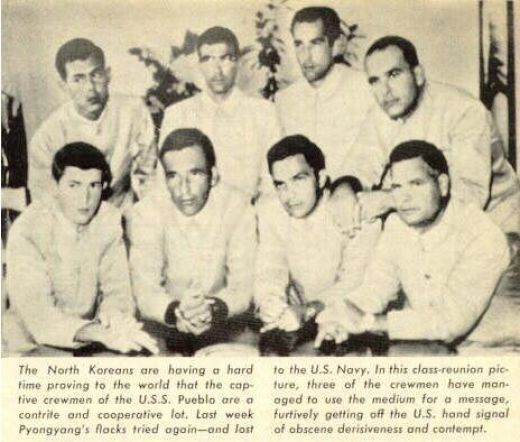
Crew of the USS Pueblo in a North Korean Propagana Photo Giving the Finger to the North Koreans
From 1950 to 1953, the United States (and other allied nations under United Nations command), fought to defend South Korea from North Korea (and their allies, China and the Soviet Union), in a conflict known as the Korean War. The major combat ended with the signing of an armistice (a type of truce) in July, 1953. Technically the war between North and South Korea never ended, it just went into a sort of time-out. The hostility between the two nations has erupted over the decades into a long series of border battles along the Korean border, which is called the DMZ (De-Militarized Zone). South Korean and American troops patrolled the DMZ to ward off North Korean probes and attacks.
Below is a list of those attacks and battles that involved American military forces. Included in this list is a largely forgotten American war called the DMZ War, waged from 1966 to 1969 (at the same time as the much larger and more well-known Vietnam War), in which American and South Korean forces fought frequent firefights against the aggressive North Koreans.
As the U.S. and the world deal with the ongoing nuclear threats from North Korea in the 21st Century, it is worth looking at the long history of U.S.-North Korean military conflicts spanning several decades and several generations of American military forces engaged in combat with North Korea.
Military Conflicts Between the United States and North Korea Since the Korean War:
April 27, 1965: Two North Korean MiG-17s attack a U.S. Air Force RB-47 Stratojet reconnaissance plane above the Sea of Japan, in international waters, some 50 miles from the North Korean coast. The American plane was damaged, but managed to land at Yokota Air Base, Japan.
DMZ War: October 1966–October 1969: The Korean DMZ Conflict, a series of skirmishes along the DMZ, results in 43 American, 299 South Korean and 397 North Korean soldiers killed. North Korea initiated a war of attrition on American and South Korean forces in the Demilitarized Zone separating North and South Korea. This conflict came in conjunction with the increasing American involvement in Vietnam, North Korea believed that an unconventional conflict could cause the U.S. to lessen its commitment to South Korea and pave the way for a communist insurgency in the South.
North Korea Captures the USS Pueblo: On January 23, 1968, the U.S. Navy ship USS Pueblo was attacked by North Korean ships. The North Koreans fired on the Pueblo and chased the ship, finally forcing the American vessel to stop and be boarded. The ship and its crew were taken the the North Korean port of Wonson, where the 83-man crew were offloaded and held by North Korea until Dec. 23, 1968. At the time of the attack the U.S. was heavily engaged in the Vietnam War, in particular, the Tet Offensive of 1968, while at the same time, engaged in the ongoing violence along the Korean DMZ. The North Koreans regularly beat, starved, and tortured the American crew of the Pueblo. Made to pose for propaganda photos, the crew creatively mangaged to rebel against their captors by "flipping off" the North Koreans in these photos. The Americans told the North Koreans that the middle finger salute was a Hawaiian gesture of good luck. When the North Koreans finally realized they were being fooled by their prisoners, the crew suffered more torture. After months of negotiations, the United States government confirmed that the ship was on a spying mission and surviving crew were released on Dec. 23, 1968. One crew member was killed in the attack, and several others wounded.
Crew of the USS Pueblo in a North Korean Propagana Photo Giving the Finger to the North Koreans
The attack on the USS Pueblo occurred only three days after North Korean commandos attacked the South Korean presidential mansion (the Blue House). This was a time of great tension and violence between the Koreas.
North Korea Shoots Down American Plane: On April 15,1969, a U.S. Lockheed EC-121M Warning Star reconnaissance plane was shot down off the North Korean coast, killing 31 Americans. The U.S. government (the Nixon Adminstration), seriously considered a military attack of some sort as retaliation, but eventually settled for a naval demonstration off the North Korean coast and a resumption of the reconnaissance missions. The U.S. was still heavily involved in the Vietnam War, and, as today, the North Koreans could easily destroy the South Korean capital of Seoul with the thousands of artillery batteries they have along the border.
DMZ Axe Murders: On Aug. 18, 1976, two U.S. officers cutting down a tree in the DMZ were killed with axes by North Korean troops. North Korean troops killed two United States Army officers, Captain Arthur Bonifas and First Lieutenant Mark Barrett, and wounded four other American troops on August 18, 1976, in the Joint Security Area (JSA) located in the Korean Demilitarized Zone (DMZ). Four South Korean soldiers were killed and several other South Korean and American troops were wounded in the attack. The American and South Korean workers were tasked with trimming a tree that partially blocked the view from a UN command post. North Korean troops at first harassed the tree-trimming party, and then attacked with axes.
Again the U.S. considered various options. Secretary of State Henry Kissinger argued for a bombing campaign against North Korea, but Presdent Ford opted for a show of force rather than a violent response. Three days after the attack, Operation Paul Bunyan was launched. In this operation, 110 troops, 64 of whom were South Korean tae kwon do experts, surrounded the offending tree while army engineer cut it down with chainsaws. Also involved in the operation were thousands more troops behind the lines and 27 helicopters flying nearby, and, over the horizon, three B-52 bombers, each capable of carrying nuclear weapons. When the North Koreans responded by sending several hundred troops to the scene, the bombers flew close enough to be visible. Shots were fired at the helicopters, but none of the American aircraft were hit.
North Korean Tunnels: November,1974: The first North Korean infiltration tunnel into ROK is discovered. The joint South Korean-U.S. investigation team ran into a North Korean booby-trap, killing one American and wounding 6 others. Several other tunnels were discovered in later years. These tunnels were designed to facilitate the movement of thousands of North Korean troops into South Korea in the event of war.
Shootdown of U.S. Helicopter: On July 14, 1977, a U.S. Army CH-47 Chinook helicopter was shot down after accidentally flying across the DMZ into North Korea. Three U.S. troops werekilled and one was briefly held prisoner before being released.
DMZ Minefield Incident: On December 6, 1979, a U.S. Army patrol in the DMZ accidentally crosses into a North Korean minefield in heavy fog. One American soldier is killed and four are wounded. The body of the dead soldier is turned over by the North Koreans five days later.
DMZ Firefight: In May, 1980, North Korean troops engage a joint U.S.-South Korean base called Outpost Ouillette at the DMZ in a firefight. One North Korean is known to have been wounded.
DMZ Firefight: In November 1987, an American soldier and two North Korean soldiers are killed, and one American soldier is wounded during a firefight that erupted when a North Korean security detail confronted a sniper detail in the DMZ into the southern-controlled sector of the Joint Security Area.
Shootdown of U.S. Helicopter: On December 17, 1994, a U.S. Army OH-58A Kiowa helicopter inadvertently crosses about 4 miles into North Korean territory and is shot down. Of the crew of two, one dies and the other is held for 13 days. Again, the U.S. considers various retaliatory options, but the threat of a wider conflict and the ongoing threat to Seoul leaves the Clinton Administratin few military options.
Aircraft Intercept: On March 2, 2003: Four North Korean fighter jets intercept a US reconnaissance plane over the Sea of Japan. No shots are fired.
"The History Guy" is a Registered Trademark