|
 World
Biography: Home World
Biography: Home
Academia
Politics
-American
Politics-Middle
East
Business
and Economics
Religion
and Faith
Legal
Terrorists
and Dictators
Military-American
Science
and Technology
Women
Presidents
and Leaders
Wars
and Conflicts
Media
and Communications
Actors
and Actresses
Writers
Education
Comics
Industry
Movies
and Television
Book
Links
Crime
and Criminals
Politics-Europe
Politics-Asia
Politics-Canada
Politics-Latin
America
Politics-Africa
Politics-Australia
and Oceana
Environment
Health
and Medicine
Activists
Inventors
Music
and Art
Historians
Sports
and Athletics
|
Michael Layne Turner (April
21, 1971-June 27, 2008), was an American comic book artist
best known for creating the graphically beautiful and
alluring female characters, Witchblade and
Fathom, which were both published by Top Cow
comics. Turner also worked on DC comics titles The
Flash , Identity Crisis, Supergirl, and
Superman/Batman, and various Marvel comics
titles. Michael Turner founded and owned the
comic entertainment company Aspen MLT. Turner died of
complications from bone cancer in a hospital in Santa
Monica, California. More
Micheal Turner Art here...
Courtesy
of Aspen MLT
Michael
Turner
Courtesy
of Aspen MLT
Michael Layne Turner (April 21,
1971-June 27, 2008), was an American comic book artist best
known for creating the graphically beautiful and alluring
female characters, Witchblade and Fathom,
which were both published by Top Cow comics. Turner
also worked on DC comics titles The Flash , Identity
Crisis, Supergirl, and Superman/Batman, and
various Marvel comics titles. Michael Turner
founded and owned the comic entertainment company Aspen
MLT. Turner died of complications from bone cancer in
a hospital in Santa Monica, California.
Family, Career,
and Personal Highlights
Spouse:
single, though he was engaged to Kelly
Carmichael
Children:
none
Mother:
Grace Crick
Siblings:
Jake Turner
Place of
Birth:
Crossville,
Tennessee
Education
College:
University of Tennessee
Professional
Career
1994: Top Cow
comics (artist)
Bibliography
Top Cow Comics
Covers
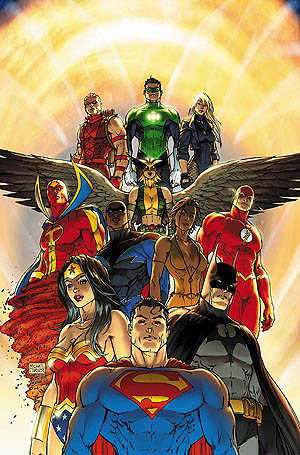 Variant
incentive cover for Justice
League of America #12. Variant
incentive cover for Justice
League of America #12.
DC Comics
- Teen
Titans #1 variant cover (DC Comics, July/2003).
Two covers were published for this issue in a 50/50
split. The Turner cover was also later used for the first
trade paperback of the series.
- Action
Comics #812-813, Adventures
of Superman #625-626 & Superman
#202-203 (DC Comics, January-February/2004). 6-part story
arc "Godfall" running for two months in the three main
series of Superman, with covers and script (co-written
with Joe Kelly) of Turner. The art (pencils, inks and
colors) of the six issues were handled by other artists
of Aspen MLT.
- Superman
#205 (DC Comics, 2004). Variant cover for the second
issue of the For
Tomorrow story arc in this series. Jim
Lee, the story's artist, also drew one variant cover
for an issue of the Turner story arc in Superman/Batman
(in addition to his duties as regular artist for the
Supergirl story).
- Identity
Crisis #1-7 (DC Comics, 2004). Turner drew all
covers for this series.
- The
Flash #207-211 (DC Comics, 2004). Turner drew
five covers for this series written by Geoff Johns, who
also works in a creator-owned project with him, the
series Ekos.
- Wildstorm
Winter Special (DC/Wildstorm, November/2004). Cover
with the characters Zealot, Apollo, Midnighter, Jack
Hawksmoor and Deathblow.
- Supergirl
(DC Comics, 2005). Turner drew variant covers for the
first issue of this new series, featuring the Kara
Zor-El Supergirl's return to continuity in his
Superman/Batman story arc.
- Justice
League of America #0-12 (DC Comics, 2006-2007).
Turner drew various covers, shifting between regular and
variants, for the first thirteen issues of the
series.
- Superman/Batman
#8-13,26 (DC Comics, 2004/2006). Turner drew a first and
second print for #8 as well as a variant for #8. He drew
one of two covers for #10, the other being drawn by Jim
Lee. He drew two covers for #13. He drew both covers for
#26, the issue dedicated to the passing of Jeph
Loeb's son Sam.
Marvel Comics
- Wolverine:
Origins #1 variant cover (Marvel Comics, 2006). The
"regular" cover of this issue was done by Joe
Quesada.
- Civil
War #1-7 (Marvel Comics, 2006-2007). Each issue
of the miniseries has three covers, one "regular cover"
by series penciller Steve
McNiven, one "variant cover" by Turner, and one
"sketch variant cover" by Turner.
- Civil
War #1 "Aspen Comics exclusive variant cover"
(Marvel Comics 2006). Turner also did another cover
featuring Iron Man, Captain America, and Wolverine
printed as an Aspen Exclusive Variant, much like
Civil War: X-Men #1.
- Black
Panther #18, & Ms. Marvel #1
(Marvel, 2006). Turner drew variant covers for these two
comic-books, that had both regular covers drawn by Frank
Cho.
- Ultimate
X-Men #75 (Marvel Comics, 2006) To introduce
Ultimate Cable in 2006, Marvel commissioned
Turner to to the cover for the first book of the story
line.
- Incredible
Hulk #100 (Marvel Comics, 2006) Turner drew a
"green hulk" variant as well as a "gray hulk" variant for
this issue.
- Onslaught
Reborn #1 (Marvel Comics, 2006) Turner drew a "B"
cover with Rob Liefeld drawing the "A" cover for this
issue.
- Black
Panther #23 (Marvel Comics, 2006) Currently
Turner worked on covers for the Black Panther
tie in to the Civil War, starting with #23
- Fallen
Son: The Death of Captain America #1-5 (Marvel
Comics, 2007) Turner drew the variant covers for this
entire series in a 50/50 split with the various artists
of the individual issues.
- Ultimate
Wolverine Turner was set to pencil the covers
and interior art for this series, written by Jeph
Loeb
- Sub-Mariner
#1 and #5 Turner draws the regular cover for these
issues.
- World
War Hulk Turner drew an Aspen Comics exclusive
variant cover for the first issue available at
AspenComics.com
- Hulk
#1 (Marvel Comics, 2008) Turner drew a "RED" variant
cover for the first issue that was only available to
advance ticket holders of Wizard Magazine's 2008 Wizard
World Comic Convention in Los Angeles, CA.
- Uncanny
X-Men #500 (Marvel Comics, 2008) With Greg
Land and Alex
Ross providing 50/50 variants, Turner drew a chase
variant cover featuring some of the most notable male
members of the mutant team for this milestone issue,
while Terry
Dodson utilized female members for his
variant.[3]
Links and Resources:
Aspen MLT,
Inc
Top Cow Productions, Inc.
Wikipedia Article on Micheal Turner
New
York Times Obit on Michael Turner
Michael Turner, a
popular comic-book artist who came to fame in the
mid-1990s and was best known for creating two sexy female
lead characters, Witchblade and Fathom, died on June 27
in Santa Monica, Calif. He was 37.
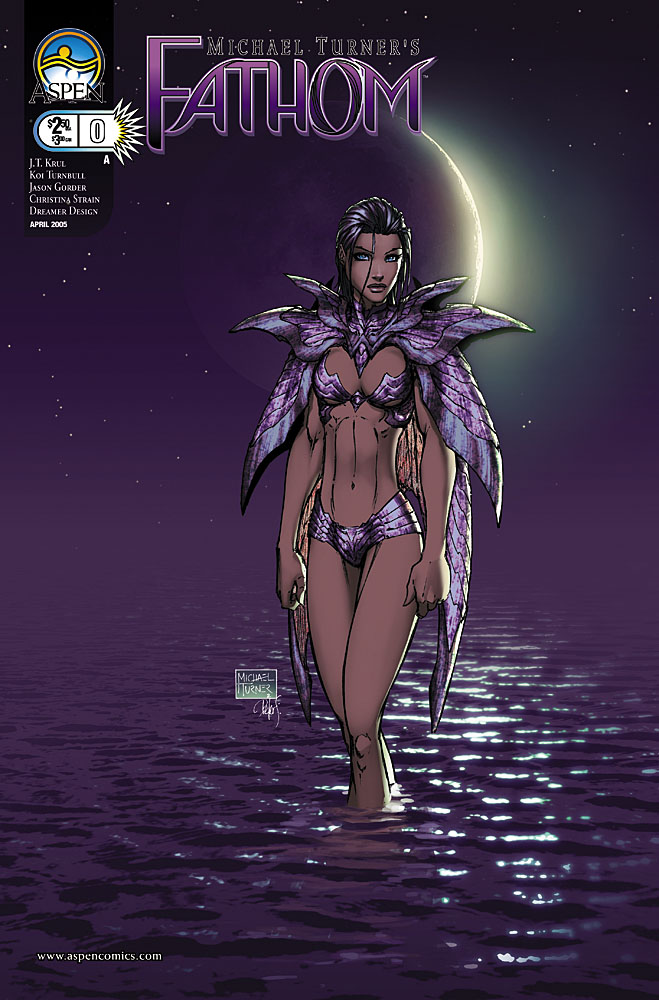
A cover of the comic book Fathom drawn
by Michael Turner. The superheroine, who possesses
water-based powers, is one of Mr. Turner’s most
popular character.
The cause was
complications from treatment for bone cancer, his
colleague Vince Hernandez said in a statement.
Armed with only a
hastily assembled five-page sample of his work, Mr.
Turner was discovered at a comic-book convention in 1993
by Marc Silvestri, one of seven artists who founded Image
Comics in 1992. Within months, Mr. Turner went from
waiting tables to being a top-selling artist.
Mr. Turner, along with
Mr. Silvestri and a few others, soon created his
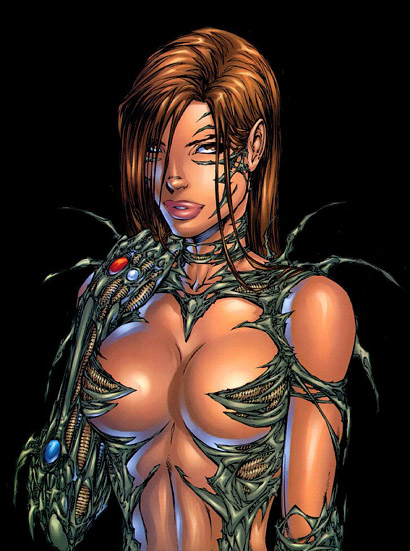
best-known character, Witchblade, named after a
supernatural weapon that affixed itself to the arm of
Sara Pezzini, a homicide detective in New York; the
transformation left her provocatively clad, armed and
dangerous.
The novelist and
part-time comic-book writer Brad Meltzer, in a special
edition of the comics-industry magazine Wizard that was
devoted to Mr. Turner before he died, said: “Anyone
who says they didn’t become aware of Mike when they
saw one of his hot girl drawings is a liar. That’s
when he hit the radar.”
Witchblade first
appeared in comic books in 1995 and became the basis of a
live-action series on the cable channel TNT in 2001. It
ran for about two seasons.
In 1998, Mr. Turner
created the aquatic Fathom, published by Top Cow
Productions. In her secret identity Fathom was a marine
biologist with a model’s looks named Aspen Matthews.
Two years later, Mr.
Turner learned he had a type of cancer called
chondrosarcoma in his right pelvis. He lost his hip, 40
percent of his pelvis and three pounds of bone and
underwent nine months of radiation therapy. He eventually
went into remission, only to have the cancer return
several times.
In 2002, Mr. Turner
founded Aspen MLT, an entertainment publishing company.
The L stood for Lane, his middle name, which he rarely
used. The company’s comics were delayed by a
yearlong legal battle with Top Cow regarding the rights
to Fathom and other properties. The case was settled out
of court the next year.
In 2004, Mr. Turner
began contributing work to DC and Marvel, the comics
industry giants. His cover art brought him particular
attention, including his illustrations for Identity
Crisis, a top-selling seven-part mystery written by Mr.
Meltzer, in which DC superheroes, including Superman,
Green Arrow and Hawkman, are forced to question their
culpability in a vengeful murder.
As with every cover
they worked on, “Mike and I spoke at length about
the design” of the final one for the project, Mr.
Meltzer wrote in an e-mail message. The cover presented
the characters as empty costumes, which ambiguously
represented either the end of the age of superheroes or a
rebirth.
Mr. Meltzer continued:
“The only thing we argued about, as only two geeks
can: whether Batman’s cowl should be flat and empty,
or stiff and armored. I lost. He won. And he was right.
But make no mistake, with Mike gone, the capes and cowls
are most certainly empty. His covers were the first thing
every reader saw. And he was the one true ‘big
name’ on the book. That’s why people picked it
up.”
Fans were important to
Mr. Turner. He was always appreciative of people who
stopped to say hello at conventions, and he signed
countless autographs, even when he was confined to a
wheelchair, Gareb Shamus, the publisher of Wizard, said.
Mr. Turner was born in
Crossville, Tenn., on April 21, 1971, and is survived by
his mother, Grace, and his brother, Jake.
In high school, Mr.
Turner took an art class, but he mostly drew for his own
amusement. In 1993, he was encouraged to put together a
sampling of his work and to attend the San Diego
Comic-Con, the nation’s largest comic convention. It
was there he met the staff of Top Cow.
“We gave him his
first shot,” Mr. Silvestri said. “That will
always be important: that we had a little something to do
with bringing Mike to the world of comics.”
One of the first tests
for the new artist was to draw a building. It looked
awful, “like a lump of bread,” Mr. Silvestri
recalled. Still, he found Mr. Turner so affable that they
tried again, this time with help from a reference book on
New York architecture. The results were remarkable.
“I did a double
take,” Mr. Silvestri said. “It was beautiful,
incredible. More than I would’ve possibly expected from
a seasoned professional. I asked him flat out, ‘Where
did this come from?’ He said, ‘No one ever told me
to look at a picture before.’ ”
|
|

