Historyguy.com
Anglo-Iraq
Wars:
Wars
and Conflicts Between Britain and Iraq
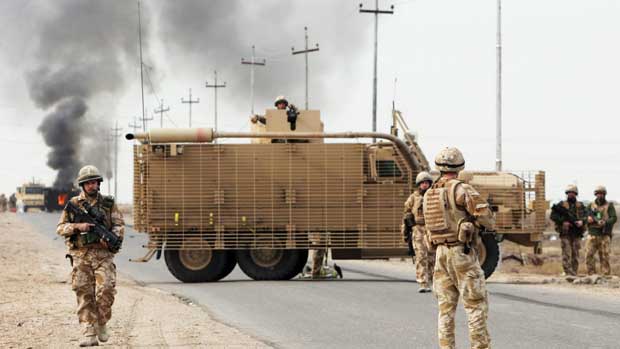
British Troops in Basra, Iraq in 2007
This page lists and explains the five wars fought between the United Kingdom and Iraq. The word "Anglo" refers to England, once known as "Angle Land," which is part of the island of Great Britain, which is the primary part of the United Kingdom.
1st Anglo-Iraq War: May 1920 to Feb. 1921
The Great Iraqi Revolution (known in Iraq as Ath Thawra al Iraqiyya al Kubra and by the British as the Arab Revolt of 1920-Rebellion by Iraqi Arabs against the rule of the British Mandate. The rebellion was suppressed by the British military. This can be considered the First Anglo-Iraqi War.
The immediate causes of this conflict arose out of the results of the British conquest of the Mesopotamian region from the Ottoman Turks during World War I. Following that war, the British established, with League of Nations approval, a colonial-style Mandate over the region now named “Iraq.” Many Iraqi nationalists, who believed independence would result from the ejection of the Turks, were severely disappointed with the establishment of the British Mandate. Other, related events and issues also inflamed Iraqi Arab opinion against the British. The Mandate government almost completely excluded Iraqis, as the British imported experienced civil servants from India (also ruled by Britain) to help administer the country. In northern Iraq, the British allowed thousands of Christian refugees escaping persecution in Turkey, to settle in mostly Muslim Iraq.
2nd Anglo-Iraq War: April 18, 1941 to May 30, 1941
The Anglo-Iraqi War of 1941, also known as the Rashid Ali Coup, was a relatively small, but very significant part of the Second World War. Since the ending of the British Mandate and the advent of full Iraqi independence in 1932, Britain retained a great deal of military influence in Iraq, despite lingering opposition from many Arab nationalists. One of these nationalists, Rashid Ali, seized power in Baghdad and refused British requests to allow British military forces to enter Iraq. Britain at this time was fighting German and Italian forces in North Africa and were preparing to invade Vichy French-held Syria. (The Vichy French were working with the Germans and British and Free French forces needed to secure the region). Believing promises of German support, Rashid Ali ordered his forces to attack British bases in western Iraq and to oppose the landing of British forces at the southern city of Basra. German support appeared in the form of a small number of Luftwaffe fighter planes, and the British forces quickly defeated the Iraqi military.
3rd Anglo-Iraq War: Aug. 2, 1990 to Feb. 1991
The Second Persian Gulf War (Also known as “Operation Desert Storm”)— On August 2, 1990, Iraqi forces invaded and quickly conquered the small, oil-rich emirate of Kuwait. Almost immediately, an international coalition of nations gathered a powerful military force under the authority of the United Nations and the leadership of the United States, first to defend the oil-rich kingdom of Saudi Arabia, and secondly, to force Iraq to withdraw from occupied Kuwait. From the beginning of the crisis, the United Kingdom, led by Prime Minister Margaret Thatcher, worked very closely with the U.S. in assuming a determined posture against Saddam Hussein's territorial ambition. Click on the blue link above for more detail on the war.
4th Anglo-Iraq War: 1991 to March 19, 2003
The "No-Fly Zone War" pitted the air and naval forces of the United States and the United Kingdom against the air defenses of Iraq. This conflict was a direct result of the agreements which ended the fighting in the Second Persian Gulf War (Also known as “Operation Desert Storm”). Click on the blue "No-Fly Zone War" link above for more detail on the war.
5th Anglo-Iraq War: March 19, 2003 to 2011
The Third Persian Gulf War , known as "Operation Telic" by the British, and "Operation Iraqi Freedom" by the U.S., ousted Iraqi dictator Saddam Hussein from power and led to the occupation of Iraq by British and American forces. Click on the blue link above for more detail on the war.
6th Anglo-Iraqi War: 2014-Present
The UK joined with the United States and other allies in fighting the Jihadist forces of the Islamic State in Iraq and Syria.
Copyright © 1998-2020 History Guy Media; Last Modified 04.12.20
"The History Guy" is a Registered Trademark.