The
text below shows the dates of previous updates. For now,
that will remain unchanged in order to provide some
historical perspective.
As
of this writing (Sept. 2, 2002), tensions between the
United States and Iraq are escalating, with President
Bush leaning toward an invasion of Iraq with the goal of
toppling the dictatorship of Saddam Hussein. Such a
war would be part of the American War on Terrorism
sparked by the terrorist attacks of September 11,
2001. The Bush Administration explains its
apprehension with Iraq with two specific concerns.
First, it accuses Iraq of not honoring the 1991
cease-fire agreement of 1991 by no longer allowing United
Nations weapons inspectors to search for weapons of mass
destruction (WOMD). Examples of WOMDs include
biological and chemical weapons, as well as nuclear
arms. In 1998, Iraq barred the UN inspectors from
the country, prompting American and British air strikes
(see Operation Desert Fox below). Since
then, no inspectors have been allowed back in. The
Bush Administration is convinced that the Saddam
government is building WOMDs and would be willing to use
them on the United States, and Americas allies in
the Middle East, including Israel and Saudi Arabia.
The second concern revolves around Iraqi support for
international terrorism. While a long-time
supporter of Palestinian efforts to fight Israel, the
allegation that the September 11 terrorists may have
enjoyed Iraqi support could be a determining factor in a
future invasion of Iraq by the U.S. In late summer,
2002, members of the U.S. administration were publicly
discussing and justifying a possible future pre-emptive
attack, while members of the U.S. Congress and the media
are asking for more information. Most traditional
American allies around the world are also expressing
doubts as to the wisdom or the need to invade Iraq.
Meanwhile, American and British air strikes on Iraqi
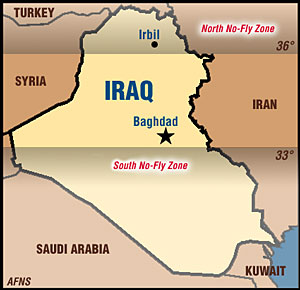
targets in the No-Fly Zones
accelerated. In the week preceding Sept. 2, 2002,
Coalition forces (U.S. and British forces) conducted six
air strikes on Iraqi targets, with the ostensible
justification that the targets posed a threat to the air
patrols in the No-Fly Zones over northern and southern
Iraq (see Washington
Post article on
the latest attacks). This conflict could soon
escalate into a major war.
Since
American and British forces carried out Operation Desert
Fox in December 1998 against Iraq, this "forgotten" war
in the Middle East has only become more intense.
According to the New York Times in an article
on August 13, 1999, American and British forces have
escalated the continuing war against Saddam Hussein and
Iraq. Since the beginning of 1999 through August 1999,
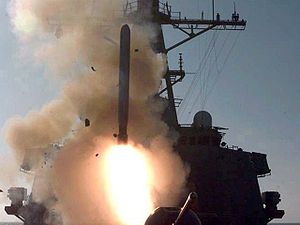
Allied pilots launched over 1,100 missiles against 359
Iraqi targets. That number equals nearly three times the
amount of ordnance used in the four-day Desert Fox
strike. Also, the pilots in the Iraq War have flown
two-thirds the number of missions as NATO pilots in the
1999 Kosovo War. By all accounts, Iraqi forces continue
to target their radar and fire missiles at Allied
warplanes despite the punishment inflicted from the air.
The estimated, unofficial cost of this war to U.S. and
British taxpayers is around $1 billion per year. As of
August 1999, over 200 military planes, 19 naval ships and
22,000 American military personnel are committed to
enforcing the "no-fly zones" and to fighting Iraq. In
addition, reports
indicate that the death rate for small children has
doubled in Iraq over the past decade. These child deaths
are attributed to the continuing war and economic
sanctions on Iraq and Saddam Husseins unwillingness
to live up to the 1991 cease-fire agreement.
Page
Summary:
In
the years since the Gulf War (1990-1991), the United
States and Iraq have engaged in a state of continued
hostility. Under the terms of the armistice, which ended
the war over Kuwait in 1991, Iraq agreed to allow United
Nations weapons, inspectors to search for and destroy
suspected weapons of mass destruction, (WOMDs). Nuclear,
biological and chemical weapons are included in this
category, and Iraq is known to have previously used
chemical weapons in warfare with Iran and with Kurdish
rebels. In 1981, Israel launched an air attack on the
Iraqi nuclear weapons research site of Osirak, thereby
publicizing the early stages of Baghdad's nuclear
program.
In
order to force Iraq to comply with these restrictions on
weaponry, the United Nations and the United States have
conducted an economic embargo of Iraq, which has
devastated the economy, and the infrastructure of the
nation. Iraq claims several hundred thousand children
have died of malnutrition and poor medical care resulting
from these economic sanctions.
Periodically,
this "cold war" erupts into open warfare, as the Iraqi
government of Saddam Hussein defies the UN and the U.S.,
prompting military responses.
Page
Menu: Click on the menu bar below
to navigate this page.
Name
of Conflict
| Belligerents | Conflict
Dates | Conflict
Type | Related
Conflicts
| Causes | Description | Consequences | Casualties | Unique
Facts or Trends
| Sources | Links
Links
on Conflict
Map
Source: U.S. Air Force http://www.af.mil/photos/art_maps.shtml
NAME
OF CONFLICT: U.S.-Iraq Conflict
ALTERNATE
NAMES: Iraq-U.S. Conflict
BELLIGERENTS:
United
States, United Kingdom and various members of the United
Nations
vs.
Iraq
Return
To
Page Menu
DATES
OF CONFLICT:
BEGAN:
1991
ENDED:
March 19, 2003
TYPE
OF CONFLICT: Inter-State (between countries)
RELATED
CONFLICTS:
PREDECESSOR:
Second
Persian Gulf War: "Operation Desert
Storm"
(1990-1991)
CONCURRENT:
Iraqi Kurdish Rebellions
(1991-present), Shiite Muslim Rebellion in Iraq
(1991-Present), Turkish Kurdish Rebellion (1985-Present),
bin Laden War (1998?-Present), Kosovo
War [NATO-Serbia Conflict]
(1999), U.S.-Afghan War (2001-Present)
SUCCESSOR:
Third
Persian Gulf War :"Operation Iraqi
Freedom"
(2003)
Return
To Page Menu
CAUSES
OF CONFLICT:
The
main cause of the continued hostility between the United
States and Iraq is disagreement over the extent and need
for continued United Nations inspections. The U.S. and
the UN claim that Iraq is not living up to the terms of
the agreement and are continuing to develop WOMDs. Iraq
denies this and claims that the U.S. is attempting to
subvert their national sovereignty and cripple the
country through continued economic sanctions.
Periodically, the government of Saddam Hussein attempts
to force the UN weapons inspectors from the country and
the U.S. and UN respond with threats and occasional bomb
and missile attacks.
Another
point of contention is the continuation of the "no-fly
zones" over northern and southern Iraq. Originally
designed to protect the rebellious Kurdish minority in
the north and the oppressed Shiite minority in the south,
these zones are Iraqi airspace in which Iraqi aircraft
are not allowed to fly. Gulf Coalition air forces have
occasionally enforced these zones by shooting down Iraqi
planes and attacking Iraqi air defense missile batteries
on the ground.
In
December of 1998, the Iraqi government evicted the UNSCOM
inspectors, accusing them of spying for the American CIA.
This allegation seems to hold some truth to it. As a
result of the end of Iraqi cooperation with UNSCOM, the
United States and Britain unleashed Operation Desert Fox
on Iraq. From December 16th through the 20th, Allied
warplanes and cruise missiles hammered Iraqi targets.
Saddam then declared that Iraq would no longer recognize
the validity of the "no-fly zones" and would actively
contest the Allies for control of all Iraqi airspace.
This has resulted in nearly continual combat in the skies
over Iraq as air-defense missile batteries attempt to
shoot down American and British warplanes. In response,
Allied forces attack these missile batteries and
occasionally engage in punishing air strikes on other
targets in Iraq.
Return
To Page Menu
DESCRIPTION
OF CONFLICT:
Over
the years, the continued conflict between the United
States and Iraq has erupted several times into violence.
The following chart details those incidents of combat. As
new attacks occur, this chart will be updated. Incidents
begin with the earliest dates, with more recent events at
the bottom.
|
Operation
Name
|
Date(s)
|
Nations
Involved
|
Type
of Action
|
Details
|
|
Operation
Southern Watch
|
August 2,
1992
|
U.S.
& UN
vs.
Iraq
|
Establishment of
"no-fly zone".
|
The "no-fly
zone" is imposed over south Iraq as a means of
halting air attacks on Shiite Muslim rebels. The
United States begins air patrols of the
zone.
|
|
Operation
Southern Watch
|
December 28,
1992
|
U.S.
vs.
Iraq
|
Air combat to
enforce Operation Southern Watch "no-fly
zone."
|
A US plane
shoots down an Iraqi Mig-25 when it enters the
"no-fly zone."
|
|
Operation
Southern Watch
|
January 13,
1993
|
U.S.
, Britain and France
vs.
Iraq
|
Retaliatory air
and missile strike.
|
Gulf coalition
forces strike Iraqi radar and missile sites near
the cities of Nasiriyah, Samawa, Najaf and Al
Amara. Over 100 aircraft take part in these
attacks.
|
|
none
|
January 17,
1993
|
U.S.
vs.
Iraq
|
Retaliatory
missile strike.
|
The United
States struck the Zafraniyah Nuclear Fabrication
Facility, near Baghdad, with up to 42 Tomahawk
Cruise missiles. This strike was designed to
punish Saddam Hussein for Iraq's non-compliance
with United Nations weapons
inspections.
|
|
|
|
Return
to Page Menu
|
|
|
|
none
|
June 27,
1993
|
U.S.
vs.
Iraq
|
Retaliatory air
strike.
|
The United
States fires 24 cruise missiles from two US Navy
ships at an intelligence headquarters in
Baghdad. Iraq claims eight people are killed in
the assault. President Clinton ordered this
attack as retaliation for an alleged plot to
assassinate former President George Bush on a
trip to Kuwait.
|
|
none
|
October 7,
1994
|
U.S.
& Kuwait
vs.
Iraq
|
Military buildup
due to renewed crisis.
|
US planes and
54,000 troops head for the Gulf as Iraq's troops
appear to be on the verge of launching an
offensive on Kuwait. Crisis is averted as Iraq
pulls back its army.
|
|
none
|
August 31,
1996
|
Iraq
and KDP (Kurdish Faction)
vs.
PUK
(Kurdish Faction)
|
Iraqi army
support for one side in Kurdish civil war inside
"protected area" in Northern Iraq.
|
Iraq seizes the
city of Irbil inside the Kurdish "safe haven"
protected by US-led troops.
|
|
Operation
Desert Strike
|
September 3 and
4, 1996
|
U.S.
vs.
Iraq
|
Retaliatory
missile strike in response to Iraqi military
actions.
|
The United
States fires 44 Tomahawk cruise missiles at
Iraqi military targets. President Clinton
extends the "no-fly zone" to cover parts of
Baghdad and central Iraq.
|
|
Operation
Desert Fox
|
December 16
through December 20, 1998
|
U.S.
and Britain
vs.
Iraq
|
Retaliatory
missile and air strikes to punish Iraq for
non-cooperation with UNSCOM's
inspections.
|
The U.S. and
Britain attacked sites related to the production
of nuclear, chemical and biological weapons.
Targets hit included airfields, military command
centers, suspected missile factories and an oil
refinery. Bases and headquarters for Saddam's
Republican Guard were also hit. As a result of
these attacks, the Iraqi government declared an
end to all UNSCOM inspections and said it would
militarily challenge the "no-fly"
zones.
|
|
None
|
December 29,
1998
|
U.S.
and Britain
vs.
Iraq
|
Iraqi missile
batteries fired on U.S. aircraft over the
northern "no-fly" zone.
|
The Allied
warcraft returned fire and destroyed the Iraqi
air-defense battery.
|
|
None
|
December 30,
1998
|
U.S.
and Britain
vs.
Iraq
|
Iraqi missile
batteries fired on U.S. and British aircraft
over the southern "no-fly" zone.
|
The Allied
warcraft returned fire and destroyed the Iraqi
air-defense battery.
|
|
None
|
December 30,
1998- March 19, 2003
|
U.S.
and Britain
vs.
Iraq
|
Continued bomb
and missile attacks by the U.S. and
Britain.
|
Since Desert
Fox, the Allies have engaged in almost daily
attacks as Iraq attempts to enforce its
sovereignty over the "no-fly" zones. After
Desert Fox, Iraq ejected all UN inspectors and
declared the "no-fly" zones to be illegal.
Violence increased as tensions mounted during
the lead-in to the 2003
Invasion of Iraq.
|
|
|
|
|
|
|
*Note:
It was reported that when the NATO assaults on
Yugoslavia/Serbia began in the Kosovo War, Iraq and
Yugoslavia communicated information regarding U.S. and
British air tactics. Also, unconfirmed reports indicate
that the two nations traded and/or sold to each other
military hardware.
CONSEQUENCES
OF CONFLICT:
1.
In effect, the Gulf War never really ended, but
merely shifted into a type of cold war, with lots of
yelling, threats and rhetoric interspersed with a few
brief moments of violence. Since December of 1998, the
violence has escalated markedly.
2.
Continued tension in the Gulf region. This has the
effect of disrupting the worldwide oil markets and has
also disrupted stock exchanges around the
globe.
3.
A continued drain on the military resources of the
United States and other Gulf Coalition allies. Increasing
criticism of the Gulf monarchies who allow Coalition
forces to use their countries as staging areas for action
against Iraq.
4.
As a result of the economic embargo against their
nation, the Iraqi people have suffered greatly. The
nation's infrastructure is collapsing and thousands of
children have died as the poorer elements of the society
are hit by the sanctions.
CASUALTY
FIGURES:
Iraq--
Several dozen military casualties resulting from air
attacks. Civilian deaths due to the sanctions run into
the thousands. Exact figures are not available. Operation
Desert Fox was first reported by Iraq to have killed
"thousands" of people, but newer numbers indicate
casualties in the low hundreds.
Gulf
Coalition Allies -- No reported casualties from
Iraqi fire.
Return
To Page Menu
UNIQUE
FACTS OR TRENDS: This section is formed from the opinion
of the History Guy regarding this conflict.
This part
of the page is still under construction. Check back
soon.
SOURCES:
(published)
1.
Kohn, George C. Dictionary
of Wars.
New
York: Facts On File Publications, 1999.
Return
To Page Menu
We
provide fast success in mcitp
database administrator 2008 by using our high quality
MCSA.
We also offer up-to-dated pmp
training and SY0-201
with definite guarantee of success in 70-640.
Links And Sources
News Links
Click
here for the latest Full Coverage news on
Iraq
U.S.
Bombing Watch--A
compilation of data on U.S. air strikes on
Iraq.
Yahoo!
Full Coverage
of the Iraq-U.S. Conflict.
New
York Times: Issues In Depth: Attack on
Iraq--News
source on the Iraq conflict.
BBC
News: Iraq - Years of tension:
1992-96--Background
information from the British Broadcasting Corporation on
the ongoing conflict between Iraq and the UN
Confrontations
Since the Gulf War--
Very detailed listing of ALL Iraq-U.S./UN confrontations
since 1991. Tons of facts available on this
site.
Arabic
News--
News from the Arab World.
IraqNet
News Center--
Good resource for finding news and other links on
Iraq and the Middle East.
History and Politics
Links on Iraq and the conflict
The
History Guy: Issues: Iraq-U.S.
Conflict--The
History Guy's page containing links to many Iraq sources.
Part of this website's Politics section.
Iraq
chronology--
Well-detailed site listing significant actions from
December of 1998 to June of 1999.
The
Iraq Foundation --"is
a non-profit, non-governmental organization working for
democracy and human rights in Iraq, and for a better
international understanding of Iraq's potential as a
contributor to political stability and economic progress
in the Middle East."*Descriptive
statement is from the Iraq Foundation website.
DOD
101: United States Military
Operations--
Fascinating website run by the Federation of American
Scientists. On this site you will find tons of data on US
military operations going back decades.
Iraq
History-- A
very detailed accounting of Iraqi/Mesopotamian history
covering Biblical times to the Present.
UNSCOM--
The United Nations Special Commission, the
organization that conducts the weapons inspections in
Iraq. This page is part of the UN website.
Iraqi
Rulers--Part
of the Iraq4ever website. Lists the rulers of Iraq from
independence to the present.
Iraq
History--Part
of the Iraq4ever website. Includes quite a bit of detail
on the history of Iraq and the Mesopotamia
region.
Anti-War Links
Iraq
Action Coalition--"The
Iraq Action Coalition (IAC) is an independent grassroots
coalition dedicated to ending the war on the people of
Iraq. IAC provides information and analysis on the
devastating effects of the continuing war (sanctions)."
**Descriptive
statement taken from IAC Homepage.**
The
Sanctions War Is Killing Iraqi
Children--Page
detailing the suffering of Iraqi children resulting from
the economic sanctions. Part of IAC website.
Iraq
Crisis Antiwar Homepage--
Physicians
for Global Survival (PGS): The Gulf War of 1991 Sanctions
and Iraq--Site
maintained by a physicians anti-war organization.
Contains many interesting links.
Siahkal
News: Wars--Web
page devoted to news and politics from Iran. This page
deals with the war in neighboring Iraq.
The United Nations
Resolutions Links
Resolution
1137 -
Nov. 12, 1997
Approves
travel sanctions against senior Iraqi
officials.
Resolution
1134 &
Resolution
1115 -
Oct. 23 & June 21, 1997
Demand
that Iraq cooperate fully with the inspections
regime.
Resolution
986 -
April 14, 1995
Approves
sale of Iraqi oil for food and humanitarian
relief.
Resolution
687 -
April 3, 1991
Formally
ends the 1991 Persian Gulf War and authorizes the
inspection and elimination of Iraq's suspected weapons of
mass destruction.
Resolution
661 - Aug.
6, 1990
Imposes
a trade and financial embargo on Iraq and occupied
Kuwait. Establishes a special sanctions committee to
implement the resolution and calls upon U.N. members to
protect the assets of Kuwait around the world.
Resolution
660 -
Aug. 2, 1990
Condemns the invasion of
Kuwait, demands Iraq's unconditional, immediate
withdrawal and calls on both countries to begin
negotiations.