Nations:
Forms of Government
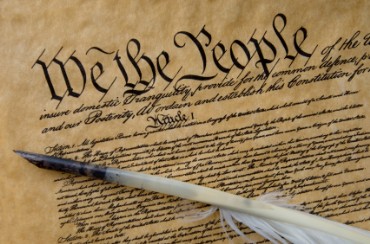
Constitution, a Form of Government
Definitions of the major governmental terms and types and forms of government are as follows:
Anarchy: A condition of lawlessness or political disorder brought about by the absence of governmental authority.
Commonwealth : A nation, state, or other political entity founded on law and united by a compact of the people for the common good.
Communism: A system of government in which the state plans and controls the economy and a single – often authoritarian – party holds power; state controls are imposed with the elimination of private ownership of property or capital while claiming to make progress toward a higher social order in which all goods are equally shared by the people (i.e., a classless society).
Confederacy (Confederation): A union by compact or treaty between states, provinces, or territories, that creates a central government with limited powers; the constituent entities retain supreme authority over all matters except those delegated to the central government.
Constitutional: A government by or operating under an authoritative document (constitution) that sets forth the system of fundamental laws and principles that determines the nature, functions, and limits of that government.
Constitutional Democracy: A form of government in which the sovereign power of the people is spelled out in a governing constitution.
Constitutional Monarchy: A system of government in which a monarch is guided by a constitution whereby his/her rights, duties, and responsibilities are spelled out in written law or by custom.
Democracy: A form of government in which the supreme power is retained by the people, but which is usually exercised indirectly through a system of representation and delegated authority periodically renewed.
Democratic Republic: A state in which the supreme power rests in the body of citizens entitled to vote for officers and representatives responsible to them.
Dictatorship: A form of government in which a ruler or small clique wield absolute power (not restricted by a constitution or laws). Also, a system in which the citizens do not possess the right to choose their own leaders.
Ecclesiastical: A government administrated by a church.
Federal (Federative): A form of government in which sovereign power is formally divided – usually by means of a constitution – between a central authority and a number of constituent regions (states, colonies, or provinces) so that each region retains some management of its internal affairs; differs from a confederacy in that the central government exerts influence directly upon both individuals as well as upon the regional units.
Federal Republic: A state in which the powers of the central government are restricted and in which the component parts (states, colonies, or provinces) retain a degree of self-government; ultimate sovereign power rests with the voters who chose their governmental representatives.
Maoism: The theory and practice of Marxism-Leninism developed in China by Mao Zedong (Mao Tse-tung), which states that a continuous revolution is necessary if the leaders of a communist state are to keep in touch with the people.
Marxism: The political, economic, and social principles espoused by 19th century economist Karl Marx
Marxism-Leninism : An expanded form of communism developed by Lenin from doctrines of Karl Marx; Lenin saw imperialism as the final stage of capitalism and shifted the focus of workers’ struggle from developed to underdeveloped countries.
Monarchy: A government in which the supreme power is lodged in the hands of a monarch who reigns over a state or territory, usually for life and by hereditary right; the monarch may be either a sole absolute ruler or a sovereign – such as a king, queen, or prince – with constitutionally limited authority.
Oligarchy: A government in which control is exercised by a small group of individuals whose authority generally is based on wealth or power.
Parliamentary Democracy: A political system in which the legislature (parliament) selects the government – a prime minister, premier, or chancellor along with the cabinet ministers – according to party strength as expressed in elections; by this system, the government acquires a dual responsibility: to the people as well as to the parliament.
Parliamentary Government (Cabinet-Parliamentary government): A government in which members of an executive branch (the cabinet and its leader – a prime minister, premier, or chancellor) are nominated to their positions by a legislature or parliament, and are directly responsible to it; this type of government can be dissolved at will by the parliament (legislature) by means of a no confidence vote or the leader of the cabinet may dissolve the parliament if it can no longer function.
Parliamentary Monarchy: A state headed by a monarch who is not actively involved in policy formation or implementation (i.e., the exercise of sovereign powers by a monarch in a ceremonial capacity); true governmental leadership is carried out by a cabinet and its head – a prime minister, premier, or chancellor – who are drawn from a legislature (parliament). The system in the United Kingdom, which has the British Royal Family AND a working democracy.
Republic: A representative democracy in which the people’s elected deputies (representatives), not the people themselves, vote on legislation.
Socialism: A government in which the means of planning, producing, and distributing goods is controlled by a central government that theoretically seeks a more just and equitable distribution of property and labor; in actuality, most socialist governments have ended up being no more than dictatorships over workers by a ruling elite.
Sultanate: Similar to a monarchy, but a government in which the supreme power is in the hands of a sultan (the head of a Muslim state); the sultan may be an absolute ruler or a sovereign with constitutionally limited authority.
Theocracy: A form of government in which a Deity is recognized as the supreme civil ruler, but the Deity’s laws are interpreted by ecclesiastical authorities (bishops, mullahs, etc.); a government subject to religious authority.
Totalitarian: A government that seeks to subordinate the individual to the state by controlling not only all political and economic matters, but also the attitudes, values, and beliefs of its population.
Sources for Forms of Government : The CIA World Factbook
American Government and Criminal Defense:
US Constitution Crime and Due Process
Criminal Defense Attorney Dayton Ohio








Comments are closed, but trackbacks and pingbacks are open.