China Vs. The United States in Wars and Conflicts 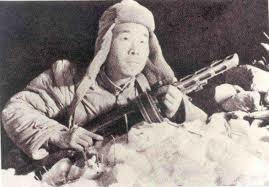
Chinese Soldier in the Korean War
The series of wars and conflicts between China and the United States can be known as the Sino-American Wars (i.e. China vs. America Wars). While only two of the Chinese-American conflicts can be considered major wars, the relations between the two world powers have been tense and hostile for over a half century now. As China continues to emerge into a formidable economic, diplomatic, and military force in Asia and the world, the possibility of a future conflict between the United States and China will grow.
How many wars between China and America have been fought? See the list of Chinese-American Wars:
The Boxer Rebellion (1899-1901)--A Chinese secret society called the Righteous Harmony Society, and called "The Boxers" by Western observers, began an uprising to drive Western influence from China. While the rebels also at first opposed the ruling government, called the Manchu Dynasty, the government soon managed to direct most of the violence against European, American, and Japanese cultural, political, military, and diplomatic interests in China. After the rebels and the Chinese government's military began a siege of the Foreign Legations (foreign embassies) in the capital of Beijing (known as Peking at the time), an unlikely alliance of eight nations gathered military forces to invade China and save their embassies, as well as to preserve the power and influence they had long held in China. These allies included: Great Britain, France, Germany, Italy, Austria-Hungary, Russia, the United States, and Japan. This China Relief Expedition totaled nearly 45,000 men, and quickly invaded China, seizing Beijing. China was forced to pay war reparations, (in other words, they had to repay their enemies for the financial cost of the war), accept more foreign troops on Chinese soil.
United States Marines from the 4th Marine Regiment in Shanghai, China (1927-1941) The United States, sent troops to protect American citizens and American property in the Shanghai International Settlement during the Chinese Civil War and the Second Sino-Japanese War. These troops, along with other foreign troops were allowed under the treaties the Chinese government had been forced to sign with many Western nations.
Korean War (1950-1953)--When the Communist North Koreans invaded South Korea, the United States and many other nations sent troops to defend South Korea. As these forces drove the North Koreans back, the goal changed from saving South Korea to liberating the North from Communist rule. The new Communist governement of China responded by sending hundreds of thousands of soldiers to aid the North Koreans. This resulted in heavy combat between Chinese and American forces until the fighting ended in 1953 with an Armistice.
Taiwan Strait Crisis (1954-1955)--The People's Republic of China (Communist China), attacked islands under the control of the Republic of China (the Nationalist Chinese government in Taiwan). The United States was not part of the fighting, but was very supportive of the Nationalists, to the point of considering military action and the possible use of nuclear weapons on mainland China.
The Vietnam War (1965-1975)--The dates listed here represent the years that Chinese military forces were stationed in North Vietnam during the war. China sent Anti-Aircraft Artillery batteries (and the troops to man them) in large numbers to help the North Vietnamese battle American warplanes over North Vietnam. At one point, in 1967, China had over 170,000 troops in 16 AAA divisions serving in North Vietnam. Chinese also supplied missiles, artillery and logistics, railroad, engineer and mine sweeping forces to aid the Vietnamese Communists in their war with the United States.
Hainan Island Incident (2001)--A U.S. Navy EP-3 reconnaissance aircraft operating above the waters of the South China Sea was struck by a Chinese Air Force interceptor jet. The Chinese plane and pilot were lost at sea, and the American plane made a forced landing on China's Hainan Island. The U.S. crew were released after eleven days of captivity. The Chinese kept the U.S. plane and gained much useful intelligence about classified American equipment and materials related to the aircraft’s surveillance mission.
2009 Naval Incidents Between the U.S. and China--In March and June of 2009, several incidents took place between the military forces of the United States and the military forces of the People's Republic of China at sea.
In June, 2009, a Chinese submarine collided with a sonar array towed by a U.S. destroyer near the Philippines.
In December, 2013, a Chinese warship set itself onto a collision course with an American naval vessel, the USS Cowpens. A collision was only avoided due to evasive action taken by the American ship.
In December, 2016, a Chinese warship intercepted and seized an unmanned American undersea drone ( U.U.V.) as an American naval vessel, the USS Bowditch, was attempting to recover it in waters off the Philippines. . The U.S. government complained, and the Chinese declared that they would return the drone. This incident came shortly after President-Elect Donald Trump irritated the Chinese government by conducting a phone conversation with the leader of Taiwan.
February, 2023--Chinese Balloon Incident: A Chinese surveillance balloon overflew the United States in February, 2023. This caused diplomatic issues between the U.S. and China. Also in this time period, multiple reports came out that the U.S. military considers China to be the primary strategic opponent and some military analysts warn/predict a possible Chinese-American war by 2025 or so over Taiwan.
Links and Resources on Chinese-American Conflicts:
Nuclear War with China is Possible, Says Dissident--1913intel.com
Chinese Support for North Vietnam during the Vietnam War: The Decisive Edge --Military History Online
Korean War: The Chinese Intervention--From the United States Army history website.
The Hainan Island Incident, Ten Years Later--Facing China
Quemoy and Matsu: An Historical Footnote Revisited--by Robert B. Norris
China Agrees to Return Seized Drone, Ending Standoff, Pentagon Says-NY Times, Dec. 17, 2016
Sources:
R. Ernest, Dupuy, and Dupuy Trevor N. The Harper Encyclopedia of Military History: From 3500 B.C. to the Present
. New York: Harper & Row, 1970.
Kohn, George C. Dictionary of Wars. New York: Facts On File Publications. 1986.
Steems, Peter and William L. Langer., ed. An Encyclopedia of World History. Boston, Massachusetts: Houghton Mifflin, 2002.
Banks, Arthur S., ed. Political Handbook of the World
. 5th ed. Binghamton, NY: CQ Press, 2004.
Copyright © 1998-2023 History Guy Media 02.04.23
"The History Guy" is a Registered Trademark.