1981-1990
Historyguy.com
1981-1990
The 1980s were a time of very active American military intervention around the world. These military actions can mostly be grouped into one of several categores:1. Cold War Actions--The Cold War with the Soviet Union and its allies Cuba and Nicaragua, was still in full swing, and American deployements to Grenada and Central American nations of El Salvador and Honduras were done in part to counter Soviet influences.2. Middle Eastern and Persian Gulf Involvement--American support of Israel and Egypt (who had signed an American-negotiated peace in the 1970s) was a paramount reason for U.S. and allied involvement in the Lebanon conflict. The U.S.-Iran conflict, which began with the fall of the Iranian Shah and the related seizure of the American Embassy in the Iranian capital of Tehran, continued as America supported Iraq in its war with Iran in the Gulf region.
3. Reaction to Terrorism--The U.S. engaged in conflict with Libya, a known sponsor of terrorism, and also reacted to individual acts of terrorism by various Arab/Muslim groups.
1981 El Salvador--After a guerilla offensive against the government of El Salvador, additional U.S. military advisers were sent to El Salvador, bringing the total to approximately 55, to assist in training government forces in counter-insurgency.
1981 Libya--On August 19, 1981, U.S. planes based on the carrier U.S.S. Nimitz shot down two Libyan jets over the Gulf of Sidra after one of the Libyan jets had fired a heat seeking missile. The United States periodically held freedom of navigation exercises in the Gulf of Sidra, claimed by Libya as territorial waters but considered international waters by the United States.
1982 Sinai (Egypt).--On March 19, 1982, President Reagan reported the deployment of military personnel and equipment to participate in the Multinational Force and Observers in the Sinai. Participation had been authorized by the Multinational Force and Observers Resolution, P.L. 97-132.
1982 Lebanon--On August 21, 1982, President Reagan reported the dispatch of 80 marines to serve in the multinational force to assist in the withdrawal of members of the Palestine Liberation force from Beirut. The Marines left September 20, 1982.
1982-1983 Lebanon--On September 29, 1982, President Reagan reported the deployment of 1200marines to serve in a temporary multinational force to facilitate the restoration of Lebanese government sovereignty. On Sept. 29, 1983, Congress passed the Multinational Force in Lebanon Resolution (P.L. 98-119) authorizing the continued participation for eighteen months.
1983 Egypt--After a Libyan plane bombed a city in Sudan on March 18, 1983, and Sudan and Egypt appealed for assistance, the United States dispatched an AWACS electronic surveillance plane to Egypt.
1983-89 Honduras--In July 1983 the United States undertook a series of exercises in Honduras that some believed might lead to conflict with Nicaragua. On March 25, 1986, unarmed U.S. military helicopters and crewmen ferried Honduran troops to the Nicaraguan border to repel Nicaraguan troops.
1983 Chad--On August 8, 1983, President Reagan reported the deployment of two AWACS electronic surveillance planes and eight F-15 fighter planes and ground logistical support forces to assist Chad against Libyan and rebel forces.
1983 Grenada--On October 25, 1983, President Reagan reported a landing on Grenada by Marines and Army airborne troops to protect lives and assist in the restoration of law and order and at the request of five members of the Organization of Eastern Caribbean States.
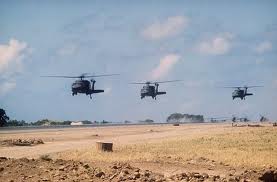
American Helicopters in Grenada 1983
1984 Persian Gulf--On June 5, 1984, Saudi Arabian jet fighter planes, aided by intelligence from a U.S. AWACS electronic surveillance aircraft and fueled by a U.S. KC-10 tanker, shot down two Iranian fighter planes over an area of the Persian Gulf proclaimed as a protected zone for shipping.
1985 Italy/Mediterranean--On October 10, 1985, U.S. Navy pilots intercepted an Egyptian airliner and forced it to land in Sicily. The airliner was carrying the hijackers of the Italian cruise ship Achille Lauro who had killed an American citizen during the hijacking.
1986 Libya--On March 26, 1986, President Reagan reported to Congress that, on March 24 and 25, U.S. forces, while engaged in freedom of navigation exercises around the Gulf of Sidra, had been attacked by Libyan missiles and the United States had responded with missiles.
1986 Libya--On April 16, 1986, President Reagan reported that U.S. air and naval forces had conducted bombing strikes on terrorist facilities and military installations in Libya.
1986 Bolivia--U.S. Army personnel and aircraft assisted Bolivia in anti-drug operations.
1987-88 Persian Gulf--After the Iran-Iraq War resulted in several military incidents in the Persian Gulf, the United States increased U.S. joint military forces operations in the Persian Gulf and adopted a policy of reflagging and escorting Kuwaiti oil tankers through the Gulf. President Reagan reported that U.S. Navy ships had been fired upon or struck mines or taken other military action on September 23, October 10, and October 20, 1987 and April 19, July 4, and July 14, 1988. The United States gradually reduced its forces after a cease-fire between Iran and Iraq on August 20, 1988.
1988 Panama--In mid-March and April 1988, during a period of instability in Panama and as pressure grew for Panamanian military leader General Manuel Noriega to resign, the United States sent 1,000 troops to Panama, to “further safeguard the canal, U.S. lives, property and interests in the area.” The forces supplemented 10,000 U.S. military personnel already in Panama.
1989 Libya--On January 4, 1989, two U.S. Navy F-14 aircraft based on the U.S.S. John F. Kennedy shot down two Libyan jet fighters over the Mediterranean Sea about 70 miles north of Libya. The U.S. pilots said the Libyan planes had demonstrated hostile intentions.
1989 Panama--On May 11, 1989, in response to General Noriega’s disregard of the results of the Panamanian election, President Bush ordered a brigade-sized force of approximately 1,900 troops to augment the estimated 11,000 U.S. forces already in the area.
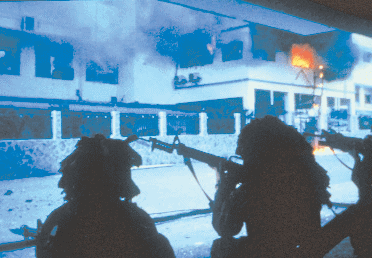
U.S. Army troops in the Panama Invasion 1989
1989 Andean Initiative in War on Drugs-- On September 15, 1989, President Bush announced that military and law enforcement assistance would be sent to help the Andean nations of Colombia, Bolivia, and Peru combat illicit drug producers and traffickers. By mid-September there were 50-100 U.S. military advisers in Colombia in connection with transport and training in the use of military equipment, plus seven Special Forces teams of 2-12 persons to train troops in the three countries.
1989 Philippines--On December 2, 1989, President Bush reported that on December 1 U.S. fighter planes from Clark Air Base in the Philippines had assisted the Aquino government to repel a coup attempt. In addition, 100 marines were sent from the U.S. Navy base at Subic Bay to protect the U.S. Embassy in Manila.
1989-90 Panama--On December 21, 1989, President Bush reported that he had ordered U.S. military forces to Panama to protect the lives of American citizens and bring General Noriega to justice. By February 13, 1990, all the invasion forces had been withdrawn.
1990 Liberia--On August 6, 1990, President Bush reported that a reinforced rifle company had been sent to provide additional security to the U.S. Embassy in Monrovia, and that helicopter teams had evacuated U.S. citizens from Liberia.
Source: Congressional Research Service
"The History Guy" is a Registered Trademark.
History Guy SiteMap