Wars, Conflicts, and Coups of the Philippines
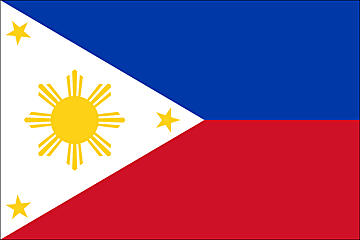
The Philippine Islands lay off the East Asian Coast, and for hundreds of years formed an important part of Spain's overseas empire. Long after Spain lost its large and rich American possessions, the Philippines (along with Cuba, Puerto Rico, and Guam) remained Spain's last colonies. Filipinos however, wanted independence, and waged many revolts against Spanish rule. The last such uprising is called the Philippine War of Independence, but it was interrupted in 1898 by Spain's short, but sharp war with the United States. American forces destroyed the Spanish fleet in Manila Bay, and accetped the surrender of the capital of Manila from the Spanish authorities. Soon thereafter, American and Filipino forces began fighting what at the time was referred to (by Americans) as the Philippine Insurrection. It more accurately is now known as the Philippine-American War.The Philippines became an American possession, but eventually, the U.S. decided it did not want colonies, so , as early as 1916, the Philippines were promised eventual independence. That freedom was delayed by World War Two, in which the Philippines were invaded and occupied by Japan. Following World War Two's conclusion, the Philippines became independent on July 4, 1946.
Since independence, the Philippines has sent troops overseas several times as an ally of the United States, and has also endured several rebellions, coups, and religious and political strife. Below is a listing of the wars and conflicts of the Philippines from the 1890s to the present.
*Current and ongoing conflicts are in bold face.
Philippine Revolution (1896-1898) --
Spanish–American War (1898) --
Philippine–American War (1899-1913)--
World War I (1914-1918) --Techically, the Philippines were involved in World War I on the Allied side as a possession of the United States, but no Filipino military units saw combat. Individual Filipino soldiers did serve in combat as members of the U.S. armed forces.
World War Two (1939-1945)--
The Hukbalahap Rebellion (1946-1954) --A Communist rebellion against the Manila government. The rebels were known as "Huks" and were defeated in 1954 through a combination of government military action and civic reforms. The name of the communist rebel forces in the Filipino language of Tagalog it is "Hukbo ng Bayan Laban sa mga Hapon."
Korean War (1950-1953)-The Philippines entered the Korean War in August 1950 as part of the United Nations forces fighting against the North Korean invasion of South Korea. The Filipino forces included 7,500 combat troops.
Vietnam War (1964-1973)- The Philippine Civic Action Group to Vietnam (PHILCAG-V) was sent to South Vietnam to aid the Saigon government in its struggle with the Viet Cong and North Vietnam. These forces included medical and engineering units to conduct civic projects to help the Vietnamese people.
NPA Maoist Rebellion (1969-Present)--The New People's Army (NPA), is the military wing of the Communist Party of the Philippines, and began a guerrila campaign against the government in 1969. The conflict continues to the present day. The NPA forces are also known as "Huks," in connection with the Hukbalahap war of the 1940s and 1950s. The NPA's name in the Filipino language of Tagalog it is "Bagong Hukbong Bayan."
Muslim Rebellion in the Southern Philippines (1969-Present): Muslim rebel groups seek autonomy/independence from the mostly Christian Philippines. The rebels originally sought independence for the Muslim region. One of the primary rebel groups, the Moro National Liberation Front, signed an agreement with the Manila government in 1996 that granted autonomy. Some rebel groups continued to fight on, but through negotiations that concluded in 2012, the main rebel Muslim group, the Moro Islamic Liberation Front, agreed to drop the demand for an independent Muslim nation.
This conflict also involves the Abu Sayyaf rebel group, which is known to have ties to al-Qaida. Abu Sayyaf formed in 2008.
Since the Muslim Rebellion began in 1969, over 120,000 people have died, and at least two million others have been displaced due to the violence.
Martial Law (1972-1981)--Martial law over the entire nation instituted by President Ferdinand Marcos.
The People Power Revolution of 1986 (also known as the EDSA Revolution and the Philippine Revolution of 1986) was a series of nonviolent mass street demonstrations in the Philippines in 1986, in protest of an election in which the reigning dictator, Ferdinand Marcos was declared the winner over challenger Corazon Aquino. The election was widely seen as fraudulent, and huge demonstrations forced Marcos to go into exile. The massive protests were aided by rebel military forces belonging to the Reform the Armed Forces Movement (RAM), a military group seeking reforms. The result of this largely peaceful revolution was the end of the Marcos dictatorship, and the ascension of Corazon Aquino to power as president.
Philippine Coup Attempts (1986-1987)--From July, 1986 through August, 1987, six attempts were made to overthrow President Corazon Aquino's government. Some of the coups were in support of the exiled former-president Marcos, and some were launched by members of the Reform the Armed Forces Movement (RAM) . All ended in failure.
Manila Hotel plot (July 6-8,1986)-500 armed soldiers and 5,000 civilians loyal to Ferdinand Marcos occupied the Manila Hotel for 37 hours. This confrontation ended peacefully."God Save the Queen" plot (November 22, 1986)--Rebel troops attempted to march on the government but were blocked by loyal troops. The rebels returned peacefully to their barracks.
Coup Attempt "GMA-7 Incident" (January 27-29, 1987)--Rebel soldiers led by Colonel Oscar Canlas seized control of the main compound of GMA Network (a television network) in Quezon City, while other troops unsuccessfully attempted to capture the Sangley Point Air Force Base in Cavite. One rebel soldier was killed, and thirty five people were injured.
"Black Saturday" incident (April 18, 1987)-56 rebel soldiers raided Fort Bonifacio. Loyal troops beat back the attack, killing 1 rebel soldier.
Manila International Airport plot (July 5,1987) --Rebel troops plotted another coup attempt through a military takeover of the Manila International Airport. The plan was never executed due to a leak to the authorities. Several military officers were arrested.
Coup attempt (August 28-29,1987)-Military coup led by Colonel Gregorio Honosan in which the presidential palace and several military bases were attacked by rebel forces. Loyal troops defeated this rebellion. This attempted coup resulted in 53 dead and more than 200 wounded. Most of the casualties were civilians. Honosan was arrested after several months on the run, but later escaped and led the 1989 Coup Attempt.
Coup Attempt (December 1-9, 1989)--The most serious coup attempt against President Aquino. The official casualty list included 99 dead (including 50 civilians) and 570 wounded. Under orders from President George H.W. Bush, the United States military supported the Aquino government during this coup. Operation "Classic Resolve" involved the use of U.S. airpower from the USS Midway and USS Enterprise aircraft carriers and F-5 fighters from Clark Air Base in the Philippines. The U.S. planes had clearance to "...buzz the rebel planes at their base, fire in front of them if any attempted to take off, and shoot them down if they did".
Persian Gulf War (1990-1991)--200 medical personnel were sent to assist the American-led coalition in the war with Iraq.
Iraq War (2003-2004 Philippines involvement)-- The Philippines sent 60 medics, engineers and other troops to assist in the invasion of Iraq. The troops were withdrawn on the 14th of July, 2004. Several Filipino soldiers received combat wounds, but no fatalities.
Links and Resources:
Dictionary of Modern Politics of Southeast AsiaMilitary History of the Philippines-Wikipedia Article