Attack on the USS Cole (October 12, 2000)
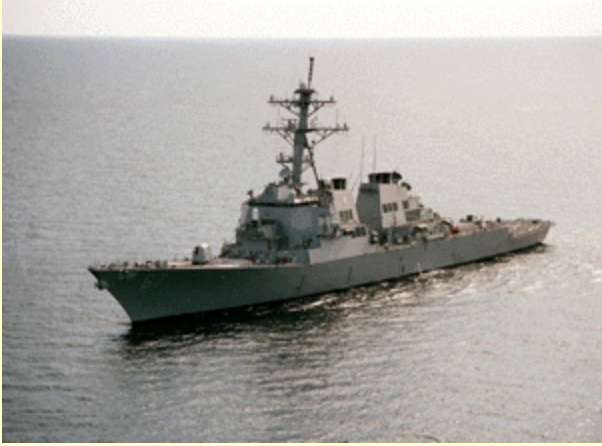
The USS Cole
On October 12, 2000, the USS Cole, a U.S. Navy Destroyer, entered the harbor of Aden, Yemen to refuel. After mooring the ship to a buoy, the refueling operation began. Approximately 45 minutes into the refueling, a small ship, described as either a Zodiac-type rubber craft or a fiberglass boat, placed itself alongside the Cole and blew up. The resulting explosion tore an 40 by 40 foot hole in the side of the destroyer, causing casualties among the ship’s crew. The casualties totalled 17 dead and an additional 39 wounded. The injured were first evacuated to Yemeni medical facilities onshore for treatment and later evacuation to the U.S. base at Ramstein, Germany and a French military hospital in nearby Djibouti.
In the words of Admiral Vern Clark, the Chief of U.S. Naval Operations, “…this was clearly a terrorist act.” As the United States later learned, the attack was carried out by terrorists associated with Osama bin Laden’s Al-Qaeda network.
Vincent Cannistraro, the CIA’s former head of counter-terrorist operations, (mentioned on Oct. 19 in the Guardian Unlimited, a British newspaper), that early evidence pointed to Osama bin Laden and his organization, al-Qaeda. Later information proved that the attack was part of al-Qaida’s war on the United States. This was nearly a year prior to al-Qaida’s September 11, 2001 attacks on the American homeland.
On January 19, 2001, the U.S. Navy released its final report on the Cole attack.
Yemen History
see also: Wars and Conflicts of Yemen (1914-Present)
Yemen is an Arabic-speaking Muslim nation on the southwestern tip of the Arabian Peninsula. From 1967 to 1990, Aden was the capital city of the People´s Democratic Republic of Yemen (also known as South Yemen), a Marxist ally of the Soviet Union. To the north and west of South Yemen was the Yemen Arab Republic (also known as North Yemen), a nation that sometimes courted favor with the West. These two rival Yemeni governments fought several wars (1972, 1979, and 1982) against each other, invariably drawing in both the United States and the Soviet Union as competing patrons. In May of 1990, the two Arab nations united peacefully into one Yemen. Regional and political differences between Northerners and Southerners erupted into civil war in 1994, with Aden attempting to reassert its independence. Forces from the north laid siege to Aden and the war ended with the defeat of the southern rebels.
Also in 1990, the Gulf War began with the Iraqi invasion of Kuwait and in 1991 became a major war with the intervention of an international coalition, led by the United States and including several Arab nations. Yemen chose to align itself with Iraq and thus quickly became a pariah state in the eyes of the United States and her allies. Not long after the USS Cole attack the outbreak of tribal violence and a border conflict with Saudi Arabia (a major ally of the U.S. in the middle east), and a spate of kidnappings of foreigners made Yemen a fairly unsafe place for Westerners. In an attempt to repair relations, Yemen and the United States arranged for a series of refueling stops for the ships of the U.S. Navy, which frequented the area as part of the ongoing enforcement of the economic sanctions against Iraq at that time.
In the years since the USS Cole bombing, Yemen has fallen into civil war, been subject to foreign intervention, and is now also a breeding ground for al-Qaida and ISIS terrorism. The United States is heavily involved in Yemen in the ongoing war against al-Qaida, and also as an ally of the Saudi-led coalition involved in the Yemen Civil War fighting against the Houthi rebels.
Beginning in 2023, the Houthi joined in the Hamas-Israel War, and also began targeting international shipping in the Red Sea. In response to this, the U.S. and the UK began air and naval strikes on Houthi targets in Yemen in 2024. This continued until May of 2025, when the Houthi and the U.S agreed to a ceasefire.
News
Prosecutors charge accused USS Cole mastermind–Reuters, June 30, 2008
USS Cole Attack Planner Escapes -Feb. 5, 2006
LinksStatement by the President on the Middle East Situation and the attack on the USS Cole in Yemen.
Defense Dept. News Briefing–Text of Secretary Cohen’s statement on the Cole attack. Oct. 12, 2000.
Navy Investigates explosion on USS Cole
Casualties from USS Cole explosion
USA Today: Probe turns to bin Laden Evidence cited in attack on Cole
Links to General Terrorism InformationForeign Terrorist Organizations–From the U.S. State Dept. Note that different nations and governments maintain different listings of terrorist organizations.
Patterns of Global Terrorism: 1999–U.S. State Dept. publication.
Patterns of Global Terrorism: 1999- Middle East Overview–Scroll to the bottom of this document for information on terrorist groups operating in Yemen.
Patterns of Global Terrorism: 1998–U.S. State Dept. publication.
Osama bin Laden Page–Biographical details and links on bin Laden.
Terrorism-Intelligence Threat Assessments–From the Federation of American Scientists. Many useful links.
Copyright © 1998-2026 History Guy Media . Last updated 05.18.26
“The History Guy” is a Registered Trademark.