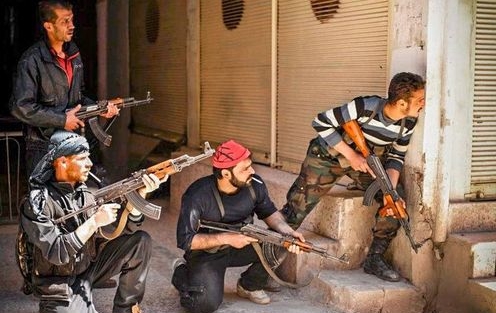
The Wars of 2013
Afghan Civil War (1978-Present)-This war, which is merely the latest in constant
fighting between various Afghan factions, has been ongoing since the communist coup
of 1978 and the subsequent Soviet invasion to support that new communist government.
Following the fall of the communists, other factions continued to fight for control,
until finally, a new rebel force, called the Taliban, swept into power after a swift
military offensive. Resistance against the Taliban continued, with the Northern Alliance
being the main surviving anti-Taliban force. After the 9/11 Terror attacks on America,
the U.S. and other Western allies entered the fray, swept the Taliban from power,
and set up a more-or-less consensual government in Kabul. The current stage of this
civil war features the Taliban, with allies such as the Haqqani network and others,
pitted against the Kabul government of Hamid Karzai and his increasingly reluctant
U.S. and NATO allies.
Boko Haram Insurgency in Nigeria (2009-Present)--The Islamic fundamentalist group
Boko Haram is waging a war against the Nigerian government and against the Christian
community in Nigeria.
Central African Republic War-(2012-present)-Rebels seized several major cities and
towns as they advanced on the capital city of Bangui in December, 2012. Neighboring
Chad sent around 2,000 troops to aid the CAR government. After only three weeks of
fighting, by December 30, the rebels controlled about one-third of the country, and
were in place to assault Bangui. Also in late December, France sent more troops to
augment the forces they already had in the country. France had publicly stated that
they would not intervene to save the government from the rebels, but were only interested
in protecting French citizens.
Chechen War (1999-Present)--Chechen rebels continue to battle against the Russian
government in the Russian Caucasus region.
Congo War (1998-Present)--Beginning in 1998, Congo (Kinshasa), has been wracked with
civil war, rebellions, presidential assassinations, and foreign interventions and
invasions. The latest fighting in the eastern part of Congo involves a rebel group
known as The March 23 Movement, better know as M23, led by Bosco Ntaganda, and covertly
supported by Uganda and Rwanda. The United Nations is also involved, trying to aid
the Kinshasa government.
Iraqi Insurgency (Post-U.S. Withdrawal-2012-Present)-Despite the withdrawal of U.S.
troops in December, 2011, the anti-government insurgency in Iraq continues, with
thousands of casualties in 2012. In addition to this insurgency, tensions between
the largely autonomous Kurdish north and the Baghdad government have escalated through
2012, along with increased bloodshed between the Sunni and Shi'ite Arab communities.
Kurdish War in Turkey (1984-Present)--The Kurdish ethnic minority in eastern Turkey
has long sought autonomy (and in some cases, outright independence), and the PKK
guerrilla force has stepped up its war againt the Turkish government in 2012, and
the Turkish military has conducted several large-scale offensives against the Kurds.
Lord's Resistance Army Insurgency (1987-Present)--Another example of a long-running
conflict that morphs from one war and one opponent into something quite different
from the original conflict. This war began as a quasi-religious uprising against
the government of Uganda in the 1980s, and is now a multi-nation hunt for warlord
Joseph Kony and his remaining small number of guerrillas. He and his "Lord's Resistance
Army" now ranges between South Sudan, Congo, Uganda, and the Central African Republic
and is pursued by the military forces of all these nations (mostly by Uganda), and
also by Special Forces from the United States.
Mexican Drug War (2006-Present)-Ongoing conflict between the Mexican government and
the various drug cartels. This conflict also pits the drug cartels against each other.
Northern Mali Conflict (2012-Present)-- In 2012, the long-simmering hostility between
the Mali government and the northern Taureg ethnic group exploded with the Taureg
conquest of northern Mali. Many of the Taureg fighters had recently arrived from
Libya, where thousands of the Taureg had served in the military of fallen Libyan
dictator Muammar Gadaffi. With Gadaffi's fall, these mercenaries left Libya with
their weapons and experience and returned to Mali, where they took up arms against
the Mali government. Soon after the rebel victory, al-Qaida affiliated Islamists
took over the Taureg revolution and began invoking Islamist Sharia law. A coalition
of African and European nations is trying to cobble together a military force to
retake northern Mali.
Pakistan's Taliban War (2004-Present)--Pakistan is combating a Taliban insurgency
along the Northwest frontier with Afghanistan.
Somali Civil War (1991-Present)--The latest stage of this war pits the weak central
government against the al-Qaida affiliated al-Shabaab rebels. The government is aided
by the United States, and by trooops provided by Kenya, Uganda, Burundi, Ethiopia,
and other African nations.
South Sudan-Sudan Border Conflict (2012-Present)-Sudan has been wracked by multiple
insurgencies and has undergone two significant civil wars (1955-1972 and 1983-2005),
the Darfur War (2003-2011), various clashes between Sudanese nomadic tribal groups
(2009-Present), and the ongoing Lord's Resistance Army conflict that spans several
central and east African nations. The largest potential conflict involving the Sudans
is the ongoing border conflict between Sudan and the newly independent South Sudan
over the Greater Nile Oil Pipeline and the disputed (and oil-rich) region of Abyei.
There is no love lost between the mostly Muslim and Arabic-speaking Sudan and the
more Black South Sudanese, who are mostly Christian and various pagan/animist worshipers.
The previous two large Sudanese civil wars were between these two groups prior to
the independence of South Sudan.
Yemen War--This is a civil war with many fronts and many belligerents. The Yemen
government is faced with a Shi'ite rebellion in the north, a separatist rebellion
in the south, and an al-Qaida connected Sunni Islamist insurgency that has drawn
in the United States. Yemen is one of America's fronts in the ongoing war against
al-Qaida, with frequent drone strikes against Islamist and Jihadist targets in Yemen.
Several terrorist attempts against the U.S. have originated in Yemen.
Wars Involving the United States of America in 2013--The United States, officially
at war on several fronts since 2001 (and unofficially, since at least 1991), is battling
al-Qaida in several nations around the world, as is actively involved in covert wars
in several others. America's current wars and conflicts include wars in:
Afghanistan--Since the 9/11 Terrorist attacks on the U.S., American forces have been
actively engaged against al-Qaida and the Taliban in Afghanistan. All signs point
to an American withdrawal from Afghanistan over the next two years, but until then,
the warfare continues.
Iraq-While officially, America's war in Iraq ended in December, 2011, hundreds of
U.S. military personnel remain in Iraq as trainers for the Iraqi military and security
forces. As the Iraqi insurgency continues, it would be foolish to believe that America's
involvement in Iraq is truly over.
Iran-The U.S., Israel, and likely other Western allies are engaged in a proxy/covert
war with Iran over Iran's involvement in the wars in Gaza, Lebanon, Syria, Iraq,
and Afghanistan.
Syria-As 2013 begins, U.S. and allied pressure on the Assad regime continues and
it is well-known that the U.S. is aiding the anti-Assad rebels. The U.S. now formally
recognizes the Syrian rebels as legitimate government of Syria. Worries over Syria's
chemical weapons, and the possibility that Assad may use them or transfer them to
Hezbollah, lead to the very strong possibility of U.S. and allied military intervention
in Syria in 2013. U.S. special forces are reportedly pre-positioned in Jordan, and
U.S. and other NATO forces are taking up positions in southern Turkey, manning Patriot
missile batteries.
Libya--After the successful military intervention in Libya in 2011, continued American
involvement in Libya hit the public eye with the September 11, 2012 attack on the
U.S. embassy in Benghazi and the death of four Americans, including the U.S. Ambassador
to Libya. The U.S. is actively involved in hunting down missing weapons in Libya
and in supporting the new Libyan government. To date, there has been no publicly
acknowledged military retaliation against the Libyan militants who attacked the embassy.
Mali--In 2012, the long-simmering hostility between the Mali government and the northern
Taureg ethnic group exploded with the Taureg conquest of northern Mali. Soon after
the rebel victory, al-Qaida affiliated Islamists took over the Taureg revolution
and began invoking Islamist Sharia law. A coalition of African and European nations
is trying to cobble together a military force to retake northern Mali. The U.S. is
involved in this effort, and 2013 may very well see some form of U.S. military intervention
in this al-Qaida-related conflict.
Somalia and the Horn of Africa--The U.S. and many other nations continue to engage
in anti-piracy operations off the Somali coastline. These operations at times result
in military engagements with the pirates, up to and including rescue operations inside
Somalia itself. Besides the anti-piracy operations, the U.S. is also involved in
Somalia due to the continuing Shabaab War. The U.S. funds and trains Ugandan, Burundian,
Ethiopian, Kenyan, and other African forces who are actively fighting in Somalia
to aid the weak central government against the al-Qaida affiliated al-Shabaab rebels.
The U.S., over the past few years, frequently launches drone attacks, Special Forces
raids, and naval attacks on al-Qaida targets in Somalia. There is no reason to believe
this will change in 2013.
Pakistan--The U.S. has been using remote-controlled drones to attack Taliban and
al-Qaida strongholds in Pakistan since 2004. Conservative reports put the death toll
in Pakistan from these drone attacks at a minimum of 3,000.
Philippines--Since 2002, U.S. Special Forces have been aiding and training Filipino
forces in their ongoing fight against al-Qaida affiliated Islamist rebels in the
southern Philippines. These rebel groups include Abu Sayyaf and Jemaah Islamiyah.
In 2009, two U.S. Special Forces troops were killed by a roadside bomb. While officially
engaged in only training missions, it is highly likely that U.S. troops are more
actively engaged.
Syrian War--The Syrian Civil War began in 2011 and has turned into one of the most
violent conflicts in the world today. With the alleged use of chemical weapons by
the Assad regime in the summer of 2013, and the subsequent warnings by President
Obama of an American military strike on Syria, this conflict has the potential to
escalate into a major war. It is well-known that the United States is providing arms
and training to certain factions of the Syrian rebels.
Yemen--Yemen is one of America's fronts in the ongoing war against al-Qaida, with
frequent drone strikes against Islamist and Jihadist targets in Yemen. Several terrorist
attempts against the U.S. have originated in Yemen.