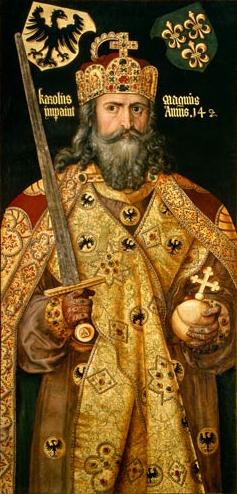
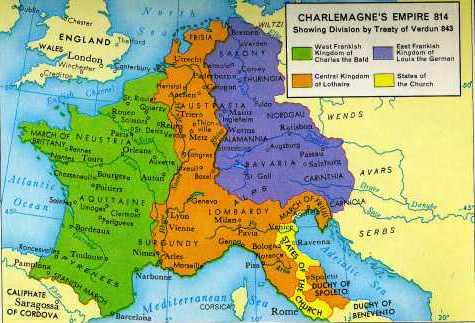
Charlemagne
was a king of the Franks, and he became the first Holy
Roman Emperor. He is known for expanding the territory
and power of his Kingdom of the Franks, and for
subjugating the Germanic Saxons. His long reign, which
began in 768 as co-ruler with his brother, and then from
771 to 814 AD as the sole ruler, makes Charlemagne one of
the most historically important rulers of the Middle
Ages. Reflecting the various languages within his empire,
he was known alternately as: Carolus Magnus (Latin), Karl
der Grosse (German), and Charlemagne (French). The
designation means “Charles the Great” in all
three languages.
Today
Charlemagne is regarded not only as the founding father
of both historical French and German monarchies, but is
also referred to as the father of Europe: his vast empire
united most of Western Europe for the first time since
the Romans, and the Carolingian renaissance encouraged
the formation of a common European identity. Some trace
the idea of the current European Union (EU) to the
concept of a united Europe as symbolized (somewhat
romantically, it could be said) by the Empire of Charles
the Great; Charlemagne.
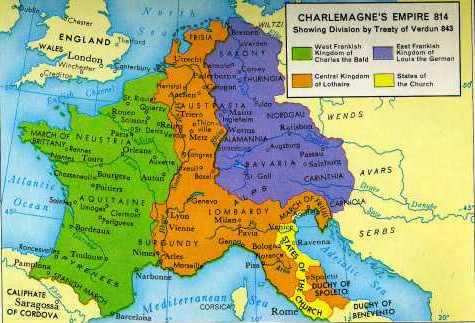
Source:
http://www.uoregon.edu/~kimball/images/0814.Charlemagne-CWA.152.jpg
Conquest of
Lombardy (773-774)--The Franks under an ealier king,
Pepin the Short, had battled the Lombards in defense of
the Pope in the years 754 and 756, forcing the Lombards
to give up land to both the Frankish kingdom and to the
Pope's rule. The lands claimed by the Pope became the
basis for the Papal
States.
The Lombard King, Desiderius, wanted those lands back,
angering the current Frankish ruler, Charlemagne, who was
married to the daughter of King Desiderius. Charlamagne
sent his wife back home to her father, and then invaded
Lombardy, conquering the Lombard lands, and declaring
himself the new King of Lombardy.
Saxon
Wars (771-804)--A series of campaigns waged over
nearly 30 years and 18 major battles. These wars
concluded with Saxony incorporated into the Frankish
Empire, and the pagan Saxons forced to accept
Christianity. A significant percentage of the Saxon
population perished in the Frankish conquest of
Saxony.
Lombardy
Rebellion (776)--Charlemagne put down a rebellion in
Lombardy by Duke Hrodgaud of Friuli and Duke Hildeprand
of Spolet. Charlemagne rushed back from Saxony and
defeated and killed the Duke Hrodgaud of Friuli in
battle. The Duke of Spoleto signed a peace treaty with
Charlemagne. Their co-conspirator, Arechis, was not
subdued Northern Italy was now under Frankish
control.
Charlemagne's
First Spanish Campaign (also known as the
Roncesvalles Campaign) (777-778)---Charlemagne agreed
to aid the Muslim governor of Barcelona in his conflict
against the Emir of Cordoba, worried that Cordoba posed a
threat to the Frankish province of Aquitaine, led his
army over the Pyrenees Mountains into Spain. The Franks
won a few minor battles and conquered the Basque
(Christian) city of Pamplona, but could not take the city
of Saragossa. Hard pressed by Muslim forces, the Franks
withdrew in 778. This Charlemagne war is best known for
the song (poem) written about Charlemagne's nephew,
Roland, who fought and died in a rear-guard battle with
Muslim forces as the Franks withdrew from northern Spain.
The Song
of Roland,
with its martial pride in the Frankish forces and
Charlemagne's cause, and, of course, Roland's bravery, is
considered one of the first true national poems of the
modern world.
Frankish-Moorish
Wars (779-812)--The Franks and Moors (Arabic Muslims
who ruled North Africa and Spain), fought throughout the
Mediterrannean Sea (The Franks seized the islands of
Corsica and Sardinia and in 799, the Balearic Islands)
and in northern Spain. In 795, the Spanish regions of
Gerona, Cardona, Ausona, and Urgel were united into the
new Spanish March, which remained under Frankish
authority until 1258.
Lombard War
(780)--Charlemagne installed his son as the ruler in
Lombardy and also strengthened the Papacy's
power.
Breton
Rebellion (786)-- In 786 Charlemagne subdued the
Bretons, in a region in the extreme western part of Gaul
along the western coast in an area known as Brittany. The
Bretons refused to obey him, so he sent an army against
them, which compelled the rebels to surrender hostages to
Charlemagne, and to promise to obey him from then
on.
Beneventian
War (787)--Charlemagne incorporated southern Italy
into his empire, besieging the city of Salerno and
forcing its ruler, Arechis, to swear loyalty.
Bavarian
War (787-788)- The ruler of Bavaria, Duke Tassilo,
was married to a daughter of Charlemagne's old enemy,
King Desiderius of Lombardy. This woman, named Liutberga,
convinced her husband to make an alliance with the Avars
(better known to history as The Huns) to exact revenge
against Charlemagne. When Frankish forces under
Charlemagne entered Bavaria, Duke Tassilo quickly
surrendered and pledged loyalty to
Charlemagne.
Frankish-Avar
War (791-796)--The Avars, or Huns, as they were often
called by the Franks, controlled the central Danube and
accumulated wealth by raiding and plundering their
neighbors. Charlemagne and his son, Pepin, fought the
Avars in a long and bloody war which resulted in the
subjugation of the Avars.
Second
Beneventian War (792-?)--Upon the death of Arechis of
Beneventa, his son, Grimold III, declared independence of
Frankish rule and warfare continued on and off for years.
Grimold never was forced to surrender his
independence.
Slavic
War (798)--In 798, Charlemagne led a campaign against
a Slavic group inhabiting what is now north-eastern
Germany. This Slavic group were known at the time as the
Wilzi, or Welatabians (also known in history as the
Wends, or the Veleti). Regardless of what we call them,
they had harassed the Abodriti, old allies of the Franks,
through continual raids. When they refused Charlemagne's
orders to halt these raids, he marched into their
territory in 798 and crushed them (this according to
Einhard, Charlemagne's biographer, who noted this in
"Vita Karoli Magni" (Life
of Charles the Great).
Pannonian
Croation War (799-803)--A Frankish commander, Eric,
the Duke of Friuli, attempted to conquer Pannonian
Croatia for the Franks. He failed miserably, being killed
in the Siege of Trsat in 799. The Croatian War continued
on and off for years.
Frankish-Byzantine
War (801-810)--Charlemagne and the Byzantine Emperor
Nicephorus I waged war on both land and sea for control
of Venetia and the Dalmatian coast (modern-day northern
Italy, Slovenia and Croatia). The war progressed well for
the Franks, plus, beginning in 809, Nicephorus was
distracted by a new war with the Bulgars. Therefore, the
Byzantines began negotiations with the Franks, and peace
was agreed upon in which Charlemagne gave up most of the
Dalmatian coast (which he had conquered), in exchange for
the Byzantine Emperor recognizing him as Emperor of the
West. The Istrian Peninsula remained a part of the
Frankish Empire.
Danish
War (808-810)--Charlamagne settled accounts with the
Danes, who had given aid and asylum to the Saxon leader
Widukind in the Saxon Wars.
Bohemian
War (805-806)--Frankish forces subdued the Slavic
region of Bohemia (modern-day Czech Republic)
Outside
Links and Resources for Charlemagne and his
Wars:
Medieval
Sourcebook: Einhard: The Wars of Charlemagne, c. 770 -
814
Charlemagne
the King: A biography from Will Durant's STORY OF
CIVILIZATION 1950
The
Wars And Military Exploits of Charlemagne (884
AD)-Literary Excerpt, By Notker The Stammerer, Monk of
Saint Gall
Kohn, George
C. Dictionary
of Wars.
New York: Facts On File Publications.
1986.