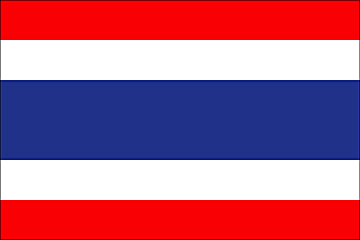
Thailand Flag
Wars and Conflicts of Thailand and Siam
Wars and Conflicts of Thailand and Siam—This page lists the wars and conflicts of the nation of Thailand. Prior to 1939, Thailand was known as Siam. The first conflict in this listing is a war between Siam and France for control of what is now Laos. Thailand’s multiple military coups and coup attempts are included, as are various border disputes Thailand has engaged in with neighboring countries.
In the early 21st century, Thailand has been dealing with internal political upheavals, a border conflict with Cambodia, and a Muslim insurgency in the south.
Wars and Conflicts of Thailand and Siam
Franco-Siam War (1893)-France, colonial ruler of most of Indochina, seized control of Laos from Siam in a sharp, bloody war.
Palace Revolt of 1912– This coup plot was the first time in Thai history that the military tried to overthrow the legitimate government of Siam. Discontentment from the Army during the reign of King Vajiravudh (also known as King Rama VI) led to an unsuccessful coup. The man chosen to assassinate the king instead revealed the plot, leading to the arrest of the coup plotters.
Thai Military Coup (1932)–This coup ended Siam’s absolute monarchy and placed limits on the powers of the king. Specifically, the coup removed conservative, pro-royalist government ministers from power.
Thai Military Coup (1933) –Army officers opposing the civilian prime minister’s closing of the National Assembly (closed in order to stop a radical economic plan opposed by conservatives) staged a coup in June 1933 that forced Prime Minister Manopakorn, restored the National Assembly, and set up a new government that respected democratic procedures.
Thai Royalist Revolt (1933)–In October, 1933, a serious royalist revolt broke out led by the king’s cousin, Prince Boworadet, who had been defense minister during the previous pro-royalist regime which was overthrown in 1932. Also known as the Boworadet Rebellion. The fighting lasted from October 11 to October 23, and resulted in the loyalist government forces defeating the rebels.
Rebellion of the Sergeants (1935) —
Songsuradet Rebellion (1939) —
World War II–During the Second World War, while France was defeated and partially occupied by Germany in 1940, both Japan and her ally Thailand initiated border conflicts with the French colonial forces in Vietnam and Indochina.
Franco-Thai Border War (Jan. 9, 1941-Jan. 28, 1941)–Thailand, then an unofficial ally of Japan, initiated an invasion of French Indochina after early border skirmishes from November 1940. After early successes, the Thai forces were forced back by French reinforcements. At sea, the French navy, in the form of one cruiser, wiped out nearly one third of the Thai navy off the island of Kho Chang on Jan. 17. Japan arranged a cease-fire on Jan. 28. Per a written agreement signed on March 11, France gave portions of Laos and Cambodia to Thailand. (External link on this war.)
Japanese Invasion of Thailand (1941)–Japan, while hoping that secret negotiations with the Thai government would result in the right to free movement of Japanese forces in Thailand, invaded Thailand on December 8, 1941. Japan’s goal was access to invasion routes to British-ruled Burma and Malaya. Thai forces put up stiff resistance for several hours, but the fighting ended when the Thai dicator, Plaek Pibulsonggram, signed an armistice with Japan.
Thailand as a Member of the Axis Powers- (1941-1945)-Thailand and Japan formed an alliance December 21, 1941. On January 25, 1942, the Thai government declared war on the United States and the United Kingdom, thus becoming a member of the Axis Powers. The Thai ambassador to the United States refused to deliver the declaration of war and became a leader in Thailand’s anti-Japanese resistance. Because of this, the United States did not declare war on Thailand. By the end of the war, Thai resistance forces numbered around 50,000 and were in opposition to the Japanese occupation.
Thai Military Coup (1947)
Thai Naval Revolt (1949)
Korean War (1950-1953)–Thailand joined other members of the United Nations in fighting against North Korea and Communist China.
Thai Naval Rebellion (1951)–Also known as the Manhattan Rebellion of June 1951, this was the Royal Thai Navy’s long-expected attempt to overthrow the government of Field Marshal Plaek Phibunsongkhram. The rebels’ defeat resulted in the near-complete dismantling of the navy, as well as the rise to power of Phibun’s two chief rivals, Phao Siyanon and Sarit Thanarat. The rebellion caused nearly 1200 deaths and 3,000 wounded, mostly civilians.
Cambodia-Thai Border Clash (1958)
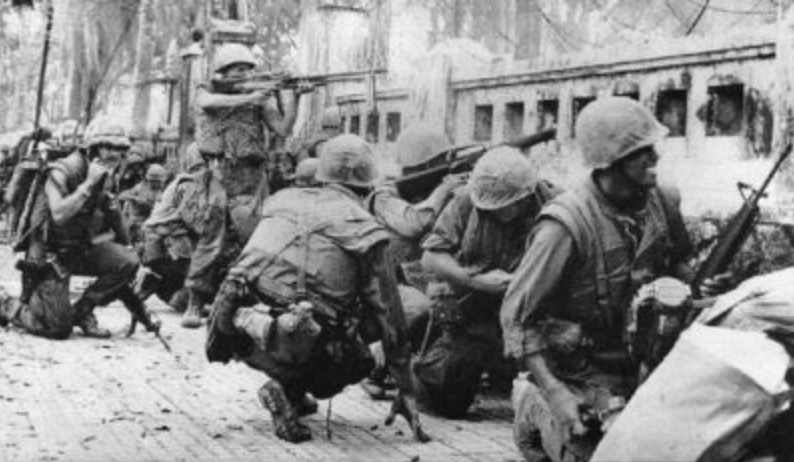
The so-called “Vietnam War” was really a regional and international conflict involving not just North and South Vietnam and the U.S. but also embroiling Laos, Cambodia, Thailand, South Korea, Australia and New Zealand. Below are some of the “smaller” conflicts that in part made up the Second Indochina War.
The American-Vietnamese War-(1956-1975)–The Communist North Vietnamese and the southern Viet Cong engaged in a long war to overthrow the pro-American government of South Vietnam. The U.S. and other allied nations sent troops to aid the Saigon regime. The last U.S. combat troops left in 1973 and Saigon fell to the North Vietnamese on April 30, 1975. Known in the U.S. and much of the world as “The Vietnam War.” Known in Vietnam as “The American War.” Thailand contributed troops to the war in South Vietnam, and served as a base for American bombing raids on Laos, Cambodia, and Vietnam.
Thai Communist Guerrilla War (1965-1982)--Low-intensity guerrilla war waged by the Thai Communist Party against the Thai government began in August, 1965. By 1977, approximately half the provinces in Thailand had a Communist guerrilla presence. A combination of government military offensives and an amnesty program caused the guerrilla movement to fail by 1982.
Khmer Rouge (Cambodia) Border Raids into Thailand (1975-1979)
Thai-Laotian Border War (1987-1988)
Thailand-Myanmar Border Conflict (2001)
Thai Muslim Rebellion (2003 – Present) Thailand vs. Muslim Separatists –Thailand’s Muslim population, located in the south near the border with Malaysia, rebelled in 2003. A similar campaign of violence hit the south in the 1970s and 1980s.
Thai Military Coup (2006)–The elected government of Prime Minister Thaksin Shinawatra was overthrown by the Thai military. This began an ongoing period of political unrest in Thai politics.
Cambodia-Thai Border Clash (2008-2011)–Thai and Cambodian troops exchanged fire with each other on the disputed territory near the Preah Vihear Temple.
Red Shirt Protests and Political Violence (2010)
Anti-Government Protests and Political Violence (2013)–Essentially a continuation of the ongoing political drama surrounding former Prime Minister Thaksin, as protests erupted against the government of Thaksin’s sister,Yingluck Shinawatra, who became Prime Minister when her Pheu Thai Party won the most seats in the 2011 elections. The protests are on behalf of the Democrat Party, which lost power in the 2011 elections.
Military Imposition of Martial Law (May, 2014)–Amid ongoing political protests and increasing violence, the Thai military unilaterally declared martial law and took control of the county.
Cambodia-Thai Border Clash (2025)–Thai and Cambodian troops exchanged fire with each across a wide stretch of their shared border. Fighting seems (as of several days in) to be fairly heavy.