Timeline of the Arab-Israeli Wars and the Gaza Wars
Timeline of the Arab-Israeli Wars
As the latest Middle East War unfolds in Gaza between Israel and the Palestinian group called Hamas, it is worthwhile to step back and examine the longer history of the larger conflict between Israel and her Arab neighbors, including the conflict with various Palestinian groups, including Hamas.
Prior to World War One, the area now called Israel and Palestine, was part of the Turkish Ottoman Empire. The region contained Muslim and Christian Arabs, as well as Jewish inhabitants. This region was, thousands of years prior, home to the ancient land called Israel. Most of the Jewish population of Israel was forced to leave during occupation by the Roman Empire some 2,000 years ago. Thus began the Jewish Diaspora. Until the creation of the modern State of Israel, the Jewish people were a minority in every nation they lived in, often enduring persecution for their religious beliefs.
Following Turkey’s defeat in World War One, the British took over control of what was then called Palestine (a word originating with the ancient rulers of this land, the Romans). The British controlled this area until 1948.
In the 1930s, a major Arab Revolt took place that pitted local Arab Palestinians against the British military and also against Jewish Palestinians. Jewish immigration to Palestine, which Jews regard as their ancient homeland of Israel, began to increase under British rule. Following World War Two and the Holocaust, Palestine became a magnet for thousands of Jewish refugees and Holocaust survivors. This increased immigration in the 1930s and 1940s led to more tension with the Arab Palestinians. Fighting between Palestinian Arabs and Jews escalated in 1947 and 1948, as the British prepared to leave Palestine.
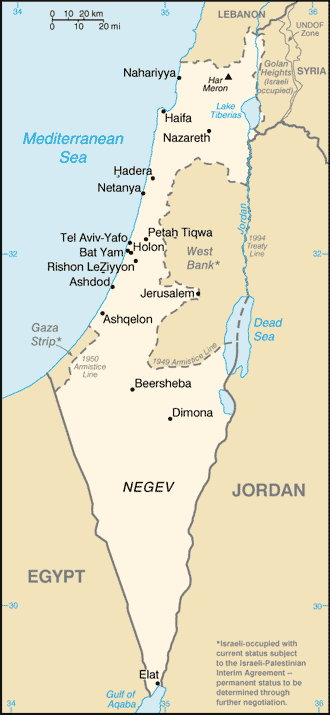
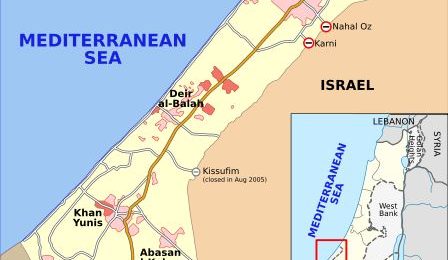
Israel and Gaza
In May, 1948, the Jewish inhabitants of British Mandatory Palestine declared independence as the new State of Israel. Immediately, war broke out, as the armies of the Arab nations of Egypt, Transjordan (now called Jordan), Saudi Arabia, Syria, Lebanon, and Iraq all invaded Israel. Local Arab Palestinian forces also fought against the Israelis. This war ended with a cease-fire (not a peace treaty) in 1949. This official state of war still exists between Israel and several of her neighbors, especially with Lebanon and Syria.
In the years after this war, Palestinian guerrillas (called Fedayeen) continued the fight, often infiltrating from Egyptian territory (Egypt had occupied Gaza after the war), Jordan (Jordan had occupied the West Bank Palestinian areas), and from Syria and Lebanon. Israel frequently retaliated with attacks into Egyptian, Jordanian, and Syrian territory.
Major wars broke out in 1956, 1967, and 1973 between Israel and her neighbors, with nearly continual border fighting, cross-border raids by both sides, and constant attacks by various Palestinian guerrilla groups. Eventually, in the 1960s, most Palestinian groups formed a larger organization called the Palestine Liberation Organization (PLO) under the leadership of Yassir Arafat, the head of the largest Palestinian resistance group, called Fatah.
It should be noted that from the 1950s onward, the Soviet Union became heavily involved as a major ally of Egypt (until the mid-1970s) and of Syria. Israel became a major non-NATO ally of the United States, as the Middle East conflict turned into a significant battleground of the Cold War.
In the early 1970s, the PLO (also supported by the Soviets) transferred from Jordan to Lebanon, after a short war with the Jordanian government forced the Palestinians out of that country. The transfer of thousands of armed PLO fighters, and thousands of Palestinian refugees helped cause Lebanon, a nation divided between Christian, Muslim, and Druze Arabs, to become more unstable.
PLO attacks on Israel in the 1970s from Lebanon led to multiple Israeli retaliatory attacks and incursions into Lebanon, further destabilizing the relatively weak government there. Eventually, Lebanon fell into a long civil war between the Lebanese Christians (who accepted aid from Israel), and the Lebanese Muslims (Lebanese Sunni Muslims, Shiite Muslims, Druze, along with the foreign PLO). Syria joined the Muslim side in this civil war. PLO attacks on Israeli targets led in part to a major Israeli invasion of Lebanon in 1982 that also pitted Israel against Syria.
Things got complicated from that point, eventually involving soldiers and Marines from the United States, France, Italy, and others. The PLO evacuated from Lebanon, while a new Lebanese Shiite Muslim militia called Hezbollah (Army of God) formed to resist the Israeli occupation. Israel occupied parts of southern Lebanon until 2000, when, under pressure from Hezbollah, they retreated back across the border. Cross-border fighting between Israel and Hezbollah continued, leading to a major war in 2006.
Meanwhile, Israel had secured peace treaties with both Egypt and Jordan, leaving the only major active front against them along the northern borders with Syria and Lebanon. However, the Palestinians living in the territories seized and occupied by Israel since the 1967 war, rose up in two major rebellions now called the 1st Intifada and the 2nd Intifida in the 1990s and early 2000s. These rebellions led to a peace deal of sorts that led to Israel withdrawing from the Gaza Strip and most of the West Bank. The PLO took over as the governing authority of these areas under the name of the Palestinian Authority (PA).
But, as mentioned before, the PLO was an umbrella organization that included many Palestinian resistance groups, all of whom had very different ideologies and goals. One of these groups was a Jihadist militia called Hamas, which was based primarily in the Gaza Strip. In a Palestinian civil war in 2006 and 2007, Hamas ejected Fatah (which controlled the Palestinian Authority) from Gaza, and set itself up as a competing Palestinian government. Hamas also continued to carry out attacks on Israel, leading to almost constant cross-border raids, rocket attacks, and other combat with Israel. The Israelis often responded with artillery and/or air strikes against Hamas and Islamic Jihad (another Palestinian group usually allied with Hamas) in the Gaza Strip. Israel has imposed an economic and military blockade of the Gaza Strip, which has impacted the lives of the nearly two million Palestinians who live there under Hamas rule.
Since 2008, there have been four (to date) major conflicts between Hamas and Israel we can refer to as the Gaza Wars. The latest of these is the major attack by Hamas on Israel commencing on October 7, 2023.
In addition, it must be noted that Israel is also in a proxy war (or shadow war) with Iran. Since 1979, Iran has been ruled by a fundamentalist Shiite Muslim theocracy that is dedicated to the destruction of Israel and the liberation of Jerusalem from the Israelis (seized in the 1967 War). Iran shares this philosophy with Hamas. Iranian-supported terrorist attacks on Israel (and Israeli allies, such as the U.S.) have been commonplace for decades. With the Syrian Civil War (beginning in 2011), both Iran and Iran’s ally, Hezbollah, actively became involved in the Syrian War in support of the Syrian government, led by Bashar al-Assad, while also encouraging cross-border raids on Israel from Syria. Israel has engaged in a (at first) secret air campaign to degrade Iranian, Syrian, and Hezbollah forces inside Syria. One major goal of these attacks was to prevent Iran from transferring major weapons systems to Hezbollah in Lebanon. Iran, while not an Arab nation, has been heavily involved in anti-Israeli campaigns by both Hezbollah in Lebanon, and Hamas in Gaza.
That is a very basic narrative of the wars between the Arabs and the Israelis. A lot of detail was left out for brevity, but the goal was to hit the major points in the history of the Arab-Israeli Wars.
Below is a timeline of the major conflicts and wars between Israel and the Arabs.
Timeline of the Arab-Israeli Wars and the Gaza Wars
1936-1939: Arab Revolt in Palestine: Arab rebellion against both the British occupying forces and the growing Jewish population in Palestine. While primarily a war between Palestinian Arabs against the British, Jewish groups were encouraged to arm themselves and fight against the Arabs.
1947-1948: Civil War in British Mandatory Palestine: After the British declared they were leaving Palestine, and a United Nations plan was proposed with separate, but connected Arab and Jewish territories, Palestinian Arab and Jewish (Israeli) militias began fighting. This combat would morph into the 1st Arab-Israeli War after the Jews in Palestine declared Israel an independent nation in May, 1948.
1948-1949-1st Arab-Israeli War: Israel vs. Egypt, Syria, Transjordan (later Jordan), Lebanon, Iraq and Saudi Arabia. In addition, local Arab Palestinian forces also fought the Jewish Israelis.
1949-1956: Cross-border raids and attacks on Israel by Egypt, Jordan, Syria and Palestinian resistance groups. Israel engages in many attacks and retaliations on all three neighboring Arab nations and Palestinian guerrilla groups based in those nations.
1956: 2nd Arab-Israeli War (also known as the Suez War or the Sinai War): In partnership with Britain and France (who had their own issues with Egypt), Israel invades Egypt, seizing the Gaza Strip and Egyptian Sinai. The cease-fire agreement, plus pressure from the U.S., forces Israel to return Gaza and Sinai to Egypt.
1956-1967: Cross-border raids continue, as Palestinian resistance groups become more organized, the Palestine Liberation Organization (PLO), led by Yassir Arafat, formed in 1964, united various Palestinian groups. The new PLO began conducting regular raids against Israel in 1964. Israel retaliated against PLO targets in Jordan and Syria. Syrian and Israeli army and air forces engaged in regular combat along their shared border.
1967: 3rd Arab-Israeli War, also called the Six-Day War of 1967: In a rapid pre-emptive attack, Israel crushed the military forces of Egypt, Jordan and Syria and seized large amounts of land from each. Iraq also participated in the fighting on the Arab side. Israel occupies the Gaza Strip, Egyptian Sinai, the West Bank part of Palestine that had been controlled by Jordan, and the Golan Heights region from Syria.
1968-1970: The War of Attrition: The War of Attrition was a limited border war fought between Egypt and Israel in the aftermath of the Six-Day War. It was initiated by Egypt as a way to recapture the Sinai Peninsula after losing it to Israel in 1967. A cease-fire in 1970 ended the fighting, but left the borders unchanged.
1968-1978: Continued PLO guerrilla and terrorist attacks and Israeli responses against Jordan (through 1970) and Lebanon. Terrorist attacks include the PLO attack and hostage-taking of Israeli athletes at the 1972 Olympic Games in Munich, Germany.
1973: 4th Arab-Israeli War of 1973: Called by Israel the Yom Kippur War, and by Arabs as the Ramadan War, began with a surprise attack launched on the Jewish Yom Kippur holiday (the dates also fell on the Muslim Ramadan holiday), as Egypt and Syria attacked Israel. Despite aid from Iraq, the Arab forces failed to defeat Israel. Also known as the “October War.”
1973-1978: PLO attacks on Israel continue from Lebanon, plus terrorist attacks around the world on Israeli targets, including airline hostage-taking and the Israeli raid on Entebbe Airport in Uganda to free Israeli citizens from pro-Palestinian terrorists.
1978: Israeli Invasion of Lebanon of 1978–Operation Litani was the official name of Israel’s 1978 invasion of Lebanon up to the Litani river. The invasion was a military success, as the Israeli military expelled the PLO from Southern Lebanon, where they had created a de facto state within a state. An international outcry over the invasion forced a partial Israeli retreat and the creation of a United Nations patrolled buffer zone between the Arab guerrillas and the Israeli military.
1978-1982: PLO attacks on Israel continue from Lebanon, plus terrorist attacks around the world on Israeli targets.
1981:The Osirak Raid –An Israeli air attack destroyed Iraq’s Osirak nuclear reactor. The Iraqi dictator, Saddam Hussein, wanted to develop nuclear weapons. Iraq was a major supporter of the PLO’s war on Israel.
1982-1984: 5th Arab-Israeli War: The Israeli Invasion of Lebanon–In response to repeated guerrilla attacks by the PLO, which were launched from South Lebanon, Israel invaded with the intent of destroying Arafat’s forces. Syria, which maintained a large army in Lebanon, also fought Israel and suffered an embarrassing defeat. Israel refers to this as their 1st Lebanon War.
1984-2000: The Israeli Occupation of South Lebanon: After withdrawing from Beirut and central Lebanon, Israel set up a buffer zone in south Lebanon to protect their northern border. The Lebanese Shiite militia called Hezbollah engaged in a war of resistance against the Israeli occupation forces and the Israel-allied South Lebanon Army. Israel withdrew from Lebanese territory in 2000, though cross-border raids with Hezbollah continued.
The First Intifada (1987-1993)–Urban uprising against Israeli rule in the West Bank and Gaza. The Oslo Peace Accords ended the Intifada and led to the formation of the Palestinian Authority with PLO Chief Yassir Arafat as the official leader of the Palestininans.
The Second Persian Gulf War (1991)–While Israel took no offensive action in this war, Iraq did launch Scud missiles which struck Israel and almost caused Israel’s intervention in the Gulf War. Iraq attacked Israel in the hope of provoking them to join the war and potentially cause the multi-national coalition fighting against Iraq to crumble. Israel wisely did not take the bait.
2000-2007: 2nd Intifada, AKA The “Al-Aqsa” Intifada–Urban guerrilla/commando war waged between Israel and various Palestinian groups, including Hamas. Leads to Israel withdrawing from the Gaza Strip.
2006: The Israeli-Hezbollah War –In response to repeated guerrilla attacks by the the Shiite Lebanese militia Hezbollah, Israel invaded southern Lebanon, set up a naval blockade, and launched a powerful bombing campaign in order to win the release of two captured Israeli soldiers. During the war, Hezbollah launched thousands of rockets and missiles into Israel. Israel refers to this as their 2nd Lebanon War.
2008-2009: The 1st Gaza War –War between the Palestinian Hamas rulers of the Gaza Strip and Israel. Began in December, 2008.
2009-2012: Frequent raids and rocket attacks from Gaza into Israel. The Israeli military launches frequent retaliatory attacks.
2012: 2nd Gaza War 2012: Operation Pillar of Defense–Israel’s second major Gaza War against Hamas.
2012-2014: Frequent raids and rocket attacks from Gaza into Israel. The Israeli military launches frequent retaliatory attacks.
Syrian Border Clashes and Air Campaign (2012-Present)–As a result of the chaos inside Syria resulting from the Syrian Civil War that began in 2011, Palestinian groups, plus Hezbollah, launch multiple incidents along the Israeli-Syrian Demilitarized Zone in the Golan Heights. Out of fear that the Syrian regime was transferring weapons to Hezbollah in Lebanon, Israel has conducted many airstrikes on Syrian, Iranian, and Hezbollah targets inside Syria.
2014: 3rd Gaza War: Operation Protective Edge-Israel and Hamas traded rocket and missile attacks, leading Israel to launch a major operation to try to stop Hamas attacks. Israel also blamed Hamas for the kidnapping and murder of three Israeli teenagers in the summer of 2014. Operation Protective Edge began on July 8, 2014 with multiple air strikes. Both Israel and Hamas launched commando raids into each other’s territory, and Israel began a large ground offensive on July 17, 2014.
2014-2023: Frequent raids and rocket attacks from Gaza into Israel. The Israeli military launches frequent retaliatory attacks.
2023: 4th Gaza War: In a surprise attack on October 7, 2023 (almost 50 years to the day of the start of the 1973 war), Hamas launched over 2,200 rockets and missiles into Israel. While under cover of this initial barrage, Hamas troops launched a combined ground, air, and sea-borne invasion of southern Israel. As of the first day, combat raged across multiple Israeli border towns and military and police outposts. Initial reports cited over 600 Israeli dead, mostly civilians. News reports also show dozens of Israeli civilians being taken back to Gaza, presumably as hostages. Israel responded with massive strikes into Gaza, while Prime Minister Netanyahu declared that Israel was in a full war, and ordered military mobilization.
Since the Hamas War’s beginning, Houthi rebel forces in Yemen have joined the war by launching missile and drone attacks at Israel and at Red Sea shipping. Also, Hezbollah has engaged in a low-level border war with Israel in support of Hamas.