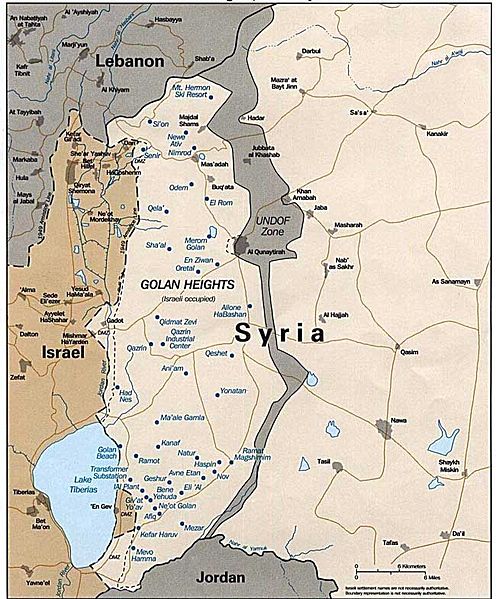
The Golan Heights is
a plateau separating Syria and Israel,
and it is currently occupied by Israel
as a result of several wars between
Israel and Syria. The Golan was
recognized as a part of Syria upon
Syria's independence from France in
1923.
In 1948, Syria
participated in the first of many
Arab-Israeli
Wars, and
upon the conclusion of that first war
with Israel in 1949, the border between
Israel and Syria formed at the edge of
Syrian Golan. Though that first major
war concluded, many instances of
border
warfare between Israel and
Syria
continued in the 1950s and
1960s.
In 1967, Syria lost
the Six-Day War with Israel, and at the
war's conclusion, Israeli forces were
in control of the Golan Heights. The
UN-brokered cease-fire line was called
"The Purple Line." Since
1967, various attempts at negotiation
and discussion have failed to return
the Golan to Syrian control. Israel
cites those border conflicts in the
1950s and 1960s when Syrian artillery
would fire on Israeli settlements in
the lowlands (the higher elevatio of
the Golan makes it a very good place
from which to target northern Israel),
as well as the use of Syrian territory
by Palestinian
forces to attack
Israel, as
reasons for Israel to keep the
Golan.
In 1973, Syria,
along with Egypt, launched a surprise
attack on Israel. Syria's goal was to
recapture the Golan Heights. Despite
fierce tank battles on the Golan
Heights, the Syrians were unable to
re-capture the Golan. The war ended
with another cease-fire negotiated by
the United Nations, and both sides
agreed to withdraw their forces back to
the Purple Line. As a result of those
UN negotiations, the United Nations
Disengagement Observer Force (UNDOF)
was created in 1974 to supervise the
disengagement agreement between Israel
and Syria, and to supervise and hold
the ceasefire. The area between the
Israeli and Syrian forces is known as
the" UNDOF Zone."
Approximately more than 1,000 UN
peacekeepers are in the UNDOF Zone as a
buffer between the two warring
neighbors.
Since 1973, the
Golan Heights has been fairly quiet. In
1981,the Israeli Knesset (parliament)
passed the "Golan Heights
Law", under which Israeli
"laws, jurisdiction and administration"
applied to the occupied Golan Heights.
This law created a de facto annexation
of the Golan to Israel, the land is
still recognized internationally as
Syrian territory under Israeli
occupation. Syria, of course, does not
recognize any Israeli claims of
authority in the Golan
Heights.
The population of
the Golan Heights includes 20,000
Israeli settlers and 17,000 Druze,
which is a religious minority found in
both Syria and Lebanon. The pre-war
Syrian Arab population stood around
148,000, most of whom fled the Golan or
were expelled with the Israeli conquest
of the Golan Heights.
The Syrian Civil War
brought new tensions to the Golan
Heights, as combat between Syrian
government forces and the rebels often
flared within sight of Israeli
positions on the Golan. On November 3,
2012, three Syrian tanks entered the
demilitarized zone at Be’er Ajam
near the UNDOF buffer in violation of
the cease-fire agreement. On November
11, 2012, a Syrian mortar round landed
near Israeli military positions in the
Golan. Israel responded with a "warning
shot" missile launch and lodged a
protest with the United
Nations.
As the Syrian War
continued on, Israeli forces frequently
engaged with Syrian, Hezbollah, and
various Jihadist forces across the
Golan border.
In March, 2019,
American President Donald Trump
publicly supported Israel's claim to
sovereignty over the Golan Heights.
Some analysts saw this public comment
as a means of supporting Israeli
President Netenyahu in his political
battles in Israeli politics.
IDF
fires warning shot into Syria after
shell hits
Golan
--Jerusalem Post, Nov. 11,
2012
Three
Syrian tanks enter Golan Heights buffer
zone-Jerusalem
Post, Nov. 3, 2012
Copyright
© 1998-2019 History Guy Media,
03.24.19