Indian Wars
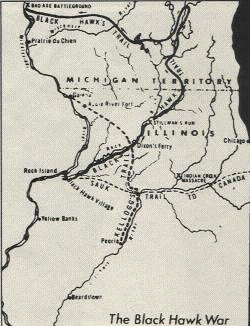
The Black Hawk War 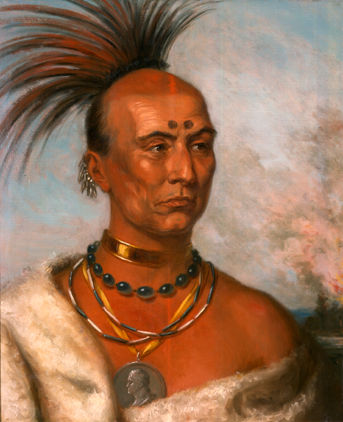
Following the War of 1812, in which the Sauk Indian leader Black Hawk (Indian name: Makataimeshekiakiak) fought with the forces of Tecumseh as an ally of the British against the United States, tension escalated between the American settlers and the Indians in what is now Illinois. Based on the Treaty of 1809, which many Sauk and Fox leaders signed, though many Indians did not recognize it, the government attempted to remove the local Native American tribes to locations west of the Mississippi, thereby freeing up more land on the east bank of that river for white settlement. By 1831, the government began a forceful removal of the Indians, including Black Hawk's Sauk tribe.
On April 5, 1832, Black Hawk returned to Illinois with nearly 400 men from the Sauk and Fox tribes, attempting to spark a general Indian uprising. He also believed that arms and other aid could be acquired from the British, who still still enjoyed sometimes bitter relations with the United States. This aid was not forthcoming. Black Hawk agreed with the philosophy of the late Tecumseh, who had also sided with the British, and believed that a united Indian front against the advances of the United States was their only hope to keep their traditional lands. To this end, he tried to rally other tribes to his cause. When no other tribes joined him, Black Hawk decided to surrender to the U.S. Army. After two of his five negotiators were killed by undisciplined local militia, Black Hawk's forces defended themselves against an attack by the militia forces. This clash, known as the Battle of Stillman's Run, turned into a victory for the Indians, as the militia found itself forced to retreat in panic. Thus encouraged, Black Hawk's forces conducted several attacks on settlers in the region, while evading the regular army and militia forces commanded by General Henry Atkinson and General Winfield Scott.
Eventually, Black Hawk decided that his hope of remaining on the east side of the Mississippi was futile and he led his band westward with the hope of re-crossing the river.
Black Hawk War of 1832--This project presents searchable primary source materials describing the Black Hawk War of 1832.
Illinois Black Hawk War Veterans Database--Database of Illinois Black Hawk War Veterans.
Black Hawk War Forum--A forum for genealogy enthusiasts.
Black Hawk--Brief biography of the Indian leader.
Captain Abraham Lincoln - Black Hawk War--Very informative article on Abraham Lincoln's role in the Black Hawk War and about life as a member of the Illinois militia which fought in that conflict.