Wars and Conflicts
of Lebanon
Lebanon has a long history of civil conflict involving its competing religious and ethnic factions. These factions include the Maronite Christian minority, who are often in conflict with the Muslim majority. The Muslims are themselves divided between the Sunni Muslim majority and the Shiite Muslim minority. The Druze peoples in the southern mountains form another distinct faction. Added to Lebanon's demographic divisions are the hundreds of thousands of (mostly) Muslim Palestinian refugees who live in permanent refugee settlements.
Prior to World War One (1914-1918) Lebanon was part of the Ottoman Empire. In the aftermath of World War One, the Ottoman Empire fell apart and France, one of the victors of the war, took control of Lebanon and Syria. Lebanon gained full independence from France in 1943.
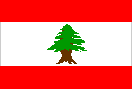
Lebanon Flag
Druze Revolt (1925-1927)--Rebellion by the Druze minority against French rule
Arab-Israeli War (1948-1949)-Lebanon joined the other Arab nations by invading the newly-created State of Israel. The Lebanese invasion was turned back by the Israelis. Israel and Lebanon would maintain an official state of war for many years.
Lebanese Civil War (1958)-Conflict between Lebanon's Christian and Muslim communities leads to a civil war which kills between 2,000 and 4,000 people. The United States lands several thousand Marines in Beirut in support of the government.
Israeli Raid on Beirut (December 28, 1968)
Palestinian-Lebanese Hostility (1969)
Christian-Shia Violence: Beirut (1969-70)
Lebanese-Palestinian Clashes (1970)
Lebanese-Palestinian Violence (1971)
Israeli Raid on Beirut (1973)
Lebanese-Palestinian Clashes (1973)
Lebanese Civil War (1975-76)
Kamal Jumblatt Assassination (March 16, 1977) -- Jumblatt was the leader of Lebanon's Druze minority. His murder is one of the sparks that set off the long Lebanese Civil War.
Tony Frangieh Assassination (June 13, 1978) -- A leader of the Christian Maronite faction, Tony Frangieh was the son of former Lebanese President Suleiman Frangieh. This assassination was part of the ongoing battle between the Marada Brigade of the Frangieh clan, and the Phalangist militia of the Gemayal family.
Israeli Invasion of Lebanon (1978)--Operation Litani was the official name of Israel's 1978 invasion of Lebanon up to the Litani river. The invasion was a military success, as the Israeli military expelled the PLO from Southern Lebanon, where they had created a de facto state within a state. An international outcry over the invasion forced a partial Israeli retreat and the creation of a United Nations patrolled buffer zone between the Arab guerrillas and the Israeli military.
Israeli Bombing in South Lebanon (1981)--In response to PLO rocket attacks, Israeli forces began heavy bombing of PLO targets in Lebanon. The United States negotiated a cease-fire.
The Israeli Invasion of Lebanon (1982-1984)--In response to repeated guerrilla attacks by the PLO, which were launched from South Lebanon, Israel invaded with the intent of destroying Arafat's forces. Syria, which maintained a large army in Lebanon, fought Israel and suffered an embarrassing defeat.
Bashir Gemayal Assassination (Sept. 14, 1982)--Gemayal, the President-elect of Lebanon, was killed by a bomb that destroyed the headquarters of his Phalangist Party. Gemayal was the leader of the pro-Israel and pro-Western Phalangist Party and a foe of Syria and the Palestinians.
The Israeli Occupation of South Lebanon (1984-2000)--As they withdrew from most of Lebanon seized in the 1982 invasion, Israel held onto a large part of Southern Lebanon with the aid of the "South Lebanon Army (SLA)," a militia set up and supported by Israel. This occupation was opposed by the PLO and other Palestinian groups as an extension of their long-running conflict with Israel. Also, other militia armies (mostly Lebanese Muslim groups), such as Hezbollah (supported by Iran and Syria), stepped up attacks on the Israeli-occupied region as well as on settlements and military targets in northern Israel. In 2000, Israel withdrew from Lebanon and the SLA disbanded.
Prime Minister Rashid Karami Assassination (June 1, 1987)--Karami was a Sunni Muslim and a veteran political leader. He was killed in a bombing that destroyed the helicopter he was flying in as he was returning to Beirut. Karami was an ally and supporter of Syria.
Grand Mufti Hasan Khaled Assassination (May 16, 1989)--Khaled was the chief legal cleric of Lebanon's Sunni Muslims. His death by car bomb is attributed to his moderate politics.
Nazem el Qadri Assassination (September 22, 1989)--El Qadri, a Sunni Muslim parliamentarian, was an opponent of Syria's occupation of Lebanon. His shooting death was seen as a not-too-subtle Syrian warning to other Lebanese politicians not to oppose Syria. Peace negotiations were underway in Taif, Saudi Arabia, and one of the items on the table was a deadline for a Syrian military withdrawal.
Lebanese President René Moawad Assassination (November 22, 1989)--Moawad, a Maronite Christian who had been President for only 17 days, died as his car was destroyed by a bomb in Beirut. Moawad had been attempting to form a unity government in order to end the civil war.
Dany Chamoun Assassination (October 21, 1990)-Chamoun was a Maronite Christian leader and the son of former Lebanese President Camille Chamoun. The younger Chamoun was an ally of General Michel Aoun, who opposed the pro-Syrian Government of President Elias Hrawi. Another Chamoun rival was Samir Geagea.
Operation Accountability/The Seven-Day War (1993)--Israeli Forces launched Operation Accountability (July 25-July 31, 1993), a week-long military campaign directed at Hezbollah (this conflict is called The Seven-Day War by the Lebanese).
Operation Grapes of Wrath (April 11-April 27, 1996) --Israel's massive air and artillery attack on Hezbollah targets in southern Lebanon which attempted to end shelling of northern Israel by the Iranian and Syrian-backed Lebanese Islamic militia. Israel forces launched 1,100 air raids and fired nearly 25,132 shells at Hezbollah targets during the sixteen-day offensive. A United Nations camp at Qana, Lebanon, was hit by Israeli shelling, killing 118 Lebanese civilians who sought shelter there. Nearly 640 Hezbollah rockets hit northern Israel in this time period, particularly the often-hit settlement of Kiryat Shemona. Israel's ally and proxy force, the South Lebanon Army (a mixed Christian and Shiite Muslim militia under the command of renegade Lebanese Major Saad Haddad), also engaged in ground fighting with Hezbollah. At least 350 civilians were wounded in Lebanon , and 62 Israeli civilians were wounded in Israel.
Prime Minister Rafik Hariri Assassination (February 14, 2005)--Prime Minister Hariri was a foe of the Syrian Occupation of Lebanon, and his murder was widely believed (though never proven) to be the work of Syria. His death sparked the so-called Cedar Revolution.
The Cedar Revolution (2005) -- The assassination of Prime Minister Hariri on February 14, 2005 triggered huge rallies opposing the 29-year Syrian occupation of Lebanon. The Cedar Revolution led to the withdrawal of Syrian forces in the spring of 2005.
George Hawi Assassination (June 21, 2005) -- Hawi, a member of the Christian minority, was another opponent of the Syrian Occupation to be assassinated, and a former head of the Lebanese Communist Party. Hawi was particularly critical of Syria's intelligence service and its influence in Lebanese affairs.
Pierre Gemayal Assassination (June 21, 2006) -- Pierre Gemayal, the son of former president Amin Gemayal and the nephew of Bashir Gemayal, was a cabinet minister.
Walid Eido Assassination (June 13, 2007) -- Eido was a member of Parliament and a Sunni Muslim. He belonged to the Future Movement, which was led by Saad Hariri and an opponent of Syrian influence in Lebanon.
June 16, 2007-The United Nations Security Council resolution creating an international tribunal to try suspects in the assassination of Rafik Hariri took effect.
The Israeli-Hezbollah War (also known in Israel as "The Second Lebanon War" (2006)--In response to repeated guerrilla attacks by the Shiite Lebanese militia Hezbollah, Israel invaded southern Lebanon, set up a naval blockade, and launched a powerful bombing campaign in order to win the release of two captured Israeli soldiers.

Hezbollah Troops
North Lebanon Conflict-(May 20, 2007- September 2, 2007)--This conflict began in May, 2007, when the Lebanese Army began a siege of the Nahr al-Bared refugee camp in order to drive out a militant Islamic militia called Fatah Islam. The resulting combat killed 158 Lebanese soldiers, 120 Fatah al-Islam militants and 42 civilians. The violence began on May 20, 2007, when Lebanese authorities raided a Fatah al-Islam safe-house in Tripoli, sparking a gun battle. The fighting spread to the nearby Nahr al-Bared camp, where Fatah al-Islam was based. The Lebanese Army quickly cordoned off the camp and began a siege which ended in September, 2007, as the defeated remnants of Fatah al-Islam attempted to break out of the camp and were destroyed in firefights with the Lebanese military.
Brigadier General François al-Hajj Assassination (December 12, 2007)-- General al-Hajj commanded the Lebanese Army in the North Lebanon Conflict's Battle of Nahr el-Bared, that pitted the government against the Fatah al-Islam militia. Al-Hajj was scheduled to succeed General Michel Suleiman (the president-elect) as the army chief of staff in 2008.
Hezbollah Rebellion (May 7-May 21, 2008)-Conflict between Hezbollah and the Lebanese government.
Syrian War (2011-Present)-Conflict between the Syrian government of Bashar al-Assad and the Free Syrian Army, a rebel group. The Syrian War began in the spring of 2011 as a protest movement, but evolved into a full-fledged civil war. The Lebanese Shi'ite militia, Hezbollah, which had long been an ally of the Assad regime, sent large numbers of fighters into Syria in 2013 to aid the Syrian government. One of the main battlegrounds involving the Hezbollah forces was the Syrian city of Qusair.
Lebanon's sectarian divisions, always just under the surface even in relative peacetime, have become frayed as a result of the Syrian War. Lebanese Sunni militias have also sent fighters into Syria to aid the rebels. Clashes in Tripoli between Shi'ite and Sunni forces have brought back worries of another full-fledged civil war.
In May, 2013, Syrian rebel forces retaliated against Hezbollah by firing rockets into Hezbollah-controlled Lebanese regions. The rebels fired 16 rockets near Baalbek in the Bekaa Valley, and a ground clash in the easternmost part of Lebanon (an area that juts into Syrian territory), occurred, resulting in several Syrian rebel dead. The Free Syrian Army says that they will continue to retaliata against Hezbollah as the Lebanese militia's intervention into the Syrian war continues. The Islamic State, one of the actors in the Syrian War, has seized small areas of territory along the Lebanese-Syrian border, prompting the Lebanese Army, along with Hezbollah, to engage in combat against ISIS forces in those border areas.
Lebanon Civil Strife (2020)-Following the massive explosion in the port area of Beirut in August, 2020, Lebanese citizens increasingly blamed the ruling political class for this disaster. Protests broke out, including a takeover of the foreign ministry building, among other government buildings. The situation puts the Lebanese government in a difficult position as it struggles to deal with this crisis. Police and security forces battled the protesters with tear gas and rubber bullets, as the situation worsened.
Copyright © 1998-2020 History Guy Media; Last Modified: 08.08.20"The History Guy" is a Registered Trademark