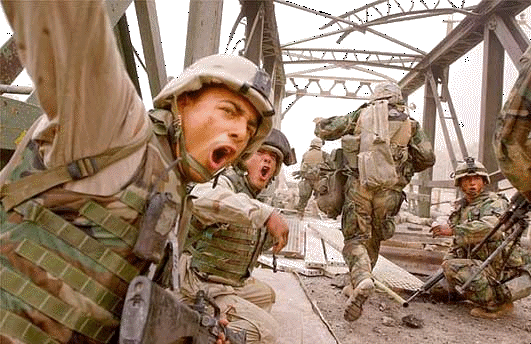
U.S. Marines Crossing a Bridge in Baghdad, Iraq, 2003
This page contains four current sections and one section not yet completed. The current sections are:
U.S. Marines Crossing a Bridge in Baghdad, Iraq, 2003
This page contains four current sections and one section not yet completed. The current sections are:
Current “Major” wars and conflicts in the world—Major conflicts are defined here as wars and conflicts in which more than a thousand people have died, involve more than one nation (for internal conflicts) or more than two nations (for international conflicts), and/or have the near-term potential to turn into a multi-national regional conflict. Alphabetical listing.
Afghan War (part of America’s world-wide War on Terrorism)--
Al-Aqsa Intifada (Israeli-Palestinian Conflict) (high-risk to become a regional war)--
Algerian Civil War—(1992-Present): After the Islamic Salvation Front won national elections in 1992, the military annulled the elections and the winning party's military wing, The Islamic Salvation Army (AIS), began a bloody rebellion. The AIS surrendered in June 1999, but other groups continue to fight the governme
Basque Separatist Conflict—(1958-Present): The rebel group called Basque Fatherland and Liberty guerrilla group (ETA) has waged an urban guerrilla movement against the Spanish government. The organization's goal is independence for the Basque region of northern Spain and southwestern France. Some operations have taken place in France, causing Paris and Madrid to cooperate. Approximately 800 deaths are attributed to the ETA's campaign.
Burma (Myanmar) Civil War—(1948-Present): In Earth's longest running and perhaps most complex conflict, several different ethnic groups attempted to secede in the years following World War 2. Most of these groups continue the struggle to this day, along with political dissidents who took up arms after a 1988 coup. Some areas of northern Burma have been controlled by Narco-guerrillas harvesting opium, which the government has attempted to halt. Military operations near border areas have brought both rebels and the Burmese government into occasional conflict with neighboring Thailand.
Burundi Civil War—(1994-Present): The Tutsi-dominated government is fighting Hutu rebels. The rebels use neighboring Congo as a base to launch attacks, thereby giving the Burundi government reason to involve itself in the Second Congolese War.
Colombian Civil War—(1964-Present): Marxist Guerrillas began a Cuban-inspired insurgency in the 1960s, which continued at a fairly low level until the 1990s, when the strength of the guerrilla groups increased due to their de facto alliance with narcotics-producing crime cartels. Over the past year (since 2001), the violence of the conflict has increased as the government realized that negotiations with the guerrillas were not leading to a peaceful solution. The United States is providing military and logistical support to the government.
Congo: Second Congolese War (This IS a regional war)—(1998-Present): Peace talks may soon end what has been called “Africa’s World War.” Congolese rebels, backed by Rwanda, Uganda and Burundi, seek the overthrow of President Kabila (the father was assassinated and his son then became president), who is supported by rebels from the above three countries, in addition to the armies of Angola, Zimbabwe and Namibia. Estimates put the number of dead in this war at over one million, mostly civilians. Also known as the “Great Lakes War.”
Chechnya (Russia): Second Chechen War--
Gaza War (2008-2009)--Renewal of the Israeli-Hamas Conflict as Israel responded to Hamas rocket attacks with air and ground attacks beginning on December 27, 2008
No-Fly Zone War (Iraq-Coalition Conflict ( 1992-2003)
Israeli Airstrikes on Syrian Forces in Lebanon—Part of ongoing conflict between Israel and Syria in Lebanon. (high-risk to become a regional war)—
July 1, 2001: Israeli warplanes struck a Syrian Army radar post and anti-aircraft site in Lebanon in retaliation for a Hezbollah attack on the Israel-Lebanon border in an area called the Cheba Farms. Israel believes Syria controls the Hezbollah and struck the Syrians in order to "send a message."
April 15, 2001: Israel dropped six bombs on a Syrian Army radar post in Lebanon in retaliation for a Hezbollah attack on the Israel-Lebanon border. Israel believes Syria controls the Hezbollah. Three Syrian troops died in the attack.
Israeli –Syrian Border Clashes—Part of ongoing conflict between Israel and Syria in Lebanon. (high-risk to become a regional war)—
January 10, 2003: Israeli troops shot and killed one Syrian soldier and captured another in an apparent attempt by the Syrian soldiers to infiltrate across the border into the Israeli-occupied Golan Heights. Approximately one hour after the initial shooting, a Syrian outpost opened fire on Israeli forces. Israel chose not to respond for fear of escalating the violence. Isael later turned over the body of the dead soldier and the prisoner to the United Nations for transfer back to Syria.
July, 1991: Three Syrians, members of a military intellegence unit, infiltrated into Israeli-Occupied territory near Mount Hermon. They fired an anitank weapon at an Israeli military outpost, killing one Israeli soldier.
Israeli-Palestinian Conflict-àSee Al-Aqsa Intifada (above)-- (high-risk to become a regional war)—
Gaza Strip Conflict/Gaza War
q q Ivory Coast (Cote d’Ivorie) Civil War—(Sept. 19, 2002-2007): Rebel soldiers (who later called themselves the Patriotic Movement of Ivory Coast (MPCI) launched a coordinated, nation-wide attack on forces loyal to President Laurent Gbagbo. Loyalist forces held onto the capital city of Abidjan, but lost control of the northern cities of Bouake and Korhogo. Initial reports had former military dictator General Robert Guei as the leader of the coup. It was also reported that he perished in the fighting. Ivory Coast has seen ethnic and religious violence since 2000 between northern Muslims (such as Guei) and southern Christians (such as President Gbagbo). The government also claims that rebel reinforcement entered the country from a bordering nation, most likely Burkina Faso to the north. Tensions have increased between the two West African nations partly as a result of the status of millions of migrant Burkina Faso citizens living in Ivory Coast seeking jobs. A cease-fire began on Oct. 17, which held until the last week of November, as government forces launched a new offensive with recently acquired helicopters and what appeared to be a unit of English-speaking mercenaries. Also, a new rebel group appeared, seizing several towns along the western border with Liberia. This group, calling itself the Ivorian Popular Movement for the Greater West, clashed with French peacekeeping forces that were attempting to evacuate Europeans from the area. This Yacouba-based tribal group, which appears to include some Liberians, may be connected to one of the factions involved in the Liberian Civil War. A second western rebel group, called the Movement for Justice and Peace, appears loyal to the late General Guei.
Kashmir Conflict (high-risk to become a regional war)—(1991-Present): Kashmir is divided between India and Pakistan, and a Kashmiri rebel movement is aided by Pakistan. Intermittent clashes along the border nearly turned into full-scale war in the summer of 1999 and in late 2001.
o o o Intense Clashes Along the LOC-- (Dec. 23, 2001-Continuing): Following the terrorist attack on India's Parliament, tensions between India and Pakistan increased, with machine gun, mortar and artillery fire across their border (Line of Control) in disputed Kashmir.o o Terrorist/Rebel Attack on the Indian Parliament in New Delhi—( Dec. 13, 2001): Kashmiri Terrorists attacked the Indian Parliament, attempting to blow it up during a legislative session. Security guard killed the militants before they could enter the Parliament building. 5 terrorists and 7 Indian security officers and 2 Indian bystanders were killed in the attack. This attack triggered a violent confrontation along the Line of Control (LOC) in Kashmir between the armies of India and Pakistan. India blamed Pakistan for aiding the rebels
Liberian Civil War--
Nepal Civil War—(Feb. 13, 1996- Present): Maoist Guerrillas seek to overthrow the Nepal monarchy though a rural uprising. This conflict has grown in intensity in recent months. Chinese aid to the rebels is alleged.
North Lebanon Conflict (2007)--Fighting between the Lebanese government and a Jihadist Palestinian militia calling itself Fatah al-Islam.
Northern Ireland Conflict—(1969-Present): This is the latest in a very long series of conflicts fought by Britain in Ireland. Northern Ireland is a part of the United Kingdom, with a Protestant majority loyal to London. The Irish Catholic minority has sought to break away and join the Irish Republic in the southern part of the island. The IRA and other groups have conducted a largely urban guerrilla campaign since 1969. Protestant para-military groups also wage an underground war against the Catholic population. Peace talks have been under way for some time. Over 2,500 deaths have occurred since1969.
Philippines Conflicts—
Muslim Rebellion in the Southern Philippines--(1969-Present): Muslim rebel groups seek autonomy/independence from the mostly Christian Philippines. One rebel group, the Abu Sayaf Group, is believed linked to Osama bin-Laden’s Al-Qaida. This connection, plus their tactic of kidnapping and beheading Americans, led the United States to send Special Forces to aid the Philippine Army.New People’s Army Rebellion--(1969-Present): The Communist New People’s Army (along with the rival Alex Boncayao Brigade (ABB); is attempting to overthrow the Philippine government and install a Marxist regime.
Rwandan Civil War—(1994-Present): The current Rwandan government is dominated by the Tutsi tribe, which overthrew the old government dominated by the Hutu tribe. Before losing power, the Hutu rulers and their militia massacred over half a million people. The Hutus now conduct a guerrilla war against the Tutsi government from bases in the Congo. Rwanda used the presence of these Hutu guerrillas to take part in both of the recent Congolese Wars.
Sri Lankan Civil War—(1983-Present): Sri Lanka's civil war is due to problems between the Tamil minority and the Sinhalese majority. In the 1980's, India intervened on the government's side, but has since withdrawn its troops. Over 70,000 deaths have resulted from this war. Peace talks have been under way for some time.
Sudanese Civil War—(1983-Present): This is a war based largely on racial, religious and regional differences. The government is dominated by Muslim Arabs, while the south of the country is largely black Christian.
War on Terrorism—Officially beginning Oct. 7, 2001, this American-led crusade against al-Qaida thus far involves: the campaign against al-Qaida and the Taliban in Afghanistan, the search by U.S. and Pakistani forces for al-Qaida followers in Pakistan, the deployment of U.S. special forces to aid government forces in the Philippines battle the Abu Sayyaf guerrillas on the southern Philippine island of Bamiyan, the deployment of U.S. special forces to Yemen to train and aid government forces dealing with rural tribes possibly allied with al-Qaida and the deployment of U.S. special forces to the republic of Georgia to train and aid government forces against rebels. Other military, para-military and covert missions are probably ongoing, but not yet public.
Ugandan Civil War--
Current “Minor” wars and conflicts in the world— Wars and conflicts, which are relatively small impact on the world or the region in which they occur. Placement on this list is somewhat subjective. For nations and individual people caught up in these conflicts, these wars are far from “minor,” but from the perspective of the world as a whole, they are possess a lower “profile” than the wars in the “major” category. This category also contains “one-time” occurrences such as the Korean border battles, which are part of a long-standing hostility. Generally speaking, these conflicts involve few than 1,000 deaths, involve only one nation (for internal conflicts) or only two nations (for international conflicts) and/or do not possess the likelihood of developing into multi-national regional conflicts.
Alphabetical listing.
Bougainville War of Independence—(1989-Present): The island of Bougainville seeks independence from Papua New Guinea.
Cabinda (Angola) Separatist War—(1984-Present): The Front for the Liberation of the Enclave of Cabinda (FLEC) seeks to separate the oil-rich enclave of Cabinda from Angola. On September 19, 2002, the Angolan army began a major military offensive against the Cabinda rebels.
Chad-Central African Republic Border Conflict—(Aug. 7, 2002): The armies of Chad and the CAR clashed in an exchange that left approximately two dozen dead. Each side blamed the other for initiating the attack. Tensions have been high since an attempted coup in the CAR last November.
Chittagong Hill Tracts War in Bangladesh- (1975?-Present): Peace settlements have ended some fighting, but at least one rebel group remains active.
Hmong Insurgency in Laos—(1975-Present): The Hmong ethnic group have fought the Communist government since it took power following the end of the Vietnam (2nd Indochina) War in 1975. Vietnam provides military aid and troops to the Laotian government periodically.
India: Minor Wars—A series of conflicts mostly involving ethnic groups seeking independence or autonomy from the central government. One conflict, the Naxalite War, is political rather than ethnic. These are in addition to the Kashmir Rebellion, which rates as a major conflict.
Hindu-Muslim Sectarian Violence—(1947-Present): Since independence from Britain in 1947, Hindus and Muslims in India have engaged in periodic outbursts of violence against each other. The latest mob violence in early 2002 in the state of Gujarat claimed 800 to 1,000 lives.Naga Rebellion—(1952-Present): The Naga ethnic group sought independence from India. A cease-fire took effect in 1997, though some Naga groups continue to oppose the government.
Mizo Rebellion—(Feb. 28, 1966-Present): The Mizo National Front (MNF) seeks independence from India for the Mizoram region.
Naxalite Guerrilla War—(May 25, 1967-Present): Beginning with a peasant uprising in the town of Naxalbari, this Marxist/Maoist rebellion sputters on in the Indian countryside. The guerrillas operate among the impoverished peasants and fight both the government security forces and the private paramilitary groups funded by wealthy landowners. Most fighting takes place in the states of Andhra Pradesh, Mahrashtra, Orissa and Madhya Pradesh.
Tripura Rebellion—(1979-Present): Tripura, in Northeast India, is embroiled in a separatist rebellion as several rebel groups fight for independence.
Assam Rebellion—(1980-Present): The United Liberation Front of Assam (ULFA) formed in April 1979 in response to an influx of non-Assamese from Bangladesh and parts of North East India. This movement seeks to evict those "foreigners" and seek greater autonomy from the Indian government.
Bodo Rebellion—(Mid-1980s-Present): The National Democratic Front of Bodoland (NDFB) is fighting for a separate state within India. They feel that their ethnic group is persecuted by the Assamese and Bengali groups which dominate the region.
Indonesia: Minor Wars—A series of rebellions against the government, along with sectarian and ethnic violence between Indonesia’s many ethnic and religious groups continues to threaten the unity and perhaps the continued survival of Indonesia. These do not include the recently resolved conflict in East Timor, which resulted in that island’s independence.
West Papua Rebellion—(1965-Present):Aceh Rebellion—(mid-1980s-Present):
Ambon Ethnic Violence—(1999-Present)
Sulawesi Sectarian Violence—(1998-Present): Violence between Muslims and Christians on the island of Sulawesi. Violence escalated in mid-2001, when thousands of members of a fundamentalist Muslim militia called Laskar Jihad arrived from the island of Java.
Iranian Mujahadeen Khalq Guerrilla War—(1979-Present): After the Iranian Revolution in 1979 toppled the government of the Shah, the Mujahadeen Khalq soon began a bloody guerrilla war against the new Islamic government. The Mujahadeen are currently based in Iraq and conduct cross-border raids into Iran, as well as conducting urban guerrilla operations in the cities and conducting political assassinations. Iran occasionally launches raids against Khalq bases in Iraq.
Japanese Coast Guard Sinking of Suspected Spy Ship—(Dec. 21 and 22, 2001): The Japanese Coast Guard chased a suspected spy ship and sank it. Crewmembers of the spy ship fired on the Japanese ships, wounding two Coast Guard sailors. The spy ship crew all perished when their vessel sank. Japan suspects the ship was North Korean.
Korean Border Battle at Sea—(June 28, 2002): North and South Korean naval vessels fought a twenty-minute gun battle in which 4 South Korean sailors died and 18 wounded near Yeonpyeong island in the Yellow Sea. A South Korean vessel was sunk and a North Korean vessel sustained damage, with casualties. This is one of several Korean border fights in recent years. News link—BBC
Korean Border Battle—(Nov. 27, 2001): The first cross-border shooting of 2001 between North and South Korea. North Korean troops fired several shots at a South Korean guard post. The South Koreans returned fire.
Kurdish Rebellion in Iraq—(1991-Present): Following Iraq's defeat in the Second Persian Gulf War (1990-1991), Iraq's Kurds rebelled, seeking independence. This is the latest in a long series of Kurdish uprisings. The Kurds currently enjoy autonomy in north Iraq under the protection of the United States and the United Kingdom.
Kurdish Rebellion in Turkey—(1984-Present): Rebel groups of the Kurdish ethnic group seek independence from Turkey.
Namibia: Caprivi Uprising—(Aug. 2, 1999-Present): The Caprivi Liberation Army, led by Namibian politician Mishake Muyongo, claims that the government is neglecting their region. Guerrillas attacked Namibian military and police on August 2 in the Caprivi area.
Niger Army Mutiny—( July 31-Aug. 9, 2002): Forces loyal to the government of Niger put down an army mutiny that had spread to several army garrisons across the country. The uprising is believed related to low pay for army soldiers. News link--BBC
Nigerian Minor Conflicts—(1991-Present): Various ethnic and religious groups in Nigeria engage in sporadic communal violence. More detail to be added soon.
Oromo Rebellion in Ethiopia—(1973-Present): Long-running rebellion by the Oromo Liberation Front. The OLF is currently allied to Eritrea, the Ogaden National Liberation Front (ONLF) and with the Aideed clan in Somalia--all of which are fighting the Ethiopian regime. See Ethiopian-Oromo Conflicts
Russian Bombing of Pankisi Gorge in Georgia—(September, 2002): Russian warplanes bombed the Pankisi Gorge in Georgia, which borders on Chechnya. Russia claimed that Chechen rebels used the Gorge as a staging area for attacks on Russian forces in Chechnya. Georgia protested the attacks.
Shiite Muslim Rebellion in Iraq--—(1991-Present): Following Iraq's defeat in the Second Persian Gulf War (1990-1991), Iraq's Shiites, a religious minority, rebelled against the government. Low-level guerrilla warfare continues in the southern marshes.
Somali Civil War (state of anarchy)—(1991-Present): The Somali government ceased to exist following the 1991 overthrow of dictator Siade Barre. Rival Somali groups fight for advantage but the net result is anarchy. In 1992 and 1993, United Nations forces, led by the United States, attempted to bring order to the country and head off a famine. After incurring casualties, the U.S. and the U.N. withdrew.
Tuareg Rebellion in Niger—
Yemen Tribal Conflict—(Dec. 19, 2001): Yemeni armed forces moved against several villages of the Abida tribe suspected of harboring al-Qaida fugitives. 24 soldiers and 16 members of the Adiba tribe perished. American Special Forces were in Yemen to train the government military so that operations such as this one against suspected terrorists could be undertaken. No Americans are known to have taken part in this operation. (part of America’s world wide War on Terrorism)--
Recently concluded or suspended wars and conflicts in the world—Wars and conflicts which, as of this page’s latest update, are concluded due to a cease-fire, peace treaty or some other apparently permanent cessation of hostilities. Many of these conflicts can easily re-erupt into violence. Generally, conflicts remain in this category until ten years have passed without a resumption of war. Alphabetical listing.
Angolan Civil War—(1975-April 4, 2002): After jointly fighting for independence against Portugal, the MPLA and UNITA, two rebel groups, fell into civil war over control of Angola. In the 1970s and the 1980s, the MPLA accepted aid from Cuba and the Soviet Union, while UNITA took aid from South Africa and the United States. UNITA used bases in neighboring Congo, which led the MPLA-led Angolan government to intervene in the Congolese Wars. After UNITA leader Jonas Savimbi’s death in early 2002, negotiations led to the April cease-fire.
Cambodian Civil War--
Chiapas Uprising in Mexico (“Zapatista Uprising”)—(Jan. 1, 1994- Present): Zapatista rebels, most of whom are Mexican Indians, launched a rebellion in the Southern state of Chiapas. Though no outright fighting has taken place since a
Congo-Brazzaville Civil War—(1997-2000):
East Timor War—(1975-1999)
Egyptian Muslim Rebellion—(1992-2000): Fundamentalist Muslim rebels seek to topple the secular Egyptian government. At least 1,200 people have perished since the beginning of the rebellion. The conflict was primarily waged as an urban guerrilla/terrorist war. The opposition Muslim Brotherhood took part in elections in 2000, indicating that they felt armed force would not work.
Second Eritrea-Ethiopia War—(1998-2000): Border war between two heavily armed east African neighbors with a long and violent history between them. Eritrea gained independence from Ethiopia in 1993 following a 30-year guerilla war.
Fiji Civil War--
Guinea-Bissau Civil War and Intervention—(1998-1999): An army rebellion against the Guinea-Bissau government plunged this West African nation into a violent civil war. Neighboring Senegal and Guinea-Conakry sent troops to aid the government. Despite this aid, the war ended with the rebel leader in control of the nation. Senegal intervened partially due to the rebellion in its own Casamance region, which borders on Guinea-Bissau.
Haiti Coup Attempt –( Dec. 17, 2001):
Israeli Occupation of Southern Lebanon –(1982-2000): Following the 1982-1984 Israeli Invasion and Occupation of Southern Lebanon, a border war has began in which Islamic and Palestinian guerrillas seek to drive Israeli troops from a strip of southern Lebanon which they occupied with the aid of the anti-government South Lebanon Army. Israel occasionally bombed and shelled areas throughout Lebanon. Israel withdrew from Southern Lebanon in mid-2000.
Intervention in Lesotho by South Africa and Botswana—Following election-related violence in Lesotho, neighboring South Africa and Botswana intervened to preserve the current government.
Kosovo War—(1998-1999): The latest round of the Yugoslav Civil War (or Third Balkan War) began as another ethnic rebellion against Serbian authority. NATO intervened to halt what it called the ethnic cleansing of Kosovo, turning this backwater war into a relatively significant air campaign leading to the liberation of the province from Serbian Yugoslav authority.
Madagascar Civil War—( June, 2002-July 7, 2002): Didier Ratsiraka and Marc Ravalomanana ran against each other in Madagascar’s presidential election of December 16, 2001. They disagreed on who should take charge of the government following Ravalomanana’s apparent victory, and violence between their supporters broke out in June, 2002. Ratsiraka fled the country in July after Ravalomanana gained the diplomatic support of the United States and France. BBC News Link
Peruvian Civil War—(1980-2000): The Peruvian government defeated the Maoist Sendero Luminoso (Shining Path) and the Tupac Amaru Revolutionary Saharan War—(1975-Present): A truce has been in place since 1991, but a permanent peace deal has not yet been reached. The Western Sahara is a former Spanish colony. When the Spanish left their Saharan colony, Morocco and Mauritania seized the area and the native Saharawi began a struggle for independence. Mauritania gave up its portion of the Western Sahara in 1979 and ended participation in the war.
Saudi-Yemen Border Conflict—(1998): Border conflict between two neighbors who have never gotten along. The border is ill defined and has been a source of conflict for decades.
Senegal Civil War (“Casamance War”)--
Sierra Leone Civil War—(March, 1991-2002):
Tajikistan Civil War—(1992-1997):
Yemeni Tribal Uprising—(1998): Rebellion by rural tribesmen protesting the poor economy. The Yemeni government alleges that Saudi Arabia coaxed the rebels into violence. Conflict between the government and the interior tribes occurs often.
Major Acts of Terrorism—This section is not yet complete, but will show major acts of terrorism from around the world. These attacks will be categorized by either the country they take place in, and/or the organization that conducted them. Terrorist acts which are an integral part of a major conflict (such as the Israeli-Palestinian conflict), generally will not appear here. Some attacks will appear twice, in the category showing where they took place and in the category showing who implemented the attack.
United States, Attacks in/or against— Attacks taking place in the United States or against American targets around the world.
Terrorist attack on the World Trade Center and the Pentagon—( September 11, 2001): Terrorists belonging to Osama bin Laden's Al-Qaida organization, hijacked four United States commercial passenger planes and flew them into the World Trade Center in New York City and the Pentagon in Virginia. The fourth plane crashed in Pennsylvania. This event triggered the Coalition invasion/liberation of Afghanistan and the continuing worldwide War on Terrorism.
al-Qaida, Attacks by—The radical fundamentalist Islamic organization dedicated to eliminating American influence in the Middle East (particularly in Saudi Arabia) and to the destruction of Israel.Attack on Israeli tourists in Kenya (Nov. 28, 2002): Israeli tourists in Kenya were targeted in two coordinated, nearly simultaneous attacks. Al-Qaida is a leading suspect in these attacks. Three men drove a SUV into an Israeli-owned Mombassa hotel, killing themselves and 13 others (10 Kenyans and 3 Israelis), destroying the hotel building. Then, as an Israeli passenger plane was taking off enroute back to Israel, two surface-to-air missiles were launched. One missile clipped the plane, but failed to explode. The other missile missed its target.
Attack on the French oil tanker Limburg (Oct. 6, 2002): An explosion caused by suicide terrorists, similar to the attack on the USS Cole two years earlier, killed one crewman of the Limburg and caused the spillage of over 90,000 barrels of oil into the Gulf of Aden.
Bali Bombing—(Oct. 12, 2002): Al-Qaida is suspected in the bombing of a nightclub frequented by foreign tourists in Bali, Indonesia. Among the 200 dead are at least 70 Australians, 21 Britons and 7 Americans.Tunisian Synagogue Bombing—(April 11, 2002): A natural gas filled truck crashed into a synagogue in Djerba, Tunisia. The blast killed 17 people, most of whom were German tourists. This was believed to be al-Qaida’s first attack outside Afghanistan since Sept. 11.
Terrorist attack on the World Trade Center and the Pentagon—( September 11, 2001): Terrorists belonging to Osama bin Laden's Al-Qaida organization, hijacked four United States commercial passenger planes and flew them into the World Trade Center in New York City and the Pentagon in Virginia. The fourth plane crashed in Pennsylvania. This event triggered the Coalition invasion/liberation of Afghanistan and the continuing worldwide War on Terrorism.
Attack on the USS Cole—(October 12, 2000):
U.S. Embassy Bombings –(August 8, 1998):
SOURCES:
1. Kohn, George C. Dictionary of Wars. New York: Facts On File Publications. 1986.
2. Marley, David F. Wars of the Americas: A Chronology of Armed Conflict in the New World, 1492 to the Present. Santa Barbara, California: ABC-CLIO, 1998.
3. Langer, William L., ed. An Encyclopedia of World History. 5th ed. Boston, Massachusetts: Houghton Mifflin, 1972.
4. Banks, Arthur S., ed. Political Handbook of the World: 1994-1995. 5th ed. Binghamton, NY: CSA Publications, 1995.
5. Project Ploughshares--http://www.ploughshares.ca/
The Correlates of War (COW) Project
Please cite this source when appropriate:
Lee, Roger A. "New and Recent Wars & Conflicts of the World." 18 Jan., 2012. The History Guy Website. Date accessed <http://www.historyguy.com/current_conflicts/index.html>.
Lee, R.A. (2012). New and Recent Wars & Conflicts of the World. The History Guy Website [# of pages or paragraphs]. Retrieved [insert date] from http://www.historyguy.com/current_conflicts/index.html
Afghanistan War (2001-Present)--The war in Afghnistan began with the American and allied response to the 9/11 terror attacks on the United States. The Taliban government was overthrown, and a new regime installed. The U.S. the Afghan government, and NATO forces are still trying to pacify parts of the country where the Taliban and al-Qaida forces operate.
Read the latest news stories on the Afghanistan War collected for you on the History Guy's War and Conflict Journal Blog.
Ethiopian Intervention in Somali Civil War (2006-Present)- The long-standing Somali Civil War (1988-Present) entered a new phase with the growth of the Union of Islamic Courts, an Islamic militant group, gained control of Mogadishu and the central part of Somali. The UIC is in opposition to the official, yet weak, government based in Baidoa. In late 2006, Ethiopia sent troops to Baidoa to support the government against the Islamic forces. In late December, 2006, Ethiopian planes bombed the Mogadishu airport and ground troops seized control of three towns, including one on the border.
Nations/Groups involved: Ethiopia, Somali Transitional Government, United States vs. Islamic Militants.
Read the latest news stories on the Ethiopia-Somalia Conflict collected for you on the History Guy's War and Conflict Journal Blog.
Hmong Insurgency in Laos (1975-Present): The Hmong ethnic group have fought the Communist government since it took power following the end of the Vietnam (2nd Indochina) War in 1975. Vietnam provides military aid and troops to the Laotian government periodically.
Nations/Groups involved: Laos, Vietnam vs. Hmong rebels.
Naxalite Guerrilla War (May 25, 1967-Present): Beginning with a peasant uprising in the town of Naxalbari, this Marxist/Maoist rebellion sputters on in the Indian countryside. The guerrillas operate among the impoverished peasants and fight both the government security forces and the private paramilitary groups funded by wealthy landowners. Most fighting takes place in the states of Andhra Pradesh, Mahrashtra, Orissa and Madhya Pradesh.
Nations/Groups involved: India vs. Naxalite Communist rebels.
Naga Rebellion (1952-Present): The Naga ethnic group sought independence from India. A cease-fire took effect in 1997, though some Naga groups continue to oppose the government.
Nations/Groups involved: India vs. Naga rebels.
Copyright © 1998-2022 History Guy Media; Last Modified: 12.20.20
"The History Guy" is a Registered Trademark.