Historyguy.com
Wars and Conflicts of England and Great Britain
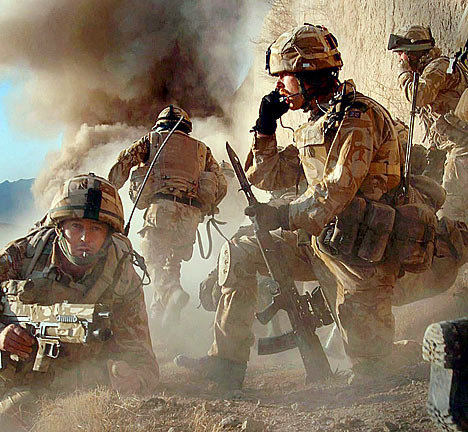
British Soldiers in Afghanistan
Great Britain is really only a part of the United Kingdom of Great Britain and Northern Ireland, but it is of course, the largest part. Great Britain itself is an island off the northwest coast of Europe and is comprised of three countries united into one kingdom. Those three countries are: England, Scotland, and Wales.
For many centuries, these three nations, along with Ireland, waged war against each other. Eventually, the English defeated the Scots and the Welsh (and the Irish), and a series of Acts of Union were passed that eventually resulted in what would later be known as the United Kingdom. In 1535, England and Wales were united as one kingdom, and in 1707, the Act of Union brought Scotland into the Kingdom of Great Britain.
This page presents a listing, with some details, of many of the wars of Great Britain (including separate English and Scottish wars) from early history to the present.
The Norman Conquest of England (1066-1072)
The Hundred Years' War (1337-1453)-The Hundred Years' War was actually a series of wars between England and France which lasted 116 years. Most historians break this conflict into four distinct wars.
Anglo-French War (1337-1360)Anglo-French War(1369-1373)
Anglo-French War (1412-1420)
Anglo-French War (1423-1453)
Wars of the Roses (1455-1485)-- A series of civil wars in which two royal houses (families) fought for control of England. The House of Lancaster (Tudor family) defeated the House of York.
English Civil War (1641–1651)-- Actually three related civil conflicts between the English Parliament and its supporters against the Royalist followers of King Charles I and King Charles II. The war resulted in the temporary overthrow of the English monarchy.
Anglo-Dutch War (1652-1654)--
Anglo-Dutch War (1664-1667)--
Anglo-Dutch War (1672-1674)--
War of the Quadruple Alliance (1718–1720) - Pitted Britan, the Holy Roman Empire, France, the Dutch Republic, and Savoy against Spain .
War of the Austrian Succession (1742–1748) - Great Britain, Austria and Holland warred against France and Prussia.
King George's War (1744–1748) ---The North American portion of this war, fought between Britain and France in their American colonies.Seven Years' War (1756–1763) - Great Britain and Prussia fought against Austria, France, Russia, Sweden, and Spain.
French and Indian War (1754–1763) -The North American portion of this war, fought between Britain and France in their American colonies. The French and Indian War ended in a total victory for the British and their American colonists. The British victory though, set the stage for the American Revolution a few years later.The American War of Independence (1775-1783)--
War of the First Coalition (1792-1798)-Britain, Austria, Prussia, Spain, Russia, Sardinia and Holland combined to fight Revolutionary France. Russia left the Coalition in 1794 to deal with troubles in Poland. French victories forced Holland, also known then as the Batavian Republic, to leave the Coalition in 1795. Prussia and Spain made peace with France in 1795 and Austria signed the Treaty of Campo-Formio in 1798, surrendering the Austrian Netherlands (now Belgium) to France.
War of the Second Coalition (1798-1801)-Britain, Austria, Russia, Portugal, Naples and the Ottoman Empire combined to fight Revolutionary France. Spain later joined France against Portugal. This alliance against France formed to counter French moves in Italy; formation of the Roman, Ligurian, Cisalpine and Helvetic Republics in Switzerland and Italy, and the deposition of Papal rule in Rome. Naples was conquered by the French in early 1799 and declared to be the new Parthenopean Republic. Napoleon Bonaparte invaded Turkish Egypt and won the Battle of the Pyramids, continuing his march into what is now Israel and Lebanon. British Admiral Horatio Nelson wiped out the French fleet at the Battle of the Nile in 1798. Due to French victories on land against both Turkish and British troops, the Ottoman Empire made peace with France at the Convention of El-Arish in 1800.
Anglo-French War (1803-1814)--While other European nations waged war and then sued for peace against Napoleonic France, Britain was in a continual state of war against France from 1803 through the first defeat of Napoleon in 1814.
Peninsular War (1807-1814)-This war began with the French Invasions of Portugal and Spain, and also included Great Britain, who sent forces to help the Portuguese and Spanish drive out the French. From the British perspective, the Peninsular War was a part of the long-running war between Britain and France from 1803 to 1814.
The Chesepeake Affair (June 22, 1807)--Naval battle between USS Chesapeake and HMS Leopard
Little Belt Affair (May 16, 1811)--Naval battle between USS President and HMS Little Belt
The War of 1812 (1812-1814)--2nd war between the United States and Great Britain
War of the Seventh Coalition (1815)-After Napoleon's return to France from exile, Britain, Russia, Prussia, Sweden, Austria, the Netherlands and a number of smaller German states combined to fight Napoleon and France. The allies defeated Napoleon once and for all at the Battle of Waterloo.
First Anglo-Afghan War (1838–1842)--
First Opium War (1839-1842)--British-Chinese War
The Crimean War (1853–1856)--Britain, France, and Sardinia joined together to aid the Ottoman Empire, which was under attack by Russia.
Second Opium War (1856-1860)----British-Chinese War.
Second Anglo-Afghan War (1878–1880)--War between Britain and Afghanistan.
First Boer War (1880–1881) --British forces battled Dutch-descended Boers in southern Africa.
The Second Boer War (1899-1902)--Britain vs. The Boer Republics (Orange Free State and Transvaal) in what is now South Africa.
Somali "Mad Mullah" Jihad (1899-1905)--Somali tribesmen led by religious leader Muhammad ibn Abd Allah Hasan waged a desert guerrilla war against Britain, Italy and Ethiopia. Following repeated defeats by the Somalis, the colonial powers offered him territory in Italian Somaliland in exchange for peace. He resumed his war in 1908 and harassed the occupiers of his country until 1920.
The Boxer Rebellion (1899-1900)-- The Chinese secret religious and nationalistic Society of the Righteous Harmonious Fists (Boxers), initiated a rebellion against both foreign colonizers, missionaries and their own government in 1899. By 1900, the Chinese government had co-opted the rebels and directed their violent fury entirely upon the foreign presence in China. The Boxers, aided by Chinese Imperial troops, besieged the diplomatic legations (embassies) of the Western powers and Japan, sparking a truly international response. A retaliatory relief expedition composed of troops from: the United State, Great Britain, France, Germany, Italy, Austria-Hungary, Russia and Japan invaded China and captured the capital of Peking (now called Beijing).
World War One (1914-1918)--The first "official" world war was originally known as "The Great War," and also as "The World War."
Russian Civil War--Britain, along with the United States, France, and Japan, intervened unsuccessfully in the civil war in Russia that brought the Communists to power.
Anglo-Irish War (1919–1921)--Resulted in the formation of the Irish Free State, and the division of Ireland, with the six northern counties (Ulster), chosing to remain a part of the United Kingdom.
Third Anglo-Afghan War (May-August, 1919)--
World War Two (1939-1945)
Anglo-Iraq War of 1941 (April 18, 1941 to May 30, 1941)--The Anglo-Iraqi War of 1941, also known as the Rashid Ali Coup, was a relatively small, but very significant part of the Second World War. Since the ending of the British Mandate and the advent of full Iraqi independence in 1932, Britain retained a great deal of military influence in Iraq, despite lingering opposition from many Arab nationalists. One of these nationalists, Rashid Ali, seized power in Baghdad and refused British requests to allow British military forces to enter Iraq. Britain at this time was fighting German and Italian forces in North Africa and were preparing to invade Vichy French-held Syria. (The Vichy French were working with the Germans and British and Free French forces needed to secure the region). Believing promises of German support, Rashid Ali ordered his forces to attack British bases in western Iraq and to oppose the landing of British forces at the southern city of Basra. German support appeared in the form of a small number of Luftwaffe fighter planes, and the British forces quickly defeated the Iraqi military.Cold War (1945-1990)--Britain, along with the United States and other Western nations, formed the backbone of anti-Communist resistance in the Cold War.
Greek Civil War (1944-1947)--British forces became involved in the early stages of the Greek Civil War when they liberated Greece from German occupation toward the end of 1944. As the Germans withdrew, competing Greek factions fought for control. The British sided with the re-established Greek government against the Communist rebels. Due to financial pressures and their own need to recover from World War Two, Britain announced a withdrawal of forces in 1947. The Greek Civil War continued until 1949, with the United States taking over the role of protector for the government. British combat involvement primarily took place in 1944 and 1945. The Greek Civil War continued until the Greek government defeated the rebels in 1949.
Palestine (1945-1948)
Malayan Emergency (1948-1960)
Korean War (1950-1953)--Britain contributed significant military forces to the United Nations cause.
Anglo-Egyptian War of 1951-1952 (1951-1952)--Egyptian guerrillas, aided by the governement carried out a campaign against British forces stationed at the Suez Canal and agains other symbols of Britain and the West. On January 25, 1952, British troops retaliated against Egypt by attacking an Egyptian police station, killing 50 and wounding 100. The conflict ended with a change in the Egyptian government and the eventual withdrawal of British troops. This conflict led to Britain's involvment in the 1956 Anglo-French-Israeli invasion of Egypt in 1956. (see below)
Mau Mau Insurgency in Kenya (1952-1956)
Suez War of 1956--(1956)--Britain and France invaded Egypt (in conjunction with Israel), in an ill-planned attempt to take control of the Suez Canal from Egypt.
Cyprus Emergency (1955-1959)
Muscat and Oman Intervention (1957-1959)--British troops aid the government of Muscat and Oman (now known simply as Oman), against rebels. British troops withdrew after a successful campaign.
Jordan Intervention (1958)--Britain airlifted troops to Jordan in response to a request for aid from the Jordanian king. King Hussein felt threatened by the recent union of Syria and Egypt, as well as the violent revolution in Iraq in which the Iraq king, a member of Hussein's family, was brutally murdered. After the situation calmed down, British troops left Jordan.
Brunei Revolt (1962) --
Indonesia-Malaysia confrontation (1962–1966) --
Ugandan Army Mutiny (1964)--The army of Uganda, which had recently become independent of Britain, mutinied against the government of President Milton Obote in January of 1964. Unable to control the situation, Obote called for help from British forces who put down the revolt.
Aden Conflict (1964-1967) --South Yemeni rebels waged guerrilla warfare against British colonial rule.
Conflict in Northern Ireland (1969-1998)--Low-level assymetric warfare (largely urban guerrilla warfare, with some rural combat) in which British military forces campaigned against the Irish Republican Army (IRA). The conflict ended via a political settlement in 1998.
Falkland Islands War (1982)-The military dictatorship in Argentina mistakenly believed that Britain, led by Prime Minister Margaret "Iron Lady" Thatcher, would not wage a war over the tiny Falkland Islands in the South Atlantic. When the Argentines invaded the British-owned and British-inhabited Falkland Islands in April of 1982, the British responded by sending the Royal Navy and other military units to liberate the islands from the Argentine invaders. The British defeated the Argentines and liberated the islands. As a direct result of the disasterous war with Britain, the Argentine dictatorship fell and was replaced by a democracy.
Gulf War (1991)--Britain was one of the major Western allies to resist Iraq's invasion of Kuwait
The Bosnian War (1995–1996) --NATO operation to protect Bosnia from Bosnian Serb rebels and regular Serbian military forces.
The Kosovo War (1999) --NATO operation to protect Kosovar Muslims from Serbian militias and regular Serbian military forces.
Afghanistan War (2001-Present)--Britain joined with the United States and other allies to oust the Taliban and al-Qaida from power in Afghanistan in the wake of al-Qaida's September 11 attacks on the United States.
Global War on Terror (2001-Present)--Britain and many other nations around the world are engaged in military, political, economic, and diplomatic efforts to combat Islamic Militancy in Afghanistan and elsewhere.
2007 Glasgow International Airport attack (June 30, 2007)--Two Islamic Militants drove a vehicle filled with propane canisters through the entrance to Glasgow International Airport in Scotland. Five people were injured, and one of the militants died of burns and injuries.London Terror Bombings (July 7, 2005)--Islamic militants exploded bombs in the London subway system and on a double-decker bus in reaction to Britain's involvment in the Iraq War. The bombings claimed 52 victims, and caused nearly 700 casualties. The four suicide bombers also died.
London Terror Bombings (July 21, 2005)--Islamic militants exploded four bombs in London, and a fifth bomb failed to explode properly. No casualties.
Iraq War (2003-2009)--Britain, along with the U.S., Australia, and Poland, invaded Iraq to drive out the regime of dictator Saddam Hussein. British forces ended their participation in the war in Iraq on April 30, 2009.
Libyan War (2011)-The UK joined with other NATO nations and pro-Western Sunni Arab nations to aid Libyan rebels overthrow Libyan dictator Muammar Ghaddaffi.
Islamic State War (2014-Present)--In response to the threat posed by the Islamic State (in Iraq and Syria, among other locations), the British Parliament on September 26, 2014 voted to begin Royal Air Force airstrikes against the Islamic State (AKA ISIL or ISIS) in northern Iraq at the request of the Iraqi government. British airstrikes on ISIS in Syria began after the December 2, 2015 Parliament vote to begin operations in that country. British allies in this ongoing war include the United States, France, and multiple other coalition nations.
Mali War (2020)-British troops are deployed in Mali to assist the UN mission there that is fighting the Jihadist rebels. The Mali War itself began in 2012 with a Jihadist/Taureg rebellion against the government. France has nearly 5,000 troops in Mali, and the British SAS currently has a small force in-country, with another 250 long-range recon troops on the way.
"The History Guy" is a Registered Trademark