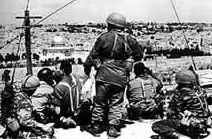
This page deals with the Six-Day War of 1967. Please use the following information, links and sources to learn more about the war in which Israel captured East Jerusalem, the West Bank, Gaza, the Sinai, and the Golan Heights.
A brief summary of the campaign:
Following the short Suez War of 1956 between Israel and Egypt resolved nothing, and only set the stage for a future war between the Jewish nation and its Arab neighbors. In the 1956 war, Israeli forces fairly easily defeated the Egypian military and occupied the Sinai Peninsula and Gaza Strip, only to give it back to Egyptian control in the ceace-fire agreement. In the years after 1956, Egypt and the other Arab powers, Syria and Iraq, more closely became aligned with the Soviet Union, which supplied them with large amounts of modern military weaponry and Soviet advisors and trainers. Likewise, Israel moved closer to the United States in those years, to the point where the Arab- Israeli Conflict became a part of the larger and very dangerous Cold War between the U.S. and its allies on one side, and the Soviets and their allies and satellites on the other side.
As the underlying tensions between the Arab nations and Israel remained unchanged since the First Arab-Israeli War of 1948-1949, the outbreak of a third major war was expected. The introduction of the American-Soviet competition and arms sales in the region only accelerated the likelihood of a Middle Eastern war evolving into a Cold War confrontation. the immediate cause of war in 1967 came out of Egypt's decision to expel United Nations (UN) troops from the Sinai peninsula and blockade Israel's port of Eilat. The UN forces were intended to form a buffer between the border separating Israel and Egypt, and their expulsion led the Israeli government to fear an imminent attack by Egypt.
It should be pointed out that ever since the start of the first war in 1948, Israel had existed in a continued legal state of war with all of its Arab neighbors, including Iraq and Saudi Arabia. The first two wars were ended with cease-fires, but with no lasting peace, not unlike the concusion of the 1950-1953 Korean War, in which an armistice ended the fighting, but did not bring a legal end to war. Thus, when the military forces of Egypt, Syria, and Jordan, as well as Iraq, began to mobilize and make obvious preparations for war, Israel felt forced to act in self-defence.
On June 5, 1967, Israel launched a pre-emptive ground attack on Egypt, along with coordinated air strikes that effectively destroyed the air forces of Egypt, Syria, Jordan, and Iraq on the ground.
General Links:
Encyclopedia of the Orient: Six-Day War - Includes hypertext links to background information on the countries involved in the Six Day War.
Israel 1967 and Afterward - From the U.S. Army Area Handbooks.
Israel at Fifty: Our Introduction to The Six Day War - Why the war was so important, and how it affects Israel today.
Six Day War - An Introduction - Including pages on the Egyptian, Jordanian, and Syrian fronts, as well as a map. From the Israel Defense Forces website.
Six Days in June - Essay on the Six Day War by William C. Varner.
Who Made Israel's Computer Models for the 1967 War? -- from "Computers and
Society." An interesting article on a little-known aspect of the war.
The Disaster of 1967--From the Jordan government website.
Six Day War --From the Israel Defense Forces website.
The Attack on the U.S.S. Liberty During the Six-Day War
USS Liberty--Dedicated to the the thirty-four men who gave their lives in an attack by the armed forces of Israel against a U.S. Navy ship.
Egyptian President Nasser
Gamel Abdel-Nasser Homepage
Speech by Nasser: Sept. 15, 1956--Nasser's speech on the Suez Canal and negotiations with Britain and France.
Sources:
Phillips, Charles, and Alan Axelrod.Encyclopedia of Wars. 1st ed. New York: Facts on File, 2004.
Marshall, S.L.A.Sinai Victory: Command Decisions in History's Shortest War: Israel's Hundred-Hour Conquest of Egypt. Morrow, New York, 1958.
Herzog, Chaim.The Arab-Israeli Wars: War and Peace in the Middle East from the War of Independence through Lebanon. Vintage Books, New York, 1982.
Barker, A.J.Arab-Israeli Wars. Hippocrene Books, New York, 1980.