
The History Guy:
The History Guy:
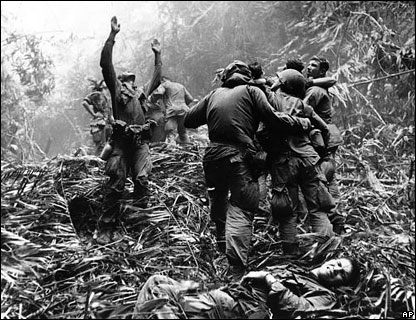
Soldiers in the Vietnam War
Click on the links immediately below to view a particular set of conflicts. Under each set of conflicts, ( for example, "Wars of the United States"), you will find more blue links leading to pages devoted to each individual conflict.
War List Page Format: the format used for these lists is fairly simple. If a conflict can be broken up into one or more component parts, the secondary wars are listed below the primary war and are indented to show they "belong" to it.
An example: Second Indochina War (1956-1975)Vietnam War (1964-1973)--The "advisory" phase of U.S. involvement goes from 1956 to 1964, and then resumes from 1973 to 1975. The years 1964 to 1973 refer to the period of "official" combat deployment of U.S. forces in the war.Cambodian Civil War (1970-1975)
Laotian Civil War (1960-1975)
In this example, the wars in Vietnam, Cambodia and Laos are all considered to be part of the larger "Second Indochina War." The blue link signifies a separate page exists for this war.
**One last note: The names of some categories, such as "Wars of the United States", are merely to show what wars the U.S. has fought. This title is not to imply that conflicts such as World War 2 were entirely an American conflict. For example, "Wars of Iraq" or "Wars of Mexico" show wars fought by those nations.
Wars of
European Nations Wars of African
Nations Wars of Asian
Nations Wars of North
American Nations Wars of Latin
American Nations Wars of Middle
Eastern Nations Sino-Tibetan
Wars --Wars and Conflicts Between Tibet and
China
Wars of the Hapsburg Empire (Austria Hungary) from 1815 to 1918
Revolution of 1848 (1848-1849)-Austrian government and Russia against anti-monarchist rebels and Czech and Hungarian nationalist rebels. The revolutionary fervor also led to the Italian War of Independence (1848-1849)
Italian War of Independence (1848-1849)-Italian revolutionaries in Venice, along with the Italian States of Piedmont, Naples and, briefly, Papal State fought against the Austrian Hapsburg Empire. The Italian forces were divided and defeated by August of 1849.
Franco-Austrian War (1858-1860)-France and Piedmont against the Austrian Hapsburg Empire.
Schleswig-Holstein War (1864)-Austria and Prussia crushed Denmark.
The Seven Weeks' War (1866)-Italy and Prussia against the Austrian Hapsburg Empire.
Annexation of Bosnia-Hercegovina (1878)-Peaceful and internationally accepted occupation of Slavic region previously controlled by the Turks. Beginning of prolonged tension with Russia and Serbia. Leading factor in the outbreak of World War I.
Provincial Revolt (1882)
World War I (1914-1918)--Last war of the Hapsburg Empire.
Wars of the Russian Empire from 1815 to 1918
Russian Conquest of Central Asia and the Far East (Ongoing)Decembrist Uprising (1825)-Short-lived military revolt.
Russo-Persian War (1826-1828)-Russia defeated Persia and acquired parts of Armenia.
Russo-Turkish War (1828-1829)-Russia defeated the Ottoman Turks. Related to the Greek War of Independence.
Polish Revolution (1830-1831)-Russian-ruled Poland rebelled and was crushed. Inspired by 1830 Paris Revolution.
The Crimean War ( 1853-1856)-Britain, France, the Ottoman Empire and Sardinia against Russia.
Second Polish Revolution (1863-1864)-Poland rebels waged a mostly guerrilla war. Rebellion defeated.
Russo-Turkish War (1877-1878)-Caused by Turkish problems with Slavic Balkan states. Treaty of San Stefano guaranteed independence from Turkey for Serbia, Montenegro, Rumania and autonomy for Bulgaria. Russia received land in the Caucasus region.
Boxer Rebellion (1900)-Involved Britain, France, Germany, Russia, the United States, Japan, Italy, and Austria-Hungary against "Boxer" rebels in China as well as against the Chinese government. Gave Russia an opportunity to occupy Manchuria, which led in part to the Russo-Japanese War.
Russo-Japanese War (1904-1905)-Russia soundly defeated by Japan.
Russian Revolution of 1905 (1905-1906)-Popular uprising against the Czarist government. Harshly suppressed by the army.
World War I (1914-1918)-Last war of the Czarist Russian Empire prior to the Bolshevik (Communist) Revolution.
French Wars In Italy This series of wars, part of the ongoing Hapsburg-Valois Wars, involved repeated French invasions of Italy, which at the time consisted of several smaller states and kingdoms. Italy was really little more than a battleground for the two most powerful empires in Europe at that time: France and the Hapsburg Empire, which controlled Austria, Spain, the Netherlands and other areas.
Naples-Fornovo (1492-1497)Milan (1499-1500)
Naples-Gaeta (1500-1504)
Revenna-Novara (1508-1513)
Marignano (1515-1516)
Anglo-French Wars-Wars between England (also known as Great Britain or the United Kingdom), and France.
Norman Invasion of England, (1066) -William the Conqueror, Duke of Normandy and a vassal of the French king, conquered the Anglo-Saxon kingdom of England, and made himself King of England. Resulting from this, the English and French royal families would fight many bloody wars trying to settle who was supposed to rule what. William's family acquired lands throughout France and ruled them as Englishmen, which really upset the French kings. This is a pretty watered-down, basic description of this rivalry, but these two nations have fought many, many wars, and William's conquest of England was the starting point for many of the earlier ones.Anglo-French War, (1109-1113)
Anglo-French War, (1116-1119)
Anglo-French War, (1123-1135)
Anglo-French War, (1159-1189)
Anglo-French War, (1202-1204)
Anglo-French War, (1213-1214)
Anglo-French War, (1242-1243)
Anglo-French War, (1294-1298)
Anglo-French War, (1300-1303)
The Hundred Years' War (1337-1453)-The Hundred Years' War was actually a series of wars between England and France which lasted 116 years. Most historians break this conflict into four distinct wars.
Anglo-French War, (1337-1360)Anglo-French War, (1369-1373)
Anglo-French War, (1412-1420)
Anglo-French War, (1423-1453)
Anglo-French War, (1475)
Anglo-French War, (1488) -Also known as Henry VII's Invasion of Brittany (a region in NW France).
Anglo-French War, (1489-1492) -Also known as Henry VII's Second Invasion of Brittany.
Anglo-French War, (1510-1513)-Also known as the War of the Holy League, England joined with the Pope, several Italian states, Swiss cantons and Spain against France. King Henry VIII of England won a favorable peace from France after winning the Battle of the Spurs on August 16, 1513. The rest of the Holy League continued fighting France until the Pope Julius II's death, which helped cause the dissolution of the League.
Anglo-French War, (1521-1526)-Henry VIII joined the Hapsburg Empire in a war against France. The war proved unpopular in England and expensive financially, and the King had difficulty raising money from Parliament. After 1523, England did not participate much in the war.
Anglo-French War, (1542-1546)-Henry VIII again joined the Hapsburg Empire in a war against France. The English captured the port of Boulogne and the French had to accept that seizure when the peace treaty was signed. The war cost England two million English pounds.
Anglo-French War, (1549-1550)-French King Henry II declared war with the intention of retaking Boulogne, which fell to him in 1550. This war was preceded by years of border combat short of all-out war.
Anglo-French War, (1557-1560)-England's Queen Mary drew her country into war allied to Spain , whose king was her husband. A very unpopular war with the English people. England lost possession of Calais on the French mainland. When Queen Elizabeth later took the throne, religious and political differences would make England and Spain bitter enemies.
Anglo-French War, (1589-1593)-England was caught up in the great Protestant-Catholic wars sweeping Europe. England sided with Protestant Dutch rebels against Catholic Spain and with the Protestant (Huguenot) French against the Catholic French in the Wars of Religion, a series of French religious civil wars. In 1589, while still fighting Spain after defeating the famous Spanish Armada, Elizabeth sent troops to aid the French Protestants.
Anglo-French War, (1627-1628)-Also known in France as the Third Bearnese Revolt, England came to the aid of Huguenot rebels fighting the French government.
Anglo-French War, (1666-1667)
Anglo-French War, (1689-1697)-Known in Europe as the War of the League of Augsburg AND as the War of the Grand Alliance. In North America the colonial aspect of the conflict was known as King William's War.
Anglo-French War, (1702-1712)-Known in Europe as the War of the Spanish Succession, in North America as Queen Anne's War and in India as the First Carnatic War. This conflict also included the Second Abnaki War. The Abnaki Indian tribe allied itself with the French against the English colonists in North America.
Anglo-French War, (1744-1748)-Known in Europe as the War of the Austrian Succession and in North America as King George's War.
Anglo-French War, (1749-1754)-Known in India as the Second Carnatic War. The British East India Company and its Indian allies battled the French East India Company and its Indian allies.
Anglo-French War, (1755-1763)-Known in Europe as the Seven Years' War and in North America as the French and Indian War. France forever lost possession of Quebec/Canada. In many ways, England's victory set the stage for the American Revolution.
Anglo-French War, (1779-1783)-Also known as the American Revolution. Also involved Spain, the United States and the Netherlands against Britain. Can also be considered as an Anglo-French War, an Anglo-Spanish War and an Anglo-Dutch War.
Wars of the French Revolution, (1792-1802)-The Wars of the French Revolution spanned a decade of great political, social and military change throughout the European continent. After the outbreak of the French Revolution in 1789, the conservative, monarchical powers of Europe attempted to extinguish the new French Republic and restore the Bourbon Royal Family. When several nations combined against France, the alliances were known as "Coalitions". Thus, this series of wars are known as the Wars of the Coalitions.
Austro-Prussian Invasion of France, (1792)-In support of the deposed, but still living French King Louis XVI, Austria and Prussia invaded France. French Revolutionary armies defeated the Allies at Valmy and Jemappes and conquered Austrian-ruled Belgium. France also defeated Austrian forces in northern Italy, seizing Savoy and Nice. Can also be considered as a Franco-Austrian War and a Franco-Prussian War.War of the First Coalition, (1792-1798)-Britain, Austria, Prussia, Spain, Russia, Sardinia and Holland combined to fight Revolutionary France. Can also be considered as a Franco-Austrian War , a Franco-Prussian War, a Franco-Dutch War , a Franco-Russian War, Anglo-French War, and a Franco-Sardinian War. Russia left the Coalition in 1794 to deal with troubles in Poland. French victories forced Holland, also known then as the Batavian Republic, to leave the Coalition in 1795. Prussia and Spain made peace with France in 1795 and Austria signed the Treaty of Campo-Formio in 1798, surrendering the Austrian Netherlands (now Belgium) to France.
This war included the battles of Neerwinden, Mainz, Kaiserlautern (early Allied victories). Later, as the Revolutionary government organized the populace and fielded huge "citizen armies" commanded by brilliant young generals like Napoleon Bonaparte, the French won many battlefield victories.
War of the Second Coalition, (1798-1801)-Britain, Austria, Russia, Portugal, Naples and the Ottoman Empire (Turkey) combined to fight Revolutionary France. Spain later joined France against Portugal. Can also be considered as a Franco-Austrian War , a Franco-Russian War, a Anglo-French War, a Franco-Turkish War, a Franco-Neapolitian War , a Franco-Portuguese War and a Franco-Russian War. This alliance against France formed to counter French moves in Italy; formation of the Roman, Ligurian, Cisalpine and Helvetic Republics in Switzerland and Italy, and the deposition of Papal rule in Rome. Naples was conquered by the French in early 1799 and declared to be the new Parthenopean Republic.
After the Coalition war began, France intervened in an internal revolt in the Swiss Confederation. The Swiss Revolt of 1798, (1798) ended with the Swiss Confederation dissolved and the Helvetic Republic in its place. Throughout the rest of the French Revolutionary and Napoleonic Wars, the Swiss were effectively under French rule with an army of occupation in place.
Napoleon Bonaparte invaded Turkish Egypt and won the Battle of the Pyramids, continuing his march into what is now Israel and Lebanon. British Admiral Horatio Nelson wiped out the French fleet at the Battle of the Nile in 1798. Due to French victories on land against both Turkish and British troops, the Ottoman Empire made peace with France at the Convention of El-Arish in 1800.
Part of this Coalition war is the so-called War of the Oranges (1801), in which France and Spain invaded Portugal. France sought to end Portugal's trade with Britain, and Spain sought Portuguese territory. In the Peace of Badajoz, Portugal promised to end trade with Britain, give land to Spain, and part of Brazil to France. This "Brazilian" land is the modern-day French Guiana.
This war included the battles of Cassano, Tribbia River and Novi (early Allied victories). Following Russian withdrawal from the war due to quarrels with Austria, the French under First Consul Bonaparte won the Battle of Marengo in 1800. The Coalition collapsed after Austria lost the Battle of Hohenlinden in December, 1800 and signed the Peace of Luneville in February, 1801.
French Revolutionary Wars.
The Napoleonic Wars, (1802-1815).
See also the page on the Second Hundred Years War between Britain and France
Anglo-Dutch War (1652-1654)Anglo-Dutch War (1664-1667)
Anglo-Dutch War (1672-1674)
Anglo-Dutch War, (1779-1783) -A part of the largerAmerican Revolution. Also involved Spain, the United States and France against Britain.
Anglo-Spanish Wars
Anglo-Spanish War, 1739-1748
Indian Sub-Continent Wars
Indo-Pakistani WarsFirst Kashmir War (1947-1948)Second Kashmir War (1965)
Bengali War of Independence (1971)
Kashmir Border Conflict/Kargil War (1990-Present)
Siachen War (1984-2003) --4th Indo-Pakistani War-The Siachen Glacier is in the Kashmir area, and as such, is part of the dispute between India and Pakistan. Each side fought to maintain control over this strategic area.
Kashmir Border Conflict (1991-Present)-Arising out of the Kashmiri Insurgency against Indian rule. Pakistan offers sanctuary and support to the Kashmiri militants (India claims Pakistani control over the militants), and this leads to ongoing border clashes.
Kargil War (1999)--5th Indo-Pakistani War- A serious border war in which Pakistan directly engaged Indian forces while supporting Kashmiri militants.
Terrorist Attack on Indian Parliament (2001)-Pakistani-supported terrorists attacked the Indian Parliament
Terrorist Attack on Mumbai (2008)--Pakistani-supported terrorists attacked the Indian city of Mumbai, killing 179.
Border Clash and Air Attacks (2019)--India and Pakistan engaged in air attacks on each other and artillery duels resulting from a Kashmiri separatist group's bombing that killed 40 Indian troops in Kashmir.
Assam-Nagaland border dispute (1979?-Present?)
Kashmir Revolt (1990-Present)-This is the internal Indian conflict involving Pakistan. (See above)
Wars of India (post-independence)
First Indo-Pakistan War (1948-1949)--Also known as the First Kashmir War.Liberation of Hyderabad (1948)--Also known in India as "Operation Polo."
Naga Rebellion (1954?-Present)
Liberation of Goa (1961)--A conflict between India and Portugal. Goa had been a Portuguese colony for centuries prior to the Indian invasion of 1961. Also known in India as "Operation Vijay."
Sino-Indian War (1962)--Border war between China and India.
United Nations Offensive Operations in the Congo (1961-1964)--India contributed troops to the UN army which undertook offensive action against rebels in the Congo.
Second Indo-Pakistan War (1965)--Also known as the Second Kashmir War.
Sino-Indian Skirmish (1967)--Also known as the Chola "Incident."
Third Indo-Pakistan War/Bengali War of Independence (1971)--India attacked Pakistan in support of rebels seeking the independence of Bangladesh (then known as East Pakistan) from Pakistan.
Assam-Nagaland border dispute (1979?-Present?)
Punjab Insurgency (1984-1989)--A rebellion in the Sikh-dominated Punjab region culminated in the bloody Battle at the Golden Temple in June of 1984. Follow-up operations in the countryside continued into 1989. India claims the Sikh rebels were backed by Pakistan.
Siachen Operations (1984-2003)--The Siachen Glacier is one of the highest glaciers in the world, and it sits astride the demarcation line between India's and Pakistan's claims in Jammu and Kashmir. Since the mid-'80's, artillery and infantry battles have broken out along this stretch of the border. These battles are related to the ongoing Kashmir Revolt (see below).
Indian Intervention in Sri Lankan Civil War (1987-1990)--India intervened in the bloody Sri Lankan Civil War (which continues into 2000) in support of the Sinhalese majority-dominated government. After suffering heavy casualties and realizing that this was a conflict best left to the Sri Lankans, India removed her troops in 1990.
Indian Intervention in the Maldives (1988)--India intervened to save the government of the Maldives Islands from a takeover by Sri Lankan rebels.
Kashmir Revolt (1990-Present)-This is the internal Indian conflict involving Pakistan and Pakistani-supported Kashmir rebels.
Kargil War (1999)--5th Indo-Pakistani War- A serious border war in which Pakistan directly engaged Indian forces while supporting Kashmiri militants.
India-Bangladesh War of 2001---Border clash between India and Bangalesh
Terrorist Attack on Indian Parliament (2001)-Pakistani-supported terrorists attacked the Indian Parliament
Terrorist Attack on Mumbai (2008)--Pakistani-supported terrorists attacked the Indian city of Mumbai, killing 179.
Border Clash and Air Attacks (2019)--India and Pakistan engaged in air attacks on each other and artillery duels resulting from a Kashmiri separatist group's bombing that killed 40 Indian troops in Kashmir.
Sources on Indian military history:
Chin <Chin National Front [CNF]> Rebellion (1980's-Present)Kachin <Kachin Independence Organization (KIO)> Rebellion
Karen <Karen National Union (KNU)> Rebellion
Student <All Burma's Students Democratic Front( ABSDF)> Revolt
Wars of the Middle East (Wars since 1948)
The Arab-Israeli Wars (1948-Present)
Israeli War of Independence (1948-1949)Suez War (1956)-Also involved Britain and France.
Israeli-Palestinian Conflict (1964-Present)
Six-Day War (1967)
Yom Kippur [or Ramadan] War (1973)
Israeli Invasion of Lebanon (1982-1984)-Also involved Syria and the PLO.
Israeli-Lebanese Border War (1984-2000)-Also involved Syria , the PLO and Lebanese militia's such as Hezbollah.
The First Intifada (Dec. 1987-1993)-An uprising by the Palestinians in the territories occupied by Israel in the 1967 War. This conflict concluded with the Oslo Accords, which set up a timetable for Palestinian nationhood and called for the establishment of the Palestinian Authority, with PLO Chairman Yassir Arafat as President.
The Gulf War (1990-1991)-Iraq attacked Israel with Scud Missiles.
The Second Intifada (Sept. 2000-Present)-An urban guerrilla/terrorist conflict between the Palestinians and Israel. Marked by suicide bombings, recurring Israeli invasions of Palestinian cities and Palestinian guerrilla attacks on Isreaeli settlements and military targets.
Israel-Lebanon/Hezbollah War (2006)
Hamas-Fatah Palestinian Civil War (2006-2007)--Fighting between the two main political factions in the Palestinian lands of Gaza and the West Bank.
Lebanese Civil War (1958)-Also involved the U.S.
North Yemen Civil War (1966-1968)-Also involved Egypt and Saudi Arabia.
Dhofar Rebellion in Oman (1960's-1970's)-Also involved Iran and Britain.
Jordanian Civil War (1970)-Also involved Syria and the PLO.
Lebanese Civil War (1975-1990)-Also involved Israel, Syria and the PLO.
Yemeni War (1979)--Involved North and South Yemen.
First Persian Gulf War (1980-1988)-Iran vs. Iraq-also involved U.S. and Kuwait.
"The Tanker War" (1987-1988)-This is the component of the First Persian Gulf War that involved the U.S. and Kuwait. In an attempt to halt Kuwaiti aid for Iraq, as well as Iraqi oil sales and deliveries, Iran attacked oil tankers in the Gulf. The U.S. stepped in to protect the Kuwaiti ships and became engaged in combat with Iran's Navy and Revolutionary Guards. Also known by the U.S. code-name "Operation Earnest Will."Second Persian Gulf War (1990-1991)
The "No-Fly Zone War " (1991-2003)
Yemeni Civil War (1994)
Yemen-Eritrea Border Conflict (1996?)
Yemeni Tribal Uprising (1998)
Saudi-Yemen Border Conflict (1998)
bin Laden's War (1998-Present) -Terrorist conflict between the United States and irregular forces led by Osama bin Laden. The violence has also involved Kenya, Tanzania, Sudan, Yemen and Afghanistan.
Third Persian Gulf War (2003)-The second major war between the United States-led coalition and the Middle Eastern nation of Iraq. Military members of the coalition also include the United Kingdom and Australia.
Sa'dah Insurgency (June, 2004-Present)-A rebellion by the Shiite Zaidiyyah sect in northern Yemen against the governement of Yemen.
North Lebanon Conflict (2007)--Fighting between the Lebanese government and a Jihadist Palestinian militia calling itself Fatah al-Islam.
Libyan War (2011)--
Syrian Civil War (2011-Present)
Islamic State War (2012-Present)-The Islamic State, also known as ISIS or ISIL, is an Islamic Jihadist group that evolved out of al-Qaida in Iraq. It currently controls significant portions of Iraq and Syria, and is also conducting operations in Libya, Egypt, Yemen, and other areas of the Middle East. It is currently at war with a large coalition of Western and Middle Eastern nations including the United States, Britain, France, Jordan, Saudi Arabia, Iran, Iraq, Syria, Yemen, Egypt, and several others.
Border War (1941)Border War (1981)
Border War ( January, 1995)
U.S.-Mexican War (1846-1847)-The United States invaded Mexico and forced the Mexicans to cede the northern half of the country and also to give up any claim to Texas.Yaqui Indian War (1899-1904?)--One of the last of the long series of Mexican-Indian Wars, this conflict began when chiefs of the eight principal Yaqui Indian tribes demand Mexican withdrawal from the Sinaloa region.
Chiapas Uprising (1994- Present)--A rebel group calling itself the Zapatista National Liberation Army (EZLN) began a revolt on New Year's Day 1994. Little fighting has taken place since 1994. The government and the Zapatistas engage in negotiations and public relations battles rather than combat, though several massacres have occurred.
*More wars to be added later.
Mauritania Insurgency (1957-1958)--Mauritanian rebels against the French and Spanish colonial powers. France and Spain crushed the insurgents in 1958Cameroon Rebellion (1960-1963)- Rebellion against the newly independent government of Cameroon by the Cameroon People's Union, a pro-Communist group. French forces aided the government in defeating the rebels.
Tuareg Rebellion in Mali (1962-1964)-Conflict between Tuareg Berbers in the north and the Black dominated government of newly-independent Mali. The Tuareg lost.
Guinea-Bissau and Cape Verde Islands War of Independence (1963-1974)- Fought against Portugal.
Nigerian Civil War aka "Biafra War" (1967-1970)
"Mercenary" Invasion of Guinea (Nov. 1970)-Mercenaries supported by Portugal attacked the Guinea government. Nigeria and United Arab Republic (Egypt) sent troops to help Guinea.
Saharan War (1975-Present)-Morocco and Mauritania against the Polisario Front. Mauritania left the war in 1978.
Gambian Marxist Coup Attempt (1981)-Insurgents seized the capital in July. Order restored with the aid of troops from Senegal.
Casamance Rebellion in Senegal (1980's-Present)
Tuareg Rebellion in Mali (1990-1995)-Conflict between Tuareg Berbers in the north and the Black dominated government.
Southern Black Rebellion in Mauritania (1989-1991?)-Following race riots in 1989, the African Liberation Forces of Mauritania (FLAM) took up arms against the Arab-dominated government.
Liberian Civil War (1991?-1997?)-also involved the Nigerian-led ECOMOG peacekeeping force.
Sierra Leone Civil War (1990's)
Guinea-Bissau Civil War (1998-1999)-Also involved Senegal and Guinea-Conakry.
Liberian Civil War (1999)--Rebels launched an invasion of Liberia from neighboring Guinea. Civil war resumed in Liberia after this attack.
Ivory Coast Civil War (2002)--Rebels from the army, mostly Muslim, launched an attempted coup in September, 2002. The government survived the initial attacks, though subsequent fighting left the mostly Muslim northern part of the country in rebel hands.
Tuareg Rebellion in Mali (2007-2009)-Conflict between Tuareg Berbers in the north and the Black dominated government of Mali.
Tuareg Rebellion in Mali (2012)-This latest Tuareg rebellion began in January, 2012, with the return to Mali of several thousand Tuareg mercenaries from Libya, where they served in the Libyan forces of Colonel Muammar Gadaffi. Following the Libyan War of 2011, in which Gadaffi was overthrown and killed, the Tuareg mercenaries crossed the Sahara from Libya and returned home to northern Mali with large quantities of heavy weapons. They began their rebellion against the Mali government in January, and completed their liberation of the Tuareg homeland in April, 2012.
Border Disputes of West Africa (short of full-fledged war)
Mali-Burkina Faso (formerly Upper Volta) Dispute (1960's-1986)-Several instances of armed clashes, the most serious being a four-day battle in Dec. 1985. The World Court mediated and divided the 100 mile-long, 12-mile wide Agacher Strip.Guinea-Bissau-Senegal Dispute (1984-1991)-Border dispute erupted into armed clashes in April and May, 1990. Each side supported neighbor's rebel movements.
Mauritania-Senegal Dispute (1989-?)-Race riots (Black vs. Arab), erupted on both sides of the border in 1989. Artillery fire exchanged in Jan. of 1990. Each nation accuses the other of mistreatment of minorities and of support for each other's rebel groups. Senegal seeks border revision.
Nigeria-Cameroon Dispute (1991-1998)-Border dispute over the oil-rich Bakassi region. A cease-fire agreement was signed in 1996, but each side accuses the other of numerous violations. In 1998, 221 prisoners of war were repatriated. In 2002, the World Court awarded the land to Cameroon.
Ugandan Uprisings (1898?-1899?)--Native Ugandan troops mutinied against their colonial British officers, causing difficulty for British forces fighting Mahdist forces in the Sudan.
Mau-Mau War (1952-1956)- Fought against British colonial rule.
Zanzibar Uprising (1964)
Buganda Separatist Revolt (1966)-Uganda's Buganda ethnic group.
Uganda-Tanzania War (1979)-Began as a border conflict in which Uganda's dictator, Idi Amin Dada, tried seizing Tanzanian territory. Tanzania counter-attacked and entered Uganda. Amin fled the country and his rule ended. Ugandan rebel forces accompanied the Tanzanian army. Amin's allies included troops from Libya and Palestinian fighters.
bin Laden's War (1998-Present) -Terrorist conflict between the United States and irregular forces led by Osama bin Laden. The violence has also involved Kenya, Tanzania, Sudan and Afghanistan.
Lord's Resistance Army Insurgency (1987)-Began as a rebellion led by Alice Lakwena against the Ugandan government of Yoweri Museveni. The LRA insurgency continued under leadership of Joseph Krony and has included Congo, Sudan, the Central African Republic, and now (2011), the United States Army.
Somali "Mad Mullah" Jihad (1899-1905)--Somali tribesmen led by religious leader Muhammad ibn Abd Allah Hasan waged a desert guerrilla war against Britain, Italy and Ethiopia. Following repeated defeats by the Somalis, the colonial powers offered him territory in Italian Somaliland in exchange for peace. He resumed his war in 1908 and harassed the occupiers of his country until 1920.Eritrean War of Independence (1962-1991)- Fought against Ethiopia. Also considered to be the First Eritrean-Ethiopian War.
Somali Border Wars with Ethiopia and Kenya (1964-1967)-also known as the Shifta War
Oromo Insurgency [Ethiopia] (1973?-Present)
Ogaden War (1977-1978)- Ethiopia against Somalia and Somali rebels in the Ogaden desert area. The Soviet Union and Cuba also involved on Ethiopia's side. Can be considered a part of the Cold War.
Eritrean Islamic Jihad (EIJ) Insurgency (?)
Somali Civil War (1990-Present)
Shabab War (2006-Present)--The latest stage of the Somali Civil War. Features Islamist insurgents al-Shabab against Somali Transitional Government, Uganda, Burundi (part of African Union force), and, as of Oct. 2011, the Kenyan military.Yemen-Eritrea Border Conflict (1996)
Second Eritrea-Ethiopia War (1998-2000)
Ethiopian Intervention in Somali Civil War (2006-Present)- The long-standing Somali Civil War (1988-Present) entered a new phase with the growth of the Union of Islamic Courts, an Islamic militant group, gained control of Mogadishu and the central part of Somali. The UIC is in opposition to the official, yet weak, government based in Baidoa. In late 2006, Ethiopia sent troops to Baidoa to support the government against the Islamic forces. In late December, 2006, Ethiopian planes bombed the Mogadishu airport and ground troops seized control of three towns, including one on the border. Ethiopian forces then launched a full campaign against the Islamic Union Courts, seized Mogadishu and put the Transitional government into power. The Islamist forces continued to fight as guerrillas into 2007.
First Sudanese War of 1881-1885-Second Sudanese War (1896-1899)--Britain and Egypt vs. the Mahdist "dervish" Army of Khalifa Abdullah. Britain decided to re-conquer the Sudan from the Mahdist cult that had defeated Britain's General "Chinese" Gordon in the First Sudanese War of 1881-1885. One of the driving forces in the timing of this offensive was the interest of Italy, Belgium and, most of all, France in the Sudan region. The Anglo-Egyptian army commanded by Lord Kitchener defeated the Mahdists at the Battle of Omdurman on September 2, 1898. On November 24, 1899, Khalifa Abdullah and the remainder of his army were wiped out and the Sudan fell under Anglo-Egyptian rule.
French Conquest of Chad (1897-1914)- French forces continued their conquest of the Sahara by moving into the area of Lake Chad, razing villages and forcing compliance with Paris' rule. In 1900, French troops defeated Rabah Zobeir, a follower of the Sudanese Mahdi. Other native leaders and tribes continued resistance to the French invasion.
Algerian War of Independence (1954-1962)- Algeria won independence from France after a very bloody guerilla war.
First Sudanese Civil War (1955-1972)- A civil war between the largely Muslim Arab north and the mostly Christian Black south.
French-Tunisian Clashes (1958, 1961)
Algerian-Moroccan Border War (1963-1964)
Saharan War (1975-Present)-Morocco and Mauritania against the Polisario Front. Mauritania left the war in 1978. Note--Polisario began fighting the Spanish colonial rulers of the "Spanish Sahara" in the early 1970's.
Egypt-Libya War (1977)-Short border conflict.
Second Sudanese Civil War (1983-2005)- A second civil war between the largely Muslim Arab north and the mostly Christian Black south.
Algerian Civil War (1992-Present)-Islamic guerillas trying to overthrow military-based secular government. This war began after a military coup which voided election results which would have given power to fundamentalist Islamic political parties.
Darfur War (2003-Present)- An ongoing conflict in the Darfur region of western Sudan, which pits the Janjaweed, a militia force made up with fighters from the local Baggara tribes, Darfur-based anti-government rebels, such as the Darfur Liberation Front (DLF) . The Sudanese government supports the Janjaweed with arms and by launching military attacks on the Darfur rebels.
Chad-Sudan Border Conflict (2005-2006)- Part of the larger Darfur War, Chad and Sudan accused each other of supporting each other's rebels, leading to conflict.
Libyan War (2011)-Rebellion against dictator Muammar Gadhafi grew into a civil war with NATO intervention.
Batetelan Uprisings (1895 and 1897-1900)--The Batetela tribe in the Congo revolted against the harsh rule of Belgian King Leopold II. The first revolt in 1895 was put down, but lingering discontent with colonial rule and exploitation led to a second revolt in 1897. Despite the Dhani Mutiny by native troops commanded by Belgian Baron Francois Dhani in 1898 or 1899, the colonial forces suppressed the Batetelan rebels.
Rwanda Hutu Uprising (1959)
Congo "Crisis" (1960- 1967)
Tutsi Invasion of Rwanda (1963)
Tutsi Invasion of Rwanda (1964)
Congolese (Brazzaville) Rebellions (1965-1969)
Burundian Civil War (1995-Present)
Zairian/Congolese Civil War (1996-1997)-Also involved Angola, Rwanda and Uganda on the rebel side.
Congo (Brazzaville) Civil War (1997)-Also involved Angola.
Congo (Kinshasa) Civil War (1998-2002)-Also involved Angola, Chad, Namibia and Zimbabwe on the Kinshasa government side and Rwanda and Uganda on the rebel side. The rebels sought the overthrow of Laurent Kabila of Congo. Following the assassination of President Kabila, negotiations began which led to a new coalition government headed by the late President's son while including members of the rebel groups. The war ended in late 2002.
Rwanda-Uganda Conflict (1999)-A rather strange part of the multi-nation Congo War, the former allies battled in the streets of Kisingani, Congo. Each nation backs a rival rebel group in the anti-Kabila rebellion.
The Second Boer War (1899-1902)--Britain vs. The Boer Republics (Orange Free State and Transvaal) in what is now South Africa.Mozambican Revolts (1895-1899) - Native uprisings against Portuguese colonial rule in Mozambique.
Madagascar Rebellion (1947)-Against French rule. France crushed the revolt.
South African Civil War (1960-1994?)
Angolan War of Independence (1961-1975)- Fought against Portugal.
Mozambican War of Independence (1964-1975)- Fought against Portugal.
Namibian War of Independence (1966-1990)
Rhodesian Civil War (1967-1979)- Can also be considered the Zimbabwe War of Independence. Rebels of the black majority fought a guerilla war against the white minority government of Ian Smith. Smith had declared unilateral independence from Britain rather than end white rule. The war concluded with a peace agreement in which each adult received the right to vote regardless of race.
Angolan Civil War (1975-2002)- Following independence from Portugal, the two primary rebel groups, the Marxist MPLA and the "pro-Western" UNITA movements battled for control of Angola. Each side received significant outside assistance. The MPLA enjoyed massive aid from the Soviet Union as well as combat troops from Cuba. Early in the conflict, Zaire sent troops to aid UNITA, while the United States (mostly through the Central Intelligence Agency) sent weapons and mercenaries. South Africa also aided UNITA with large cross-border incursions. South Africa's involvement came out of concern that a pro-Communist regime would aid SWAPO rebels fighting for Namibia's independence from South Africa. The war finally ended after the death of UNITA leader Jonas Savimbi.
Mozambican Civil War (1975-1992) - Also known as the "Renamo War." The Renamo rebel group attempted to overthrow the leftist government with aid from Rhodesia and South Africa. The fighting ended in 1992, with a formal peace treaty ending the war signed in 1994.
Caprivi Uprising [Namibia] (1999) - Rebels in the Caprivi region launched a guerrilla uprising against the Namibian government.
First Balkan War (1912-1913)-The Ottoman Empire defeated by Serbia, Albania, Bulgaria and Greece.Albanian-Serb Warfare Since 1912-A history of warfare between these two ethnic groups in the Balkans.
Second Balkan War (1913)-Bulgaria defeated by Serbia, The Ottoman Empire, Romania and Greece.
Third Balkan War (1991-Present)-The breakup of Yugoslavia can be seen as one long conflict divided into at least six separate wars, all which involve parts of the disintegrated Balkan nation.
Yugoslav Civil War (1991-1992)-The breakup of Yugoslavia as one nation, involved two separate but related wars. The Yugoslav regions of Slovenia and Croatia declared independence from the Belgrade government.Slovenian War of Independence (1991)-Slovenia's war against the Serbian-dominated Yugoslav Army was short and victorious. This was due in part to Yugoslav President Slobodan Milosevic's realization that his main worry was the war in neighboring Croatia.Croatian War of Independence (1991-1995)-Croatia fought both the Yugoslav/Serbian Army and Serb rebels in the Krajina region.
Krajina Rebellion (1991-1995)-Croatia's Serb minority attempted to form a separate nation during the Croatian War of Independence from Yugoslavia. The Serb rebels succeeded in driving the Croatian military out of the Krajina region bordering Bosnia. However, in May of 1995, the Croatian Army launched an effective offensive (Operation Storm), which forced an end to the Krajina Republic. As a result of this action, most Krajina Serbs fled into Serbia in a form of "ethnic cleansing." The Yugoslav/Serb Army aided the Krajina rebels. Many of these Serb refugees settled in the Voyvodina region of northern Serbia, but some of them moved to the Serb province of Kosovo, which erupted into war in 1998.During the Bosnian War, airplanes from Krajina bombed Muslim held Bihac in Bosnia. Following this, NATO warplanes bombed the Serb airfield at Udbina in Krajina.
Bosnian Civil War (1992-1995) -Also involved Croatia, Yugoslavia/Serbia and NATO. In April of 1992, Bosnia declared independence from Yugoslavia. Almost immediately, the Bosnian Serb population rebelled against the Muslim and Croatian portions of the new nation. Parts of the war saw the Muslims and Croatians cooperate against their common foe, but from 1993-1994, Bosnia saw a three-way war when the Muslims and Croats battled each other as well as fighting the Serbs. Troops from Serbia/Yugoslavia and the rebel Krajina area entered Bosnia to aid the Bosnian Serbs, while the Croatian Army aided the Bosnian Croat forces. In April, 1994, NATO forces began selected, limited bombing of Serb positions around the capital of Sarajevo in an attempt to force the Serbs to the peace table.
On February 5, 1994, Serb artillery hit a marketplace in Sarajevo, causing severe civilian casualties. This caused increased American pressure on the Muslims and Croats to stop fighting each other and unite against the Serbs. On Feb. 23, both sides signed a cease-fire, which soon led to the formation of the Muslim/Croat Bosnian Federation.
August 28, 1995, Serb mortars cause 37 civilian dead in Sarajevo. Major NATO (Operation Deliberate Force) airstrikes against the Serbs began on August 30 and continued until a bombing pause on September 14. U.S. airpower contributed 65.9% of the NATO air sorties. At this point, the Bosnian Serbs agreed to end the fighting and participate as a part of the Bosnian nation.
Fikrit Abdic Uprising (Autumn of 1993- 1995) --In addition to fighting the Serbs and Croats, the Bosnian (mostly Muslim) government also had to deal with an uprising by a Bosnian Muslim businessman named Fikrit Abdic. He allied himself with local Serb forces against the government. In July, 1995, Bosnian government forces captured Abdic's stronghold in the Bihac region. News article on Bihac Muslims following Abdic's fall.Sources on the Bosnian War:
CRS 93056: Bosnia: U.S. Military Operations
Bombs Over Bosnia: The Role of Airpower in Bosnia-Herzegovina
Unconquered Bosnia--Website containing numerous articles on the Bosnia War.
Kosovo War (1998) Links Page-Also involved NATO. Ethnic Albanians living in the Serbian province of Kosovo sought independence from the Yugoslav Serb government in Belgrade. After a 78-day bombing campaign by NATO forces, the Serbian army evacuated Kosovo.
Presevo Rebellion (2000-2001)-One of the latest conflicts to come out of the Yugoslav breakup is a small (so far), rebellion by ethnic Albanians living in the Presevo Valley region of Serbia. This area borders on Kosovo.
Albanian Uprising in Macedonia (2001-2001)-The latest conflict to come out of the Yugoslav breakup is a small but noisy rebellion by ethnic Albanians living in the area of Macedonia bordering on Kosovo and Serbia. Macedonia is the southernmost of the new post-Yugoslav nations. Albanians form a sizeable minority in Macedonia.
Colonial Wars -A series of wars involving the colonizing European powers of England, France, Spain, the Netherlands and Sweden in North America and the Caribbean.King William's War, (1689-1697)-Known in Europe as the War of the League of Augsburg AND as the War of the Grand Alliance and in North America as King William's War.Queen Anne's War, (1702-1712)-Known in Europe as the War of the Spanish Succession, in North America as Queen Anne's War and in India as the First Carnatic War. This conflict also included the Second Abnaki War. The Abnaki Indian tribe allied itself with the French against the English colonists in North America.
The War of Jenkins' Ear, (1739-1743)-Fought between Britain and Spain.
King George's War, (1744-1748)-Known in Europe as the War of the Austrian Succession and in North America as King George's War.
French and Indian War, (1755-1763)-Known in Europe as the Seven Years' War and in North America as the French and Indian War. France forever lost possession of Quebec/Canada. In many ways, England's victory set the stage for the American Revolution.
Colonial Indian Wars (1609-1775)-A series of wars involving the colonizing European powers of England, France, Spain, the Netherlands and Sweden and their colonists against the native tribes of North America.
American Revolution (1775-1783)- Also involved France, Spain and the Netherlands against Britain. The first Anglo-American War.
Indian Wars (1775-1890)-A series of wars involving the United States government and her migrating settlers with the native tribes of what became the continental United States.
Shay's Rebellion (1786-1787)
The Whiskey Rebellion (1794)
Quasi-War with France (1798-1800)
Fries's Rebellion "The Hot Water War" (1799)
U.S. Slave Rebellions (1800-1865)
Tripolitanian War (1800-1805)Algerine War (1815)
War of 1812 (1812-1814)-The second Anglo-American War.
Invasion of Spanish Florida (1819)-Andrew Jackson seized Florida from Spain.
U.S.-Mexican War (1846-1847)-The United States invaded Mexico and forced the Mexicans to cede the northern half of the country and also to give up any claim to Texas.
Kansas Civil War "Bleeding Kansas" (1855-1860)-Guerilla warfare between pro and anti slavery forces.
Brown's Raid on Harpers Ferry (1859)-Anti-slavery militant John Brown's attempt to jump start a slave rebellion.
Civil War (1861-1865)
U.S. Intervention in Hawaiian Revolution (1893)
Spanish-American War (1898)
U.S. Intervention in Samoan Civil War (1898-1899) with U.S. and British Naval Bombardment of Samoa --A resumption of past civil wars in which Samoan chief Mataafa seized power following the death of his rival, King Malietoa Laupepa, who had defeated him in the last Samoan Civil War (1893-1894). Fighting ensued, which was complicated by the long-standing rivalry between the U.S., Britain and Germany for de facto control over the Samoan Islands. On March 15, 1899, warships of the American and British Navies bombarded the Samoan city of Apia to intimidate the reigning Samoan king, who was allied with the Germans. An Anglo-American landing force took control of Apia, but were not able to pacify the interior. All sides agreed to cease fighting on May 13, 1899. Later that year, the three Western nations signed a treaty dividing Samoa between them. This whole conflict was part of a wider Samoan civil war.
Philippine-American War (1899-1902)
Boxer Rebellion (1900)-Also involved Britain, France, Germany, Russia, Japan, Italy, Austria-Hungary against "Boxer" rebels in China as well as the Chinese government.
The Moro Wars (1901-1913)-Guerilla warfare against U.S. forces by the Moro Muslims of the southern Philippines. Can be seen as a continuation of the Philippine-American War.
U.S. Intervention in Panamanian Revolution (1903)-The U.S. landed troops in Panama to prevent Columbia from crushing the separatist Panamanian government.
The Banana Wars (1909-1933)-A series of U.S. interventions in various Central American and Caribbean countries.
U.S. Occupation of Vera Cruz (1914)-The U.S. landed troops in Vera Cruz, Mexico.
Pershing's Raid into Mexico (1916-1917)-After Mexican rebel Pancho Villa attacked a U.S. town, General Pershing pursued him across the border.
World War I (1917-1918)
Allied Intervention in Russian Civil War (1919-1921)-Also involved Britain, France, Japan, Italy, Poland and the Czech Legion against the new Bolshevik (Soviet Communist) government in Russia.
World War II (1941-1945)
The Cold War (1945-1991)
Korean War (1950-1953)-Also involved Britain, France, Turkey, and others against North Korea and China.
Intervention in Lebanon (1958)
Second Indochina War (1956-1975)
Vietnam War (1964-1973)--The "advisory" phase of U.S. involvement goes from 1956 to 1964, and then resumes from 1973 to 1975. The years 1964 to 1973 refer to the period of "official" combat deployment of U.S. forces in the war.Cambodian Civil War (1970-1975)
Laotian Civil War (1960?-1975)
Dominican Intervention (1965-1966?)
Iranian Hostage Crisis (1979-1980)
Lebanese Intervention (1982-1984)
Grenada Invasion (1983)
First Persian Gulf War (1980-1988)-The U.S. gave logistical and intelligence information to Iraq in its war against Iran.
"Tanker War" (1987-1988)-The U.S. provided naval protection for Kuwaiti oil tankers in the Persian Gulf. This led to multiple clashes with the Iranian military.Panama Invasion (1989)
Second Persian Gulf War (1991)
No-Fly Zone War (1991-2003)
Somalia Intervention (1992-1993)
Occupation of Haiti (1994-Present)
Bosnian War (1995)-The U.S. and NATO engaged in air strikes to force the Bosnian Serb forces to negotiate a peace agreement. Also known as Operation Deliberate Force. U.S. airpower contributed 65.9% of the NATO air sorties.
bin Laden's War (1998-Present) -Terrorist conflict between the United States and irregular forces led by Osama bin Laden. The violence has also involved Kenya, Tanzania, Sudan and Afghanistan. Also originally called the "War on Terror."
Kosovo War (1999) --Links Page
The War in Afghanistan (2001-Present)
The Third Persian Gulf War : "Operation Iraqi Freedom" (2003-2011)--The second major war between the United States-led coalition and the Middle Eastern nation of Iraq. Military members of the coalition also include the United Kingdom and Australia.
Intervention in Haiti (2004)--Intervention to prevent civil war/anarchy in Haiti following the Gonsalves Rebellion against the Haitian government.
ISIS War (2014-Present)-American and Allied forces are engaged against the Islamic State (ISIL/ISIS) Jihadist forces in Iraq, Syria, Libya, and Yemen.
Iran Crisis (2019-2020)-U.S. and Iran conflict in Iraq, involving the American assassination of a key Iranian leader, and the Iranian missile strike at American bases in Iraq.
SOURCES:
1. Kohn, George
C. Dictionary
of Wars.

2. Marley, David F.
Wars
of the Americas: A Chronology of Armed Conflict in the New World,
1492 to the Present
3. Steems, Peter and William L. Langer., ed. An Encyclopedia of World History. Boston, Massachusetts: Houghton Mifflin, 2002.
4. Banks, Arthur S., ed.
Political
Handbook of the World
5. Internal Wars and Failures of Governance, 1954-1996--By the State Failure Project.
6. Fagg, John
E.Latin
America: A General History
Please cite this source when appropriate:
Lee, R. "The History Guy: The War List"
http://www.historyguy.com/War_list.html
"The History Guy" is a Registered Trademark.
 To
Page Menu
To
Page Menu