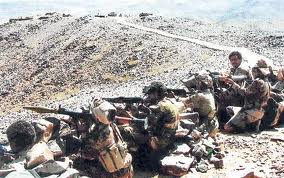
Yemeni troops fighting
the al-Houthi Rebellion
History
of Yemen: Wars and Politics
Overview
| North
and South Yemen
| al-Houthi
Rebellion
| al-Qaida
in Yemen
| Yemen
Links and Resources
Yemen
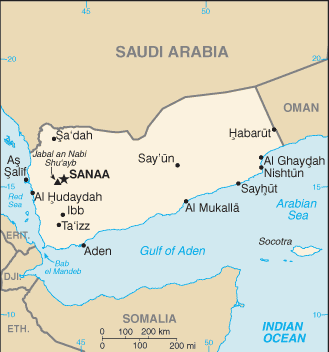
is a Muslim nation on the southeastern tip of
the Arabian Peninsula with a weak central
government and possessing many indicators of a
nation on the verge of falling apart. Yemen is
plagued with a rebellion in the north by a
Shiite Muslim sect, a separatist insurgency in
the south, and a growing al-Qaida
presence that draws the attention of the United
States and is quickly turning Yemen into a
leading front in the War on Jihadist Terror. The
Yemeni government is fighting multiple wars
within its own borders, and recently enlisted
the aid of powerful neighbor Saudi Arabia in
helping to fight one of those wars.
Yemen is one of
the poorest nations in the world, with high
unemployment, a low literacy rate, a corrupt
government, a well-armed population with a
history of stronger allegiance to tribe, clan,
and family than to the nation, and a long
history of civil conflict. Many analysts
consider Yemen a leading candidate to become a
"failed state," as Afghanistan
once was and Somalia is now. Both Afghanistan
and Somalia have become havens for al-Qaida and
other Jihadist Muslim organizations intent on
destabilizing secular Arab nations and launching
attacks on Western interests. The presence of
al-Qaida is not Yemen's only military problem,
though it may be the most pressing as 2010
begins. The attempted
bombing of an American airliner on Christmas
Day, 2009
has been linked to al-Qaida forces in Yemen
(part of the larger al-Qaida in the Arabian
Peninsula organization, also known as AQAP). The
suspected
airline bomber
spent time in Yemen and evidence points toward
the likelihood that he received training in
Yemen from al-Qaida. Also, a Yemeni radical
Yemeni cleric was connected to the U.S. Army
officer who killed several soldiers at Fort Hood
earlier this year. As of this writing, many
experts believe that an increased American
involvement in Yemen is highly likely in 2010 as
U.S. forces are likely to seek out and destroy
al-Qaida elements linked to the attempted
airliner bombing.
On
May 22, 1990 the Republic of Yemen was
established with the merger of the Yemen Arab
Republic [Yemen (Sana'a) or North Yemen]
and the Marxist People's Democratic Republic of
Yemen [Yemen (Aden) or South Yemen]).
With Yemeni history and politics, nothing is
easy to comprehend or necessarily logical; the
old North Yemen became independent in at the end
of World War One in November of 1918 from the
Ottoman Empire, and became a republic with the
overthrow of the theocratic Imamate (religious
monarchy) in 1962. South Yemen became
independent on November 30, 1967 from Great
Britain. The new South Yemeni nation became the
only Marxist (i.e. Communist) nation in the Arab
or Muslim world, and naturally became an ally of
the old Communist Soviet Union. This put South
Yemen at odds with more the more
tradition-minded North Yemen, but also made
enemies of the pro-Western and conservative
neighboring nations of Saudi Arabia and Oman. As
with many other places in the world with a
conservative/Marxist split, the two Yemens
became one focus in the Cold War rivalry between
the United States and the Soviet Union. When
North
and South Yemen went to
war
against each other in 1972 and 1979, both
conflicts turned into Cold War flashpoints. In
the late 1980s, the two Yemens discussed the
possibility of peaceful unification, and in May
of 1990, the two nations merged into one
Republic of Yemen. Four years later, tensions
between the conservative North, which dominated
the new nation, and the more progressive South
erupted in a short but bloody civil war in 1994.
South Yemen declared independence, but lost the
war. In recent years, factions in South Yemen
have agitated against the central government. In
the far northeast of North Yemen, the Shia
(members of the Shia sect are known as Shiites)
minority began a rebellion in 2004, which drew
in Saudi Arabia against the rebels in November
of 2009.
Most
Yemenis are of the Sunni branch of Islam. A
large religious minority belonging to the Shi'a
(Shiite branch of Islam lives in the north, and
is the main components of the so-called
al-Houthi rebellion in Sa'dah. The rebellion was
begun in 2004 by Hussein
Badreddin al-Houthi,
head of the Shi'a Zaidiyyah sect, and the rebels
take their name from their now-dead leader. The
government embarked on a large military
offensive called "Operation Scorched Earth" in
the August of 2009. This intensified fighting
caused by this offensive spilled over the Saudi
border, and in November, 2009, Saudi forces
engaged in combat against the al-Houthi rebels,
using airstrikes, artillery, and ground forces
to fight the rebels. It must also be noted that
Iran, the leading Shiite Muslim nation, is
believed to be an active supporter of the Shiite
al-Houthi rebels. Saudi Arabia, which is ruled
by a Sunni ruling family, has long supported the
Yemeni government against the Shiite rebels in
Sa'dah. Iran and Saudi Arabia are long-time
rivals, and many analysts see their ongoing
support of the two sides in the Yemeni war as a
proxy battle between the two great Muslim
powers. Also, the fact that the U.S. is a major
supporter of the Yemen government also explains
the Iranian connection, as the U.S. and Iran
have been enemies since the Iranian Revolution
in the late 1970s and the U.S.-Iran
Hostage Crisis
in 1979 and 1980.
On February 11,
2009, the Yemen government and the al-Houthi
rebels agreed to a cease-fire in the Sa'dah
conflict.
Yemen
has long been connected to the family of Osama
bin Laden and his al-Qaida terrorist
organization. The bin Laden family originated in
Yemen prior to settling in Saudi Arabia and
becoming wealthy in the construction business.
Like Afghanistan and Somalia, other favorite
bases for al-Qaida, Yemen status as a nation
with a fairly weak central government and the
frequent conflicts inside Yemen's borders makes
the poor Arabian nation a good location for
al-Qaida to hide, recruit, and plan further
attacks on the West and on others. In October of
2000, al-Qaida operatives rammed a small boat
into the side of an American warship,
the
USS Cole,
blasting a hole in the side of the ship and
killing 17 American sailors. A year later, in
October, 2002, al-Qaida attacked a French oil
tanker, killing one, and causing the spillage of
100,000 gallons of oil. In September, 2008,
al-Qaida attacked the U.S. Embassy in Sana'a in
a car bomb attack followed by a gun battle with
Embassy guards. The Yemeni government has worked
with the United States since the September 11,
2001 attacks on the U.S. in combating the
al-Qaida presence in Yemen. In 2002, an American
Predator drone controlled by the Central
Intelligence Agency destroyed a vehicle in Yemen
containing several al-Qaida operatives.
Airstrikes against al-Qaida targets in Yemen in
2009, prior to the Christmas
Day airliner attack,
are believed to have been conducted with
significant American aid, though officially the
attacks were conducted by the Yemeni
government.
In early
January, 2010, General David Petraeus, the
commander of U.S. forces in the Middle East, met
with Yemeni President Saleh, and soon after, the
Yemen government announced the deployment of
more troops into the areas east of the capital
near the Saudi border. That border area is known
to possess a strong al-Qaida presence. These
border provinces, such as the Hadramut area,
contain many corrupt government officials, and
many of the tribal leaders are aligned with
al-Qaida. Also, Britain and the U.S. announced
the closure of their embassies in Yemen due to
the overall al-Qaida threat.
The movement for
an independent South Yemen has gained strength
since 2007, when protests broke out over the
forced early retirement of several army officers
from the south. Fears of a renewed civil war are
constant, and many Yemenis still remember the
bloody 1994 civil war. Violence continued in the
south with armed rebels killing a police officer
in late February, 2010, and security forces
arresting 21 separatist leaders, which sparked
large protests. Notably, some of these protests
featured the flag of the old South
Yemen.
In an interview
with the New
York Times
in Febuary, 2010, separatists claim that more
than 100 people have been killed in clashes with
the police and security forces since the
southern movement began in 2007, with arrested
secessionists numbering around 1,500 remaining
in prison as of early 2010.
Links
and Resources:
In
Yemen’s South, Protests Could Cause More
Instability--New
York Times, Feb. 27, 2010
Waq
al-Waq--Website/blog
covering the insurgencies in Yemen
Profile:
Tariq Nasr al-Fadhli--History
Commons
Fresh
separatist ambush kills policeman in
south--Yemen
News Agency, Feb. 26, 2010
Al
Qaeda Threat Escalates : As Yemen Turns Up Heat
on Terror Group, U.S. and U.K. Shut Embassies on
Attack Fears--Wall
Street Journal, Jan. 3, 2010
What
other Al Qaeda-linked attacks have involved
Yemen?--Christian
Science Monitor, December, 2009
Civil
war fears as Yemen celebrates
unity
--BBC, May, 2009
Shi'ite
Insurgency in Yemen: Iranian Intervention or
Mountain Revolt?--Jamestown
Foundation, May, 2005
CIA
Factbook on Country or
conflict
--Click
on the country name (Yemen) at this
site.
Southern
Yemen totters dangerously on the edge of
secession--Lebanon
Daily Star, June 11, 2009
Security
Incidents in Yemen,
1998--From
the Al-bab website.
Tiny
Voices Defy Child Marriage in
Yemen--June
29, 2008
Massive
protest in south Yemen--by
Jane Novak, for the Long War Journal, May 27,
2008
Yemen's
Intifada--by
Jane Novak, for the Long War Journal, January 2,
2008