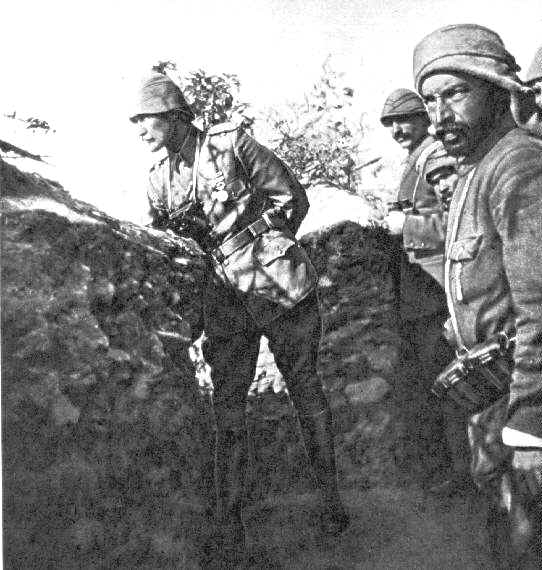
Turkish troops at the Battle of Gallipoli in World War One
The Fall of the Ottoman Empire
The Fall of the Ottoman Empire
Turkish troops at the Battle of Gallipoli in World War One
The Fall of the Ottoman Empire
In 1900, at the dawn of a new century in the 700th year of its existence, the Ottoman Empire began to die a violent, climactic death. The forces that destroyed this old and once powerful state catapaluted the Middle East, Europe, and indeed the world, toward increased instability and chaos. Out of the ruins of the Ottoman Empire arose the forces that contributed, directly or indirectly, to some of the most long-lasting and horrific conflicts to afflict the world since 1914. Both World Wars, the Holocaust, the rise and reign of Soviet Communism in Russia, the Arab-Israeli wars, the various Iraq wars and the terrorism that shook the world on September 11, 2001 are all related. All these events and the world-wide violence that ensued, originated, to some degree, with the death throes of the Ottoman Empire.
By 1900, the Ottoman Sultan could claim rule over a domain that stretched from the deserts of Libya in Africa to the snow-covered mountains of Armenia and Kurdistan. This ruler controlled the oil fields and marshes of southern Iraq and the mountain valleys of Bosnia on the Austrian border. The Sultan's flag flew along the shores of the Adriatic Sea near Italy in Europe and down to the southern tip of the Arabian Peninsula in West Asia. Between these geographic extremes, lay a vast and diverse empire containing multiple ethnic and religious groups, many of whom disliked each other more than they disliked Turkish rule. These groups, over the hundred years prior to 1900, had begun to identify themselves as distinct national groups rather than as subjects of the Ottoman Empire.
The disintegration of the Turkish Ottoman Empire accelerated in the Twentieth Century. By 1923, the Ottoman Empire was destroyed, replaced by a significantly smaller country simply known as "Turkey;" a nation stripped of most of its non-Turkish lands and peoples. Also, several smaller nations were born out of the dead body of the Ottoman lands in the Middle East, including the states of Iraq, Jordan, Syria, Lebanon and yet-to-be-born state of Palestine. In addition, Arabia began its transformation into a country ruled by the al-Saud family, who seized the current Ottoman territory in Arabia, including the holy cities of Mecca and Medina. Out of the remaining carcass of Ottoman-ruled Europe, Albania became an independent nation for the first time in over 400 years.
The destruction of this very old empire began much earlier, but the events of the Twentieth Century bear special significance for the end of the realm begun by the Turkish tribal leader Osmanli in the year 1300. This is a tale of revenge, deceit, conspiracy, war in the name of empire-building, war in the name of nation-building, war in the name of God and religion, and war in the name of vengeance.
The Last Wars of the Ottoman Empire
From 1897 to the signing of the Lausanne Treaty in 1923, the never-ending internal and external conflicts eventually tore apart the Ottoman Empire and sent it to the graveyard of dead nations. As described in the individual sections for each conflict, the Ottomans were engaged in many conflicts, including: Uprisings in Albania (1897, 1908, 1910, 1911 and 1912), a chaotic and multi-sided uprising in Macedonia (1903-1912), a long rebellion by the people of the Yemen for self-rule (1904-1911), a political revolution by part of the Ottoman Army, led by a group called the "Young Turks."
In addition to the internal rebellions, foreign enemies picked apart the Ottoman Empire through land seizures, attacks and invasions. A list of these foreign wars and foes includes: the annexation of Ottoman Bosnia by Austria (1909), Bulgaria declaring full independence from the Ottomans (1909), war with Italy (1911-1912), wars with Greece (1897, 1912-1913, 1920-1922), Montenegro (1912-1913), Serbia (1912-1913), Bulgaria (1912-1913, and a second Balkan War in 1913), the Arab tribes ruled by the al-Saud family (1913), the World War One Allies (Britain, France, Italy, Australia, New Zealand, Russia) from 1914 to 1918.
The climax to this long list of wars and conflicts was the Turkish War of Independence. This struggle by the Turks to create a non-Ottoman Turkish nation was opposed by Greece, Britain, France, and Italy. In addition to all the military actions mentioned above, several coups and uprisings among the Turks themselves took place, as well as the infamous "Armenian Massacres." See also: Wars of Modern Turkey.
*The modern nation of Greece was born after its long War of Independence from the Ottoman Turks (1821-1832). In the eyes of most historians, the Greece of today is different from the Greek Byzantine Empire of the Middle Ages (also known as the Medieval Period). That Greek empire fought many wars against the young Ottoman Empire. The Turks finally completed their conquest of the medieval Greeks in 1453, when they captured the Greek capital of Constantinople. The Turks turned the city into their capital, later renaming it Istanbul. The Turks then ruled the Greeks for nearly 400 years.
Tweet
See also: Greco-Turkish Wars
Pages on Middle Eastern History
History of Yemen: Wars and Politics
The Bombing of the U.S. Marines Barracks in Beirut (October 23, 1983)
"The History Guy" is a Registered Trademark.